
Last updated: September 2026
A quick note before we start. This is a guide, not accounting or tax advice. I am a business owner sharing how I have learned to read my own numbers, not a chartered accountant. The principles here are universal, but your specifics are yours, so when real money and real filing are on the line, sit down with an accountant. This is here to make sure you know what to ask.
– Saqib
Most people who run a services business in Pakistan never learned Business Finance Basics, what some people call small business accounting, and for a long time it does not matter.
You are one person, or a few. Money comes in, you pay for a couple of tools, you keep the rest.
It feels like enough of a system.
Then one day it does not. You want to hire, or raise your rates, or figure out why a great month left nothing behind, and you realize you have been flying on a feeling instead of a number.
I have run all sorts of businesses over the years, and in the product ones the math is blunt and obvious. You buy a thing for 100, you sell it for 150, you can see the Profit. A services business was different. The math got slippery, and I found out how many basic money ideas I had been getting away with ignoring.
This is the guide I wish someone had handed me then. Not a bookkeeping course. The handful of concepts that decide whether you actually have a business, or just an expensive job you built for yourself.
TL;DR: Revenue is not Profit, and the Profit you think you make is usually fake, because you never counted your own time as a cost.
In a services business your biggest Cost of Delivery is people (including you), so track hours even though you should never sell by the hour.
Pay yourself a real salary first; what is left after that and after Delivery is your true Net Profit, the “good” kind that tells you whether you can scale or hire.
Watch Cash Flow and Runway, not just Profit. Keep two simple statements, a monthly P&L and a balance sheet, run all business money through a business account, and do not hire full time unless you can cover a year of that salary.
What’s covered, in order:
- Start With the Words
- Sell on Value, Account in Hours
- Gross Profit vs Net Profit, and Why the Gap Matters
- What “Cost of Delivery” Means in a Services Business
- The Cost You Keep Forgetting: Your Own Time
- Pay Yourself Like an Employee
- When You Can Actually Afford to Hire
- The Two Statements Worth Keeping
- Cash Is Not Profit
- Keeping the Books Clean: Personal In, Business Out
- The One Number That Matters
- What It Comes Down To
- A Quick Glossary
- Business Finance Basics FAQs
Start With the Words
Before any of the deeper stuff, learn the vocabulary. Half of why Business Finance Basics feel intimidating is that nobody defined the words, so people nod along in calls pretending to know what a Margin is.
The whole core set is in one table below, then the rest of the guide uses these terms on purpose. Read this with a real business in mind. The example is a 2 crore (PKR 20,000,000) per year services business.
| Revenue – Amount | Gross Profit – Amount | Net Profit – Amount | Gross Margin – %age | Net Margin – %age | |
|---|---|---|---|---|---|
| Also called | Top Line, Sales, Turnover | Gross, GP | Bottom Line, Net, Earnings | GM | Profit Margin |
| What it is | All money in, before any cost | Left after Cost of Delivery | Left after all operating costs | Gross Profit as a share of Revenue | Net Profit as a share of Revenue |
| How you get it | The total you brought in, nothing taken out yet | Revenue, minus what it cost to deliver | Gross Profit, minus Overhead | Gross Profit as a percent of Revenue | Net Profit as a percent of Revenue |
| Formula | (it’s the total) | Revenue − Delivery | Gross Profit − Overhead | Gross Profit ÷ Revenue | Net Profit ÷ Revenue |
| Example | PKR 20,000,000 | 20,000,000 − 14,000,000 = PKR 6,000,000 | 6,000,000 − 2,000,000 = PKR 4,000,000 | 6,000,000 ÷ 20,000,000 = 30% | 4,000,000 ÷ 20,000,000 = 20% |
Two quick anchors so you never mix them up.
Your Top Line is Revenue, the very top row, before a single cost comes out.
Your Bottom Line is Net Profit, the very last row, after everything.
Most of running the money is just managing the distance between those two lines. Tax comes out of Net Profit, and because freelancers here usually handle tax separately, treat Net Profit as your pre-tax number. One exception worth knowing: foreign export income is taxed here as a fixed percentage of your gross export proceeds, whatever your profit, which Taxation 101 walks through.
There is one more term you will hear thrown around, usually by investors and buyers: EBITDA.
It sounds scary and it is not. It is just your Net Profit with four specific things added back, one for each letter.
Take the same 2 crore business and watch what it adds back.
| Step | What you add back | Why it’s stripped out | Example (PKR) |
|---|---|---|---|
| Earnings (start) | your pre-tax Net Profit | the Bottom Line you already have | 4,000,000 |
| + Interest | any loan interest | so how you financed it doesn’t distort the picture | + 0 (no loans) |
| + Taxes | tax | so different tax situations compare fairly | + 0 (handled separately) |
| + Depreciation | gear write-down (laptop, equipment) | a paper cost, no cash actually left | + 200,000 |
| + Amortization | intangibles write-down (a software build, a website) | same, a paper cost | + 100,000 |
| = EBITDA | operating earnings, stripped clean | 4,300,000 |
Table B starts from the 4,000,000 Net Profit you already have from Table A, your Bottom Line, and adds back the four things EBITDA chooses to ignore. For a services business, Interest and Taxes here are basically zero, so the only real add-backs are a little Depreciation and Amortization, which nudges EBITDA up to 4,300,000, barely above your Bottom Line.
That closeness is the point.
People love EBITDA because it strips out how a business is financed (Interest), where it is taxed (Taxes), and paper costs that never actually leave the account (Depreciation and Amortization), so you can compare the core engine of two very different businesses fairly.
It is also the number buyers anchor on, since acquisitions get priced as a multiple of EBITDA. For a small services business it barely differs from your pre-tax Net Profit, so recognize it, do not obsess over it until someone is trying to buy you.
That is the vocabulary. Now the rest of this guide puts it to work.
Every kit, tool, and guide we build for the community now lives on Patreon. Follow to unlock them all, get new drops the moment they land, and help keep the work going.
Sell on Value, Account in Hours
Every good sales guide tells you the same thing. Do not price by the hour. Charge for the outcome, sell retainers, tie your fee to the value you create, not the time you spend. That advice is correct, and I stand by it. On the sales side, the moment you start justifying your hours, you have lost.
But there is a trap hiding in that advice, and it is where a lot of otherwise smart operators go wrong. They hear “do not sell by the hour” and quietly conclude “do not track hours at all”. Those are two completely different things.
You do not track hours to price by them. You track them because they are the only way to know what a project actually cost you to deliver, what your real Gross Margin is, which clients are quietly draining you, and whether you are about to burn out. Selling is about value. Accounting is about hours. You need both, pointed at different problems.
This is the whole reason small business accounting feels harder for a services business than for a shop. A shop can see its cost in the inventory. Yours is buried in time, and if you do not measure the time, you are guessing at every number that matters.
Gross Profit vs Net Profit, and Why the Gap Matters
You have the definitions from the table above. The split earns its keep because the gap between Gross Profit and Net Profit tells you exactly where your money is going.
If your Gross Profit is healthy but your Net Profit is thin, your Delivery is fine and your Overhead is eating you, so you fix the Overhead.
If your Gross Profit itself is thin, the problem is in how you deliver, and no amount of trimming software subscriptions will save you.
One number tells you it is a Delivery problem, the other tells you it is an Overhead problem.
Lump them together and you cannot see either.
One term reminder so nothing trips you up later. Profit is a rupee amount. Margin is that same amount as a percentage of Revenue.
Gross Profit becomes Gross Margin, Net Profit becomes Net Margin. People say “Margin” when they mean “Profit” and confuse themselves, so keep them straight.
What “Cost of Delivery” Means in a Services Business
Cost of Delivery is obvious for a product company. It is the inventory, the raw materials, the thing you bought or built to sell.
Accountants call it Cost of Goods Sold, COGS.
For a services business there is no inventory, so the question becomes: what does it actually cost me to deliver this work? The answer is almost always people.
The salaries or fees of whoever does the delivery, you included, allocated across the projects they work on. That is your Cost of Delivery, except the goods are hours.
At the simplest level, aggregate it. Add up your Revenue for the month, subtract the total cost of the people who delivered it, and you have your Gross Profit for the month. You do not need per project precision to start.
When you do want per project cost, it comes back to hours, which is why tracking them matters. The way I keep it sane: one person works a maximum of two projects at a time. Two projects means each one is roughly half of their month, so the cost allocation basically solves itself. You are not doing forensic accounting, you are splitting a known salary across a known number of projects.
That rule has a useful side effect. If a project is too small to justify even half a person, it is probably too small to take, unless you are taking it deliberately as a foot in the door or a relationship play. Most of the time, a project that does not fit the model is a project quietly costing you more attention than it returns.
The Cost You Keep Forgetting: Your Own Time
Now the one that changes everything, and the one nobody counts when they start.
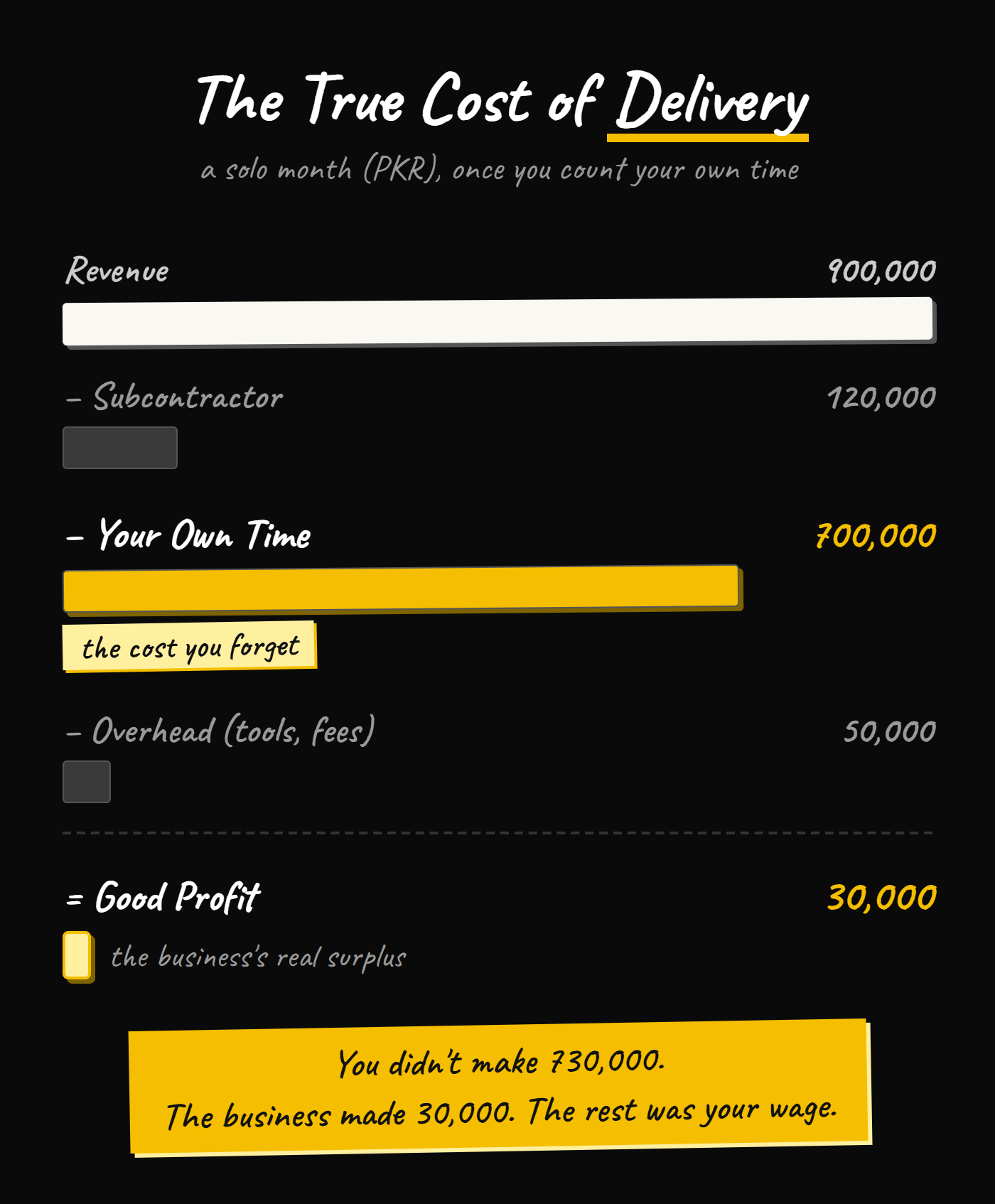
Say you make $2,500 a month. You subtract your tools, your bank fees, a subscription or two, and you call the rest Profit. It feels great. You made almost $2,500 in Profit this month.
Except you did not. You forgot the single most expensive input in the whole business: you. Your own time is a cost.
If you disappeared tomorrow and had to pay someone to do everything you do, that salary is a real number, and it comes out of the business before you get to call anything Profit.
Cost your own time in, and the picture changes completely. That “Profit” was mostly your wage wearing a nicer name.
Whatever is left after you have paid yourself a proper salary is the real Net Profit, the Profit the business itself generates, separate from the job you are doing inside it.
I did not figure this out from a book.
I figured it out when I had to hire.
You cannot decide what to pay someone else until you have answered what you are worth, so I had to put a number on my own time first: if I were an employee of my own business, what would I earn? Everyone else then gets benchmarked against that, some percentage of my number based on their capability.
And the day I found someone as capable as me, I knew I should pay them what I pay myself. That is exactly how I found my first business partner.
The reframe is simple and it stings a little. Profit that only exists because you underpaid yourself is not Profit. It is a loan you are taking from your own labor, and one day the bill for it arrives.
Pay Yourself Like an Employee
The fix for all of this is a habit, not a spreadsheet.
Most solo operators pull money out whenever it lands. You can run it that way if you are genuinely disciplined, but most people are not, and the money quietly blurs into personal spending until you have no idea what the business actually kept.
So pay yourself like an employee of your own business. Decide on a salary, set aside what comes in, and withdraw it on a fixed cadence, the same day every month, the way a real payroll works. You are the owner, but you treat your own pay as just another cost the business has to cover. It builds the discipline, and it forces the question every month: after I have paid myself, did the business actually keep anything?
When You Can Actually Afford to Hire
Once your own time is a real number on the page, hiring stops being a vibe and becomes math.
The exact math depends on what kind of business you are running. I run a high value consultancy that sells retainers, so my numbers look nothing like someone selling small projects at volume. There is an old strategy idea underneath this, usually traced to Michael Porter’s “stuck in the middle”: pick a lane, high value or high volume, because the businesses that try to sit in the middle are the ones that die. My own version is to sell high value work at real prices until you have enough behind you to serve the masses cheaply. Whichever lane you pick changes what you need to see before you add a head.
But there is one rule I hold regardless of the model, and it is as much ethics as accounting. If I hire someone full time, I have committed to paying them for at least a year, so I do not hire unless I already have a year of that salary set aside.
We have a bad habit in this country of hiring people the moment a project lands and cutting them the moment it wobbles, which is how you get an industry full of churn and burned people. If the role is genuinely a contract, call it a contract. If it is full time, guarantee the year.
I wrote more about that reputation problem in Are You an Unethical Freelancer, and on paying people properly in What Should Be My Starting Salary.
I learned the softer version of this the hard way. Early on we landed our first decent project and I hired too many people too fast, scaling fixed salaries against a single win instead of sustained Revenue.
They drifted off, and it taught me to add people carefully, stretch with AI to make sure the need is real and lasting first, and only then commit against a full year of reserved Revenue. Hire on demand, not on excitement.
The Two Statements Worth Keeping
You do not need accounting software or a bookkeeper to start.
You need two simple statements, updated monthly and tallied at year end, kept for every year so you can see the trend.
The first is the profit and loss statement, the P&L. It is just the story of a period: what came in, what it cost, what was left. A simplified monthly version for a solo services business, in rupees.
Notice the line most people leave out, and note the Net Profit here is before tax.
| Line | PKR |
|---|---|
| Revenue (client and consulting income) | 900,000 |
| Cost of Delivery, subcontractor (part time) | (120,000) |
| Cost of Delivery, your own time (owner salary) | (700,000) |
| Gross Profit | 80,000 |
| Software and tools | (20,000) |
| Bank, transfer and conversion fees | (15,000) |
| Other admin (internet, misc) | (15,000) |
| Net Profit (before tax, the “good” Profit) | 30,000 |
Look at what that table does. Without your own salary on it, this business looks like it made 730,000 in Profit.
With it, the business itself made 30,000. That 700,000 gap is not Profit, it is your wage. And the real number, the 30,000, is tiny, which is the honest signal that right now this is a well paid job, not yet a business that can grow on its own.
The second is the balance sheet. Most small owners never make one, and it is the one that answers a different question. The P&L asks “how did this month go”. The balance sheet asks “what is this business actually worth right now”. What it owns, what it owes, and what is left over.
| Balance sheet | PKR |
|---|---|
| Cash, business account | 250,000 |
| Cash, savings and reserve | 400,000 |
| Equipment (laptop, gear) | 150,000 |
| Total assets | 800,000 |
| Taxes payable | (50,000) |
| Total liabilities | (50,000) |
| Net assets | 750,000 |
| Owner’s capital and Retained Profit | 750,000 |
The line to care about is Retained Profit, the “good” Profit you kept in the business instead of pulling out, stacked up over time.
That number is your scale fuel. It is the money that lets you hire, invest, survive a slow quarter, or build the next thing. When people ask what number actually matters, this is close to it: the balance sheet is where “do I have a business that can grow” finally shows up as a figure you can point at.
Cash Is Not Profit
There is one truth the P&L will not show you on its own, and it ambushes profitable businesses all the time. Profit and cash are not the same thing.
You can have a great month on paper and still not make payroll, because Profit is what you earned and cash is what actually landed. The gap between them is timing, and timing is where services businesses get hurt.
Cash Flow is just the money moving in and out over a period, regardless of what you have “earned” on paper. A month where three invoices go out and none get paid is wonderful for Profit and brutal for Cash Flow.
Accounts Receivable is the money clients owe you but have not paid yet. The day you invoice, the P&L counts it as Revenue. Your bank account counts it as nothing until it clears.
Big Accounts Receivable, empty account is the classic services squeeze, which is why chasing a late invoice is one of the most important things you do all month. The feast and famine cycle most freelancers know is really a Cash Flow problem in disguise.
Then there is Runway: how long you could survive if the money stopped tomorrow. Take your cash reserves, divide by your monthly costs with your own salary included, and that is your Runway in months.
2 months of Runway plus a fat Accounts Receivable is a business one late client away from a crisis. 6 months of Runway is a business that can afford to say no to bad work. Runway, not Profit, is the number that actually lets you sleep.
Keeping the Books Clean: Personal In, Business Out
There is a practical wrinkle in Pakistan that makes clean books harder, and it is worth getting right early.
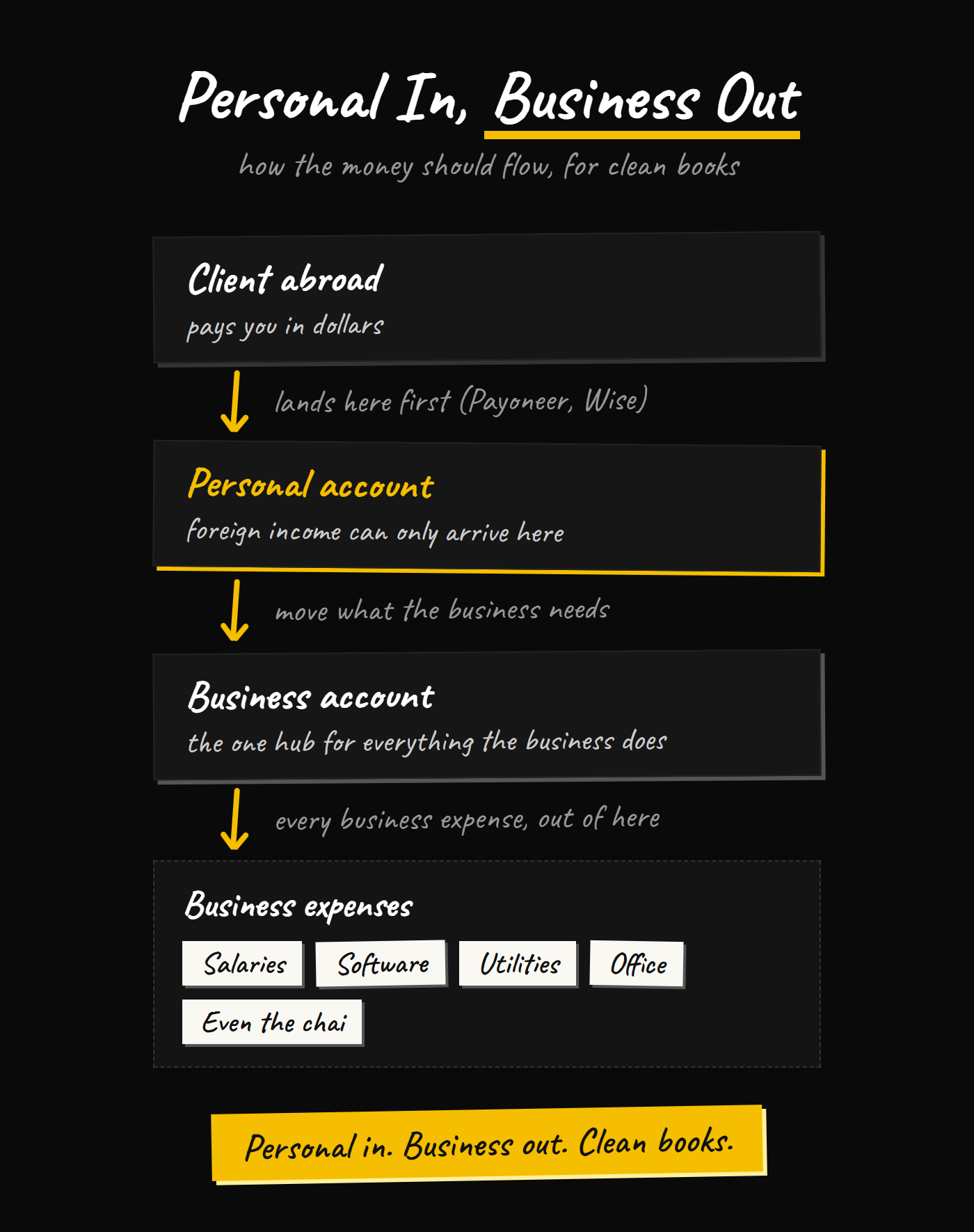
Your foreign income almost always lands in your personal account, because the services that bring dollars in, Payoneer and the like, generally will not pay into a business account (the reason, and what it does to your PRCs, is in my banking guide’s filing update). So the money comes in personal, and then you move what the business needs into the business account.
From there, the rule is simple: every business expense goes out of the business account. Salaries, software, utilities, the office, even the chai. If it is a business cost, it flows through the business account, so at the end of the month your books are a clean record instead of a guessing game tangled up with your personal spending.
Which accounts to actually open for this is its own decision, and I covered it in Banking 101 in Pakistan. The tax side of clean records, what to hand your accountant and why it matters, is in Taxation 101 for Pakistani Freelancers. And if you have never tracked where your money actually goes, the Personal Expense Tracker is the place to build the habit.
The One Number That Matters
You can track a dozen metrics. Utilization, the share of your working hours that are actually billable, since the rest disappears into sales, admin, and email.
Effective Hourly Rate, your real earnings divided by the hours you truly worked, which is almost always lower than your quoted rate and a lot more honest. Gross Margin, Net Margin, Cash Flow, and the rest. At a small scale, most of these are noise you can grow into later.
The one that matters is whether there is enough good Net Profit left over to scale, or whether you are just living off the top. Both are fine, but they are different games, and most people cannot tell which one they are playing because their Profit is fake.
Real Net Profit, the kind that answers this question, is what is left after you are properly paid and Delivery is covered. Not the number that only looks good because you shortchanged yourself.
If that surplus is real and growing, you have a business, and you can think about hiring, investing, building. If it is near zero after you pay yourself, you have a job, a possibly excellent, well paid job, but a job.
That is not a failure. Plenty of people should stay a profitable solo operator and never want the headache of a team. But you should know which one you are, on purpose, and the only way to know is to run the numbers with your own time costed in.
What It Comes Down To
Business Finance is not really about spreadsheets. It is about telling yourself the truth.
If you remember nothing else:
- Revenue is not Profit, and Gross Profit is not Net Profit. Know which number you are looking at.
- Your own time is a cost. Count it, or every Profit figure you have is a lie you are telling yourself.
- Sell on value, but account in hours. They solve different problems.
- Pay yourself a real salary on a fixed cadence, then see what the business actually kept.
- Cash is not Profit. Watch Cash Flow and Runway, not just the Bottom Line.
- Do not hire full time without a year of that salary in reserve.
- Keep a monthly P&L and a balance sheet. Retained Profit is your scale fuel.
- Run every business rupee through the business account.
Do all of that and the big question answers itself. You stop guessing whether you are running a business or an expensive job, and you get to choose, with your eyes open, which one you actually want.
A Quick Glossary
The whole vocabulary in one place, so the next time one of these lands in a call you are not nodding along blind.
| Term | What it means |
|---|---|
| Revenue | All the money in, before any cost. Also called Top Line, Sales, or Turnover. |
| Top Line | Revenue. The very top row of the P&L. |
| Bottom Line | Net Profit. The very last row, after every cost. |
| Gross Profit | Revenue minus Cost of Delivery. |
| Net Profit | What is left after all operating costs. Tax comes out of this. |
| Gross Margin / Net Margin | Gross Profit or Net Profit written as a percent of Revenue. |
| Profit Margin | Unqualified, this usually means Net Margin. |
| Cost of Delivery (COGS) | What it costs to deliver the work. In services, mostly people’s time, yours included. |
| Overhead | The running costs that are not Delivery: tools, rent, fees, admin. |
| Cash Flow | Money actually moving in and out over a period, separate from Profit earned. |
| Runway | How many months you can survive on reserves if income stopped. Cash divided by monthly costs. |
| Accounts Receivable | Money clients owe you that has not landed in the account yet. |
| Utilization | The share of your working hours that are actually billable. |
| Effective Hourly Rate | Real earnings divided by the hours you truly worked. Usually humbling. |
| Retained Profit | Profit kept in the business over time instead of pulled out. Your scale fuel. |
| EBITDA | Earnings Before Interest, Taxes, Depreciation, Amortization. Operating earnings stripped clean; matters mostly at valuation. |
| MRR | Monthly Recurring Revenue. Income that repeats every month, like a retainer. |
| ARR | Annual Recurring Revenue. MRR times 12. |
| In the Black / In the Red | Profitable / losing money. |
| The Nut | Your fixed monthly costs you have to cover before you make a rupee. |
| Burn | How fast you are spending cash. |
Business Finance Basics FAQs
What is the difference between Gross Profit and Net Profit?
Gross Profit is what is left after only the Cost of Delivery (mostly the people who did the work, you included). Net Profit is what is left after all your operating costs, Delivery plus Overhead, with tax then paid out of what remains. The gap between them tells you whether your problem is Delivery or Overhead.
What is the difference between Top Line and Bottom Line?
Your Top Line is Revenue, the money in before any costs. Your Bottom Line is Net Profit, what is left after every cost, including your own salary. Most of Business Finance is managing the distance between the two.
What is the difference between Cash Flow and Profit?
Profit is what you have earned once costs come out of Revenue. Cash Flow is the money actually moving through your account. You can be profitable and still short on cash if clients have not paid yet, which is why Runway and Accounts Receivable matter as much as Profit does.
How do I calculate COGS for a services business?
There is no inventory, so your Cost of Delivery is the cost of the people delivering the work, allocated by the hours they spend on each project. Aggregate it at first (total Revenue minus total delivery salaries for the month). Go per project only when you need to, using hours as the split.
Should I count my own time as a business cost?
Yes, and it is the single most important habit here. If you would have to pay someone a salary to replace yourself, that salary is a real cost. Subtract it before you call anything Profit. What is left after paying yourself is the true Net Profit the business generates, separate from your wage.
How do I pay myself from my own business?
Decide a salary and take it on a set date each month, like real payroll, instead of dipping into the account whenever money lands. The mechanics are not the point. A fixed number forces you to see whether the business actually cleared anything once you are paid. If it did not, that is information, not a reason to skip your own pay.
When can I afford to hire someone?
When you can cover a full year of their salary from reserves, not from a single project you just landed. Hire on sustained demand, not excitement. Full time means a full time commitment, so if the work is really short term, hire a contractor and call it that.
Do I need accounting software to start?
No. A monthly profit and loss statement and a balance sheet, kept in a simple sheet and tallied at year end, are enough for a long time. This is the whole of small business accounting when you are small. Software helps once you have a team and more moving parts, but the discipline matters more than the tool.
What is a balance sheet and why does it matter for a small business?
A balance sheet is a snapshot of what the business owns, owes, and is worth right now. It matters because the Retained Profit line, the good Profit you kept in the business over time, is your scale fuel, and it is where “do I have a business that can grow” shows up as an actual number.
Why does my business money have to go through a separate account?
Because clean books are impossible when business and personal spending are tangled together. In Pakistan foreign income usually lands in your personal account first, so move what the business needs into a business account and pay every business expense out of it. See Banking 101 in Pakistan for the account setup.
One last reminder. This is me sharing how I read my own numbers, not formal accounting or tax advice. The concepts are universal, but your situation has details a good accountant will catch that a guide cannot. Use this to know what questions to ask, then go ask them.
– Saqib
With or without my help – I wish you the best.
Come Build With Us
400+ members showing up, shipping work, and helping each other get better.
Or keep going: the Workshops and Templates & Tools →

See, at the heart of it – I love solving problems for people using tech, it doesn’t get simpler than that.
I am known for constant experimentation and relentless execution.
Right now – my focus is to help everyday folks of Pakistan understand tech, career, and business better with everything I do.