
Last updated: July 2026
One thing up front: this is about classic SEO, the fundamentals that get you found in ordinary search. It deliberately does not cover AI Overviews, chatbots, or optimizing to be quoted inside AI answers. That is a different discipline with its own moving parts, and it gets its own guide.
SEO gets sold as a dark art. It isn’t. Most of what actually moves the needle in small business SEO is a short list of fundamentals done steadily, and almost none of it needs an agency retainer to pull off.
I have spent years on the growth and marketing side of businesses, and the same 3 questions come up every single time someone launches something: how do I show up on Google, how long does it take, and what do I actually have to do first. This is the answer I wish someone had handed me at the start.
It does not matter whether you run a service business, an online store, or a local shop with one location. The foundation is the same. Get it right early and you are already ahead of most of your competition, who are either ignoring SEO completely or paying someone too much to do it badly.
TL;DR: SEO is not a dark art, it is a foundation you lay once and then maintain. It splits into 3 buckets: on-site (your own pages), off-site (who links to you), and technical (how fast and crawlable your site is). Figure out which bucket matches your kind of business, do the fundamentals consistently, and give it roughly 6 months to show. You do not need an agency to start, and you should be deeply suspicious of anyone promising to rank you fast.
What’s covered, in order:
- What SEO Actually Is
- What an SEO Crawler Does
- Building a Strong SEO Foundation
- Building a Keyword Research Strategy
- On-Page Optimization
- Content Creation for SEO
- Off-Page SEO
- Technical SEO
- Common SEO Mistakes Small Businesses Make
- Scaling Your SEO Strategy
- Small Business SEO FAQs
What SEO Actually Is
Search Engine Optimization is the work of making sure your business shows up when someone searches for what you sell. That is it. It is not paid ads and it is not a growth hack. SEO plays a longer game, earning visibility on search results the organic way, which is slower to start and much harder to take away once you have it.
In practice it breaks into 3 buckets, and almost every task you will ever do sits in one of them:
- On-site SEO, anything indexable and visible on your own pages. Your homepage, service pages, product pages, blog posts, FAQs.
- Off-site SEO, anything that points back to your site from somewhere else. Backlinks, social posts, guest articles, mentions.
- Technical SEO, the under-the-hood work that lets search engines crawl and rank you efficiently. Speed, structure, mobile, the plumbing.
Keep those 3 in your head and the rest of this stops feeling like alphabet soup.
What an SEO Crawler Does
You will hear “crawl” and “index” constantly. A crawler is an automated bot that scans your website, reads what is there, and files it away so a search engine can serve it to people. Every search engine runs its own, and each has its quirks, but they all reward the same thing: a clean, well-structured site that is easy to read. Build a strong foundation and you are in good shape with all of them at once.
So you design your pages, write the content, ship the site, hit publish. Then what?
Then, roughly, you wait about 6 months before your SEO really starts to kick in and move you up the rankings. That number is a rough estimate, not a promise, but it is the right mental model: SEO is a slow compounding thing, not a switch.
You do not sit idle for those 6 months, though. That is exactly what the rest of this is for.
Building a Strong SEO Foundation
I love working with small businesses, and the one constant is constraints. Limited time, budget, and hands. So you do not need to attack every corner of SEO on day one. You need to know which corner matters most for your kind of business, and start there.
This table is the shortcut. Find the row that fits you and prioritize it before you touch anything else:
| Business Type | Where to Focus First |
|---|---|
| Local presence (shop, clinic, restaurant) | Optimize your Google Business Profile. Get customers leaving reviews. Use location-based keywords across your pages. Keep contact info current everywhere. List on local map services. |
| E-commerce | Write product titles and descriptions that read well for humans and crawlers. Use keywords that define the product, especially when the brand name does not. Add alt tags and real detail on sizing, variants, and colors. Add a general product FAQ. If the category is crowded, build comparison pages. |
| Services | Highlight services on the homepage, but give each service its own dedicated page with clear CTAs and FAQs. Use those pages to answer a common question in your field, which pulls in long-tail searches. Keep the whole site cohesive and easy to get around, with getting in touch one click away. |
| Blog / content-led | Write, a lot. Content is still king. Plan your categories, tags, and a real publishing cycle. Use idea tools to find low-hanging content. Optimize titles and meta descriptions. Break posts into chunks that can win featured snippets. Lean hard on internal linking to keep readers moving. |
| B2B / enterprise | Lead with social proof and testimonials. Build dedicated landing pages per audience. Put your detail out in the open (FAQs, docs, support articles). Lean on stats, data, and case studies. Take branding seriously, and invest in tracking, because ROI is the whole conversation. |
Building a Keyword Research Strategy
The keyword is the one-word (or few-word) theme of a page. This piece is built around “small business SEO”, for example. But not all keywords are the same, and understanding the shape of search demand is what keeps you from chasing terms you can never rank for.
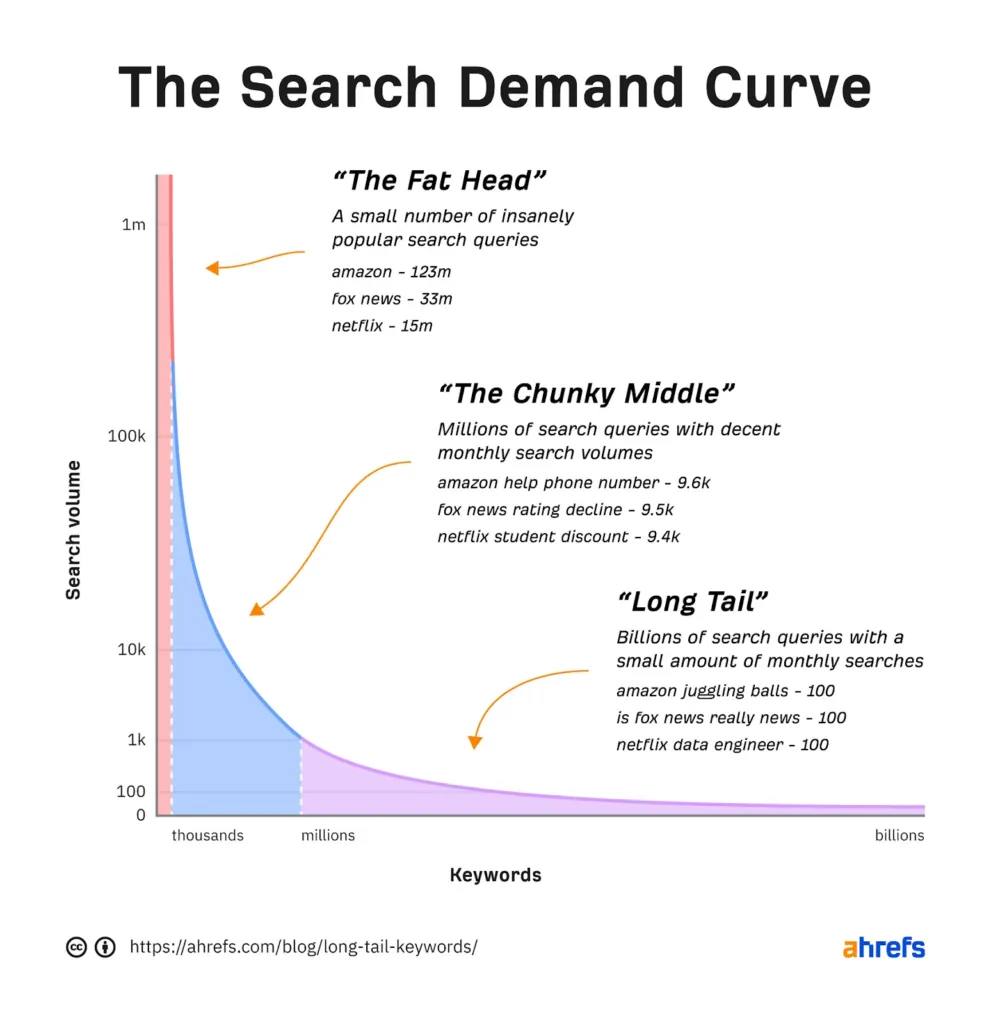
The fat head is a handful of enormous, generic terms you will not win early. The long tail is the specific, lower-volume stuff where a new site actually has a chance. As a small business, you live in the middle and the tail.
A simple way to start:
- Make a list of words and phrases relevant to what you sell.
- Run them through a tool like Google’s Keyword Planner to sanity-check that people actually search them.
- Since you are new, do not obsess over competition yet. For each keyword you want to rank for, drop it into a “whisper” tool that surfaces the real questions people ask around it, and let those questions shape your content.
Once you have your keywords, your content ideas, and a rough priority order, start building pages around them. And do not make the rookie move of stuffing the same keyword in over and over. Use it naturally. The phrase “small business SEO” has shown up a handful of times in this article and not once has it felt forced, which is the whole point.
On-Page Optimization
Got your keywords? Good. On-page is where you put them to work. Keep it simple:
- Keep your page title, meta description, SEO title, URL, and headings consistent with each other, both in the keywords they use and in plain readability. On WordPress, Yoast makes this hard to get wrong.
- Structure matters. Use a table of contents on longer pieces, one H1 for the main title, H2s for sections, H3s for anything nested under them.
- Use lightweight media formats like
.webpand.webmso pages stay fast. - Keep URLs simple and human-readable. If your blog has a cute name, still route it under something obvious like
/blogso neither people nor bots have to guess. - If you run media-heavy pages, invest in a content delivery network and better hosting so it all loads quickly.
- Always have clear CTAs, easy-to-find contact info, and, for a local business, your location front and center.
Content Creation for SEO
Content is where most of your organic growth is actually going to come from, so it is worth knowing the full menu before you cook. There are more content types than most people realize, each with a different job and a different kind of search it captures. You will not use all of them. You should know they exist.
| Type | Purpose | What It Wins |
|---|---|---|
| How-to Guides | Teach a specific task | “How-to” queries, solve real problems |
| Landing Pages | Convert for a campaign or offer | Leads, sales, campaign traffic |
| Product Pages | Show features and benefits | Transactional keywords |
| Best-Of Posts | Curate top tools or products | Comparison queries |
| Case Studies | Show real success | Credibility, social proof |
| Alternatives | Compare against a popular option | Comparison traffic, purchase intent |
| Templates | Give a ready-made format to adapt | Immediate value, sign-ups |
| Reviews | Evaluate products or services | “Review” searches, decisions |
| Lists | Organize items to skim | “List” queries, easy shares |
| FAQs | Answer common questions | Question-based searches |
| Steps | Lay out a process | “Step-by-step” keywords |
| Interviews | Share unique perspectives | Authority, original content |
| Checklists | Help verify nothing is missed | High-value reference |
| Definitions | Explain a term or concept | Definition searches |
| Pillar Pages | Anchor a topic and link to subtopics | Topical authority, internal linking |
| Infographics | Present data visually | Social shares, backlinks |
| Ultimate Guides | Go all-in on one topic | Go-to-resource status |
| Beginner’s Guides | Simplify for newcomers | Onboarding, first-time searchers |
If you are staring at that list wondering where to begin, the honest answer is: begin at all. The first 100 pieces you write will be rough, and that is the cost of entry. Figuring out what to actually write about is the part that compounds.
Off-Page SEO
Off-page is the hardest bucket, because most of it is a shot in the dark. You are trying to get the rest of the internet to vouch for you, and you do not control the rest of the internet.
For a brand-new business I usually say do not over-invest here yet. But since the goal is to understand the whole picture, off-page work looks like this:
- Backlinks are the big one. When trusted, high-authority sites link back to you, search engines read it as a vote of confidence. This is roughly 70% of the off-page game.
- Reach out to relevant sites and offer to write posts about your product or service.
- Write guest posts on other people’s sites with a link back to yours, with their blessing.
- Use social content as a way to point back to your site, though this channel is worth less than it used to be.
- Avoid spam links, and never pay a random “SEO expert” for cheap backlinks. This will wreck your site’s standing after a short, fake burst of traffic. It is the single fastest way to undo everything else.
- Invest in other content formats over time, like a podcast.
- Register on relevant review sites so real customers can vouch for you where buyers look.
A lot of off-page SEO is really just marketing yourself well beyond the platforms you started on, and it starts with an online presence worth linking to.
Technical SEO
The most overlooked bucket, and the one that sounds scariest. Good news: for most simple, CMS-based sites, technical SEO is genuinely easy to improve. The 80/20:
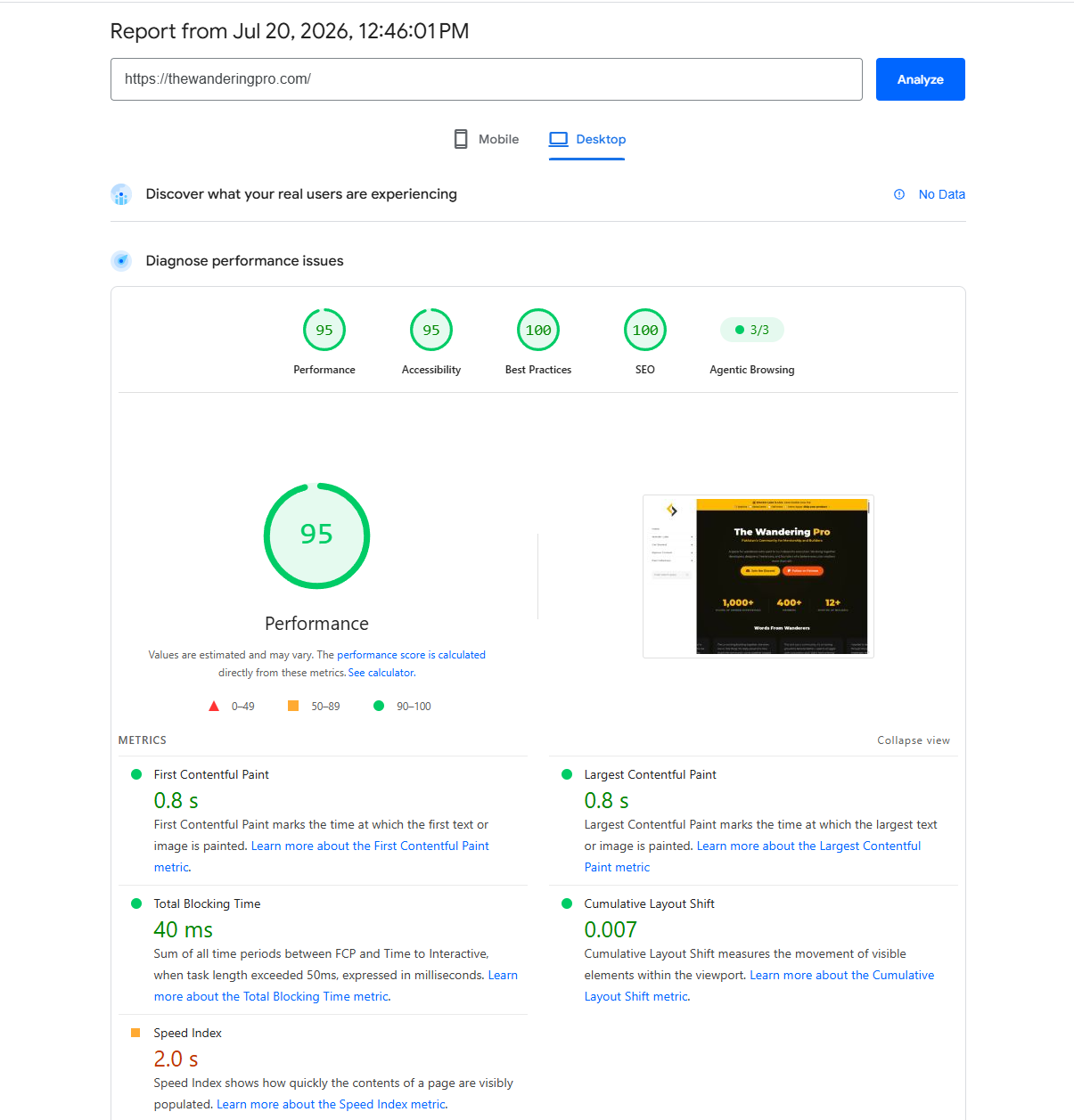
Run your site through PageSpeed Insights and do what it tells you.
For most businesses, that is most of the job. But a few things underneath are worth understanding:
Core Web Vitals are the heart of technical SEO. As of 2024, Google measures 3:
- Largest Contentful Paint (LCP), how fast your main content loads. Aim for under 2.5 seconds.
- Interaction to Next Paint (INP), how quickly your site responds when someone interacts with it. Aim for under 200 milliseconds. (This one replaced the old First Input Delay metric in March 2024, so if a guide still tells you to chase FID, it is out of date.)
- Cumulative Layout Shift (CLS), whether your layout jumps around as it loads. Aim for 0.1 or less.
A few more that matter:
- Improve mobile responsiveness. More than half of all traffic is mobile now. Do not ship an over-designed site that falls apart on a phone.
- Set up an XML sitemap. It is a quick task and it hands crawlers a map of your site.
- Use structured data (schema markup / JSON-LD) so search engines understand what your pages actually are. schema.org has premade schemas you can lift. Think of it as advanced categories for your content, and if that sounds intimidating, start with the basics and grow into it.
- Upgrade hosting once you are past ~10,000 visitors a month, not before.
- Move off drag-and-drop builders like Wix or Squarespace once performance starts to bite, toward a custom-coded site, a lightweight WordPress theme, or Webflow. That is its own rabbit hole for another day.
And so you know what a good report looks like, this is where this very site lands on PageSpeed Insights, no touch-ups:
Once you have the basics down, the whole thing fits on one cheat sheet. Save it, and check yourself against it every couple of months:
| SEO Bucket | Main Focus | The Standing Habit |
|---|---|---|
| Keyword Research | Finding relevant keywords | Keep monitoring keyword and question tools for new terms to target |
| On-Page Optimization | Structure | Audit your site’s structure and mobile responsiveness every couple of months |
| Off-Page Optimization | Backlinks | Earn links from trustworthy sites in competing or adjacent industries |
| Technical SEO | Performance | Run a Core Web Vitals report and fix what is critical |
| Content Marketing | Content creation | Publish at least a couple of pieces of content a month |
Common SEO Mistakes Small Businesses Make
Before we close, the traps. These are the ones small businesses fall into again and again:
- Expecting instant results. SEO is long-term. Rankings take months, not days. Budget your patience accordingly.
- Keyword stuffing. Cramming keywords does not fool anyone anymore, it actively penalizes you. Write naturally, for the reader.
- Ignoring mobile. If more than half your traffic is on phones and your site is slow or clumsy there, you are losing customers and rankings at once.
- Chasing vanity metrics. Total visitors and social likes feel good. Conversions, engagement, and keyword rankings are what actually tell you if SEO is working.
- Neglecting technical basics. Broken links, slow pages, a missing sitemap, no HTTPS. Small oversights, real ranking damage.
- Buying cheap backlinks. A short fake boost, then lasting harm to your authority. Not worth it.
- Letting content go stale. Fresh, updated content signals a living site. Abandoned posts signal the opposite.
Dodge these and you are already past most of the field.
Scaling Your SEO Strategy
The last thing worth talking about is scale, and specifically measurement, because it is genuinely one of the hardest parts of small business SEO. A lot of businesses run ads that inflate their content and then read the bump as organic growth. It is rarely that simple.
The only real way to know if SEO is working is to look at the data: how your site performs against competitors, what users actually do once they land, and where the gaps are in your content, landing pages, and FAQs. There is a deep bench of tools for this, roughly in 3 groups:
- User behavior, heatmap and session tools that show you what people click, scroll, and ignore.
- Traffic and metrics, analytics platforms (Google Analytics 4 is the default now) that track where visitors come from and what they do.
- SEO-specific, tools like ahrefs and Moz for keyword tracking, backlinks, and competitor visibility.
Pick one from each group, actually look at them, and let what you see decide where the next month of effort goes.
And that is the foundation. Grasp what is here and most rivals are already behind you. Nearly all of it you can do yourself with a little patience. Later, once revenue is coming in, a proper audit from someone good is a smart way to build a real strategy on top of what you have already laid down.
One warning to end on: the SEO industry has a lot of people who will promise to rank you if you pay them. It usually leads nowhere, and you end up spending what you would have spent on ads anyway. Small business SEO rewards long-term consistency over short bursts. Keep optimizing, keep publishing, and it will outlast every trend and fad.
Small Business SEO FAQs
How long does SEO take to work for a small business?
Plan for around 6 months before your efforts really start to show, and longer for competitive terms. SEO compounds slowly. Anyone promising fast rankings is either overcharging you or about to damage your site. The upside is that once you have earned rankings the organic way, they are sticky and hard for a competitor to take.
Do I need to hire an SEO agency?
Not to start. Almost everything in this guide you can do yourself with a little patience, and doing it yourself means you actually understand your own site. Once real revenue is coming in, a one-off audit from someone genuinely good is worth it to build a strategy on top of what you have built. What you should not do is hand a new business over to a cheap monthly retainer that promises rankings.
What is the difference between on-site, off-site, and technical SEO?
On-site is everything on your own pages (content, titles, structure). Off-site is what points back to you from elsewhere (mostly backlinks). Technical is the plumbing that lets search engines crawl and rank you (speed, mobile, sitemaps, structured data). You need all 3, but you start with the one that matches your business type.
Where should a brand-new business start with SEO?
With the bucket that fits you. A local shop starts with its Google Business Profile and reviews. An online store starts with product pages and keywords. A content-led site starts by publishing consistently. Match your effort to your model before you try to do everything at once.
Does keyword stuffing still work?
No, and it hasn’t for years. Overloading a page with the same keyword gets you penalized, not promoted. Search engines read for meaning now. Write for a human, use your keyword where it fits naturally, and move on.
How much should content matter in my SEO plan?
For most small businesses, a lot. Content is how you capture the long-tail searches you can actually rank for early. If you are content-led it is the whole game, and even if you are not, learning to write consistently is one of the highest-return habits you can build. Marketing that content well is a skill worth developing beyond the obvious channels.
Is technical SEO too hard to do myself?
For most simple sites, no. Run PageSpeed Insights, fix what it flags, make sure the site works well on mobile, and set up a sitemap. That covers the majority of it. The deeper stuff (structured data, hosting upgrades, moving off a drag-and-drop builder) can wait until you have grown into needing it.
How do I measure whether my SEO is actually working?
Look at the data, not the vanity numbers. Conversions, engagement, and organic keyword rankings tell you the truth. Total visitor counts and social likes usually don’t. Pick an analytics tool, a behavior tool, and an SEO tool, and let what they show you decide where next month’s effort goes.
With or without my help – I wish you the best.
Come Build With Us
400+ members showing up, shipping work, and helping each other get better.
Or keep going: the Workshops and Templates & Tools →

See, at the heart of it – I love solving problems for people using tech, it doesn’t get simpler than that.
I am known for constant experimentation and relentless execution.
Right now – my focus is to help everyday folks of Pakistan understand tech, career, and business better with everything I do.

Great breakdown of SEO fundamentals for small businesses. I especially appreciated the reminder that even without a content strategy, having a strong technical foundation can set you apart from competitors. Thanks for sharing this practical resource.
Really glad you liked it!
Strategy comes later, foundation is what it is all about. Lemme know if you have any other quesitons!