
A Boss Bot Platform for
Cybersecurity Communities
Umro Ayyar is a boss bot: one small, stable core that runs a crew of independent feature bots for a cybersecurity community on Discord. Its proven flagship module is a Discord community bot that automates the manual admin behind HackTheBox Islamabad meetups, from onboarding and role assignment to Meetup.com sync and access to the HackTheBox Enterprise Labs. Built in-house for one community, not sold as a product.

The Manual Cost of Scaling a Meetup
HackTheBox Islamabad was growing. The chapter moved from monthly meetups to fortnightly ones and added cert-prep study groups on top. More events meant more people, and every new attendee meant another manual onboarding done by hand.
Every lab session created its own queue of work. Attendees needed access to the HackTheBox Enterprise Labs, where the session’s machines, Academy modules, and challenges live, and each request was handled one at a time: read the request, find the person, grant access, confirm it landed. Multiply that by a full room and it becomes an evening’s job for a volunteer.
Every meetup added a second layer. RSVPs lived on Meetup.com, the community lived on Discord, and nothing connected the two. Someone had to pull the attendee list, find each person’s Discord account, assign the correct roles, and keep track of who was allowed into what.
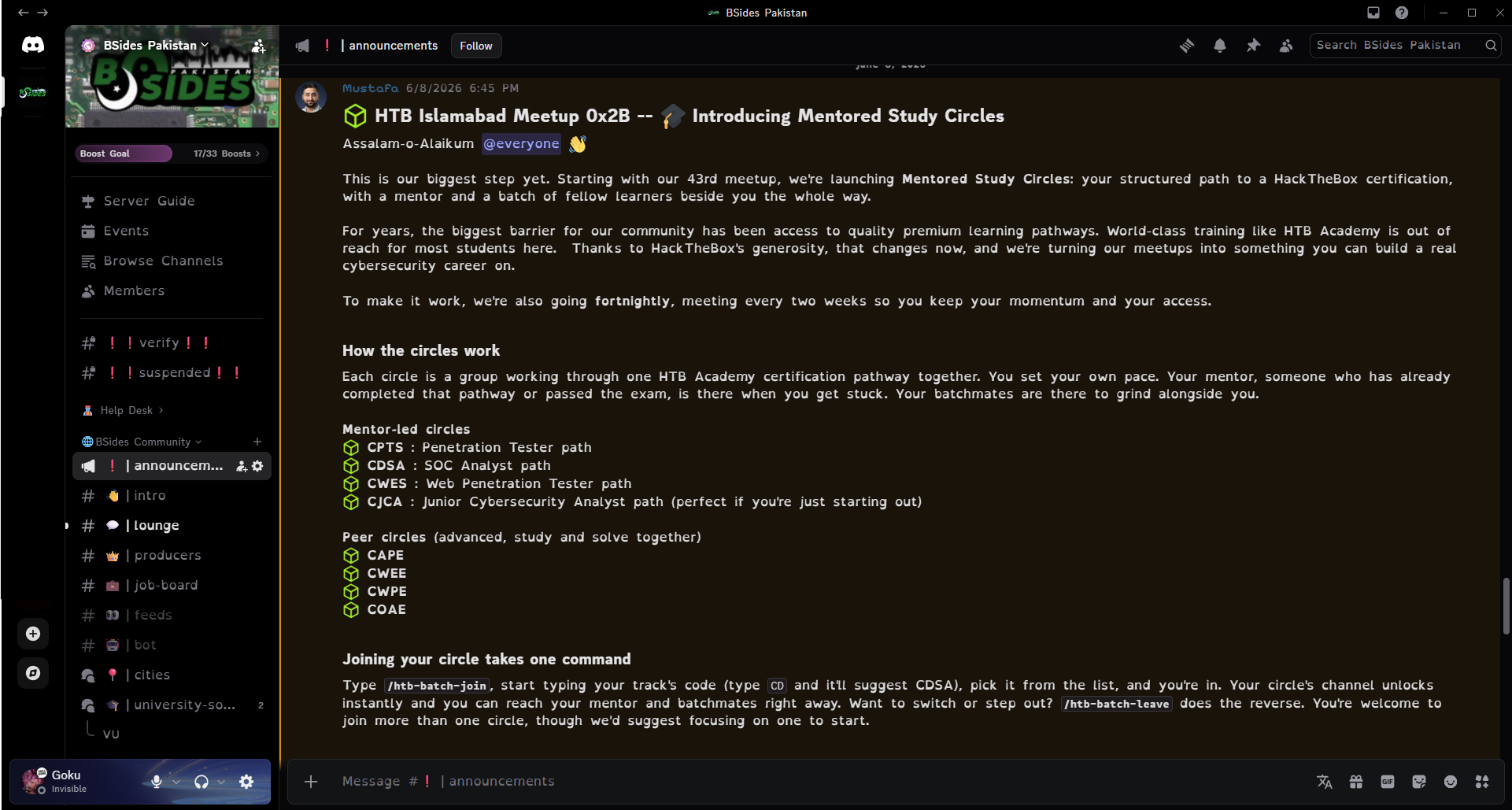
The community lives on Discord; matching it to Meetup.com RSVPs used to be a manual, name-by-name job.
Volunteers carried all of it. That worked when there was one meetup a month and a short list of names. It does not work when you double the frequency and stack new programs on top. The work scales linearly with attendance, and the people doing it do not.
Why a Generic Discord Bot Doesn’t Fit
There is no shortage of Discord bots. There are bots for moderation, for roles, for welcome messages, for tickets. None of them run a high-frequency cybersecurity meetup, because none of them know anything about the platforms those meetups depend on.
The gap is specific. What the community needed was not another general bot but one purpose-built for the operational load of a high-frequency cybersecurity meetup, integrated directly with Meetup.com and the HackTheBox Enterprise Labs. Built once, in-house, on a core the community owns, rather than stitched together from several vendors at once.
“We already had a meetup on the calendar. That deadline is what cut a sprawling design doc down to one flow and actually got it shipped.”
One Coherent Path, From RSVP to Lab
For a member, the whole thing should feel like one smooth path. They RSVP on Meetup.com, join the community on Discord, onboard once, and arrive at the meetup already set up with the right roles and lab access. No chasing a volunteer, no separate sign-ups, no figuring out which channel to ask in.
Umro Ayyar’s job is to make that path hold together. It connects what happens on Meetup.com with what happens on Discord and in the HackTheBox Enterprise Labs, so the pieces line up on their own instead of a member having to bridge them by hand.
The first version keeps a human in the loop by design. Staff stay in control of when each step runs, which keeps the experience predictable while the core proves itself against real events. Deeper automation builds on that foundation over time.
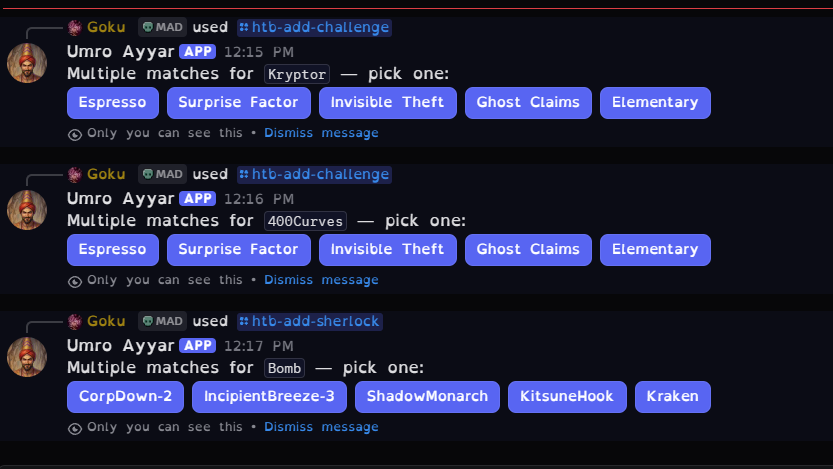
Umro Ayyar resolves lab and challenge requests inline, so members are set up without a manual back-and-forth.
What the Meetup Module Does
Knows Who’s Coming
It reads the RSVP list from Meetup.com and lines each attendee up with their Discord account, so the people in the room and the people in the server are finally the same list.
Onboards Everyone, Once
When members join, the bot walks them through onboarding and gives them the right roles automatically, so nobody waits on a volunteer to be let in.
Gets Members Into the Lab
It handles access to the HackTheBox Enterprise Labs for each session, so attendees land in the right place for the meetup without a manual back-and-forth.
Hosts More Than One Bot
The meetup module is one feature on a shared core. Other feature bots, like invite tracking, run independently on the same platform, each replacing a standalone bot.
That last point is the design. Umro Ayyar is a platform, not a single bot. Think of it as the boss: one small, stable core that runs a crew of independent feature modules, each built in-house instead of rented from a separate vendor. The meetup module is simply the first and most proven of them.
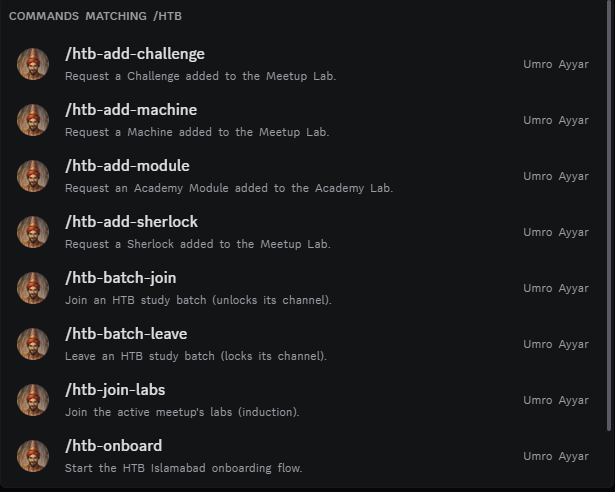
Slash commands let members request machines, modules, challenges, and Sherlocks for the meetup lab.
From a Sprawling Doc to a Shipped Bot
Umro Ayyar did not start as a bot. It started as a documentation site. Three days of brainstorming turned into a full design doc: user stories, workflows, gate logic, and infrastructure decisions, all published and cross-linked. On paper it looked thorough. In practice it was a trap.
The feedback from Wander Labs was blunt: too much planning, not enough building. Cut it down. Pick one core flow. Build onboarding first, and see it work with real people before designing anything else.
So the doc came down. Pages were cut to a handful. v0.1 milestones were defined, then broken into atomic issues small enough to finish and ship. And the work was pointed at a hard, immovable deadline: a real HackTheBox Islamabad meetup was already on the calendar, with real people about to RSVP.
That deadline did the work planning could not. The accountability of a real event is what forced the scope cut and got the first version out the door. There was no room to gold-plate features nobody had used yet, because the meetup was happening whether the bot was ready or not. Every decision became “does this help the meetup run,” and anything that did not answer yes was cut or deferred.
Shortly after the meetup proved the core out, the project was rearchitected. What began as a single meetup bot became the Umro Ayyar platform: a stable core that could host new feature bots without rebuilding the foundation each time. The standalone tool became the flagship feature of something larger.
The meetup-automation module went live at HackTheBox Islamabad meetup #43 (0x2B) on 23 May 2026. 50 users onboarded live during the event, 42+ completed onboardings, around 8 production deploys landed inside the event window, and there were 0 crashes and 0 data loss. Three separate external-system failures hit during the live run: a Discord platform limit, a HackTheBox Enterprise behavioural gate, and a Meetup.com front-end change. All three were recovered without any manual data repair, and none of them were bot-internal.
Here is the same story as a timeline, from the published-design-doc trap to a battle-tested platform built through Wander Labs.
Mustafa brings his own side project to Wander Labs: automate the manual admin behind HackTheBox Islamabad meetups before the events outgrow the volunteers running them.
A three-day design doc, published as a full site, meets blunt feedback: too much planning, not enough building. Cut it down, pick one flow, build onboarding first.
v0.1 milestones become atomic issues, pointed at a HackTheBox Islamabad meetup already on the calendar with real people about to RSVP.
The first rollout: 50 members onboard during the event, with zero crashes and zero data loss. Three external-system failures hit and recover without manual data repair.
Proven at a real event, the single meetup bot is rearchitected into Umro Ayyar: a stable core that hosts independent feature bots. Invite tracking is the second module to land on it, replacing a paid third-party bot.
The Wander Labs project wraps with a battle-tested core, more than one feature bot, and a graduating public case study.
Umro Ayyar runs HackTheBox Islamabad’s operations from one core, with a growing set of in-house feature bots and a roadmap aimed at real community needs.
Why Umro Ayyar Matters
Umro Ayyar is internal tooling, not a product for sale. As a Discord community bot, its success is operational, not commercial. A real fifty-person meetup ran on it, the core flows held, and the failures that did happen were external systems misbehaving, not the bot losing data. That is the bar it was built to clear, and it cleared it under a real deadline.
Building it also built a specific set of skills. AI-assisted development at real scale, since the bot was built almost entirely with Claude Code. Scoping discipline, cutting a large design doc down to one shippable flow. Shipping under a hard deadline set by a real event rather than a self-imposed one. And engineering for graceful recovery, so that when external systems fail mid-event the bot recovers on its own instead of falling over and waiting for a human.
The momentum shows up in the community itself. As the meetups grew more frequent, the enthusiasm grew with them. More members started stepping forward to mentor newcomers, and study circles formed around cert-prep goals. That energy is what the platform is built to serve.
The roadmap for the Discord community bot follows that lead. Each new feature bot on the shared core, from invite tracking to a future BSides meetup module, aims at a real community need: helping members grow in their careers and giving everyone a frictionless experience at HackTheBox Islamabad meetups. The hard part was never the first feature. It was building a core stable enough to carry the next ten.
Discord Community Bot FAQ
Build Something of Your Own.
Most communities optimize for engagement: more members, more messages, more activity. Wander Labs optimizes for output. We’d rather have five people build something than fifty people post daily updates that lead nowhere.
1-on-1 Coaching
Weekly or biweekly calls with the founder and coaching team. Real conversations about your Quest, not recorded workshops.
Public Case Study
Your project gets a dedicated page on The Wandering Pro, with backlinks to your portfolio, LinkedIn, and what you built.
Builder Network
Access to mentors and serious peers who’ve built, shipped, and scaled, all working professionals.
A small group, so the coaching goes deep.