
Today’s topic – How to do Competitor Analysis and Market Research.
Welcome to another resource from The Wandering Pro. These guides exist to help you build a working career, whether you freelance, run a small agency, or are building your own product. This one covers a step most people skip: understanding the market before you commit to building anything. If it helps you, please share it with someone who needs it. Unlock the kit by clicking here.
Why Market Research Comes First
Building has never been easier. AI can stand up a product in a weekend. Which means the hard part isn’t building anymore, it’s knowing what to build. And that answer lives in the market.
Whether you’re building your own product or doing the groundwork for a client, market research and competitor analysis are how you find out what’s actually worth building. Skip it and you risk pouring months into something nobody was waiting for.
In this guide, I’ll break down the key components of solid market research and how to develop the materials that go into it. Each part builds on the last.
Please watch the attached video for further explanation and insights.
Breakdown of the Market Research Deliverable
Below are the sections your deliverable should be based on. Each client or stakeholder has different wishes, but the list below covers the basics for most.
When it comes to presenting the outputs, you have a free hand in how you compile your findings and share them, whether that’s with a client or your own team. I recommend a 2-3 page document structured around the following deliverables.
Direct Competitors
These are the direct competitors that exist for the business. In simple terms, they offer the same product and services, in a similar market, at a similar price point. Feature for feature, user for user. The obvious ones.
When researching competitors, always account for all three of these elements and don’t go beyond the scope of it.
Also verify direct competition with the client, or against your own idea, as you scope the list. My go-to tip for finding competitors is getting comfortable with SEO tools like Ahrefs or SEM Rush. For any online business, using what’s already indexed online is the quickest way to start your search.
Secondary Competitors
Secondary competitors offer the same product, aimed at a different user, segment, or price point. Close to direct, the difference is the market. Basecamp and Jira are both project management tools, so you could file them as direct. Look closer and they’re built for different worlds: Basecamp for the agency or freelancer managing clients, Jira for the enterprise team tracking internal engineering. Same category, different buyer. Secondary competitors like these show you how a category stretches across segments and price tiers, which is often where your next market is hiding.
Finding them can be tricky depending on the industry. Filter your initial research and divide your findings by the differences in market and user. SEO tools are your best bet for online products and services. For offline, get comfortable with Google Maps.
Indirect Competitors
Indirect competitors solve the same need with a different product, or just compete for the same time and budget. Different solution, same job to be done. Audible is a software subscription. A physical book is a printed object you buy once. Two different products, yet both do the same job: get you through a book. A founder counting only rival audiobook apps writes off print entirely, and forgets that a reader has only so much time and money for books, so every Audible subscription is a stack of paperbacks not bought. Different product, same need, and it’s the competitor you never think to put in a feature grid.
Finding good indirect benchmarks is the hardest part of any competitor analysis. You need a wide feel for the space to catch something chasing the same need from a completely different angle. But mapping them shows you where you could be challenged from a direction you weren’t even watching.
One caution now that AI makes research frictionless: cap your list. Around five direct competitors, ten to fifteen at the absolute most. It’s easy to let a tool scrape a hundred sites and drown yourself in tabs. More names isn’t more insight, it just pulls you off what you’re actually trying to decide.
Analysis Parameters & Key Takeaways
Got the list of your competitors? Now the fun part starts.
I’d recommend writing down your key takeaways for every competitor you’ve shortlisted.
- 2-3 positives about the competitor, generally speaking
- 2-3 negatives about the competitor, generally speaking
- 1-2 points on general user experience and findings
This helps you drill down further when you run the parameter-based analysis.
So what are the parameters for analysis? Fancy speak for the different aspects you want to rank.
Below is a diagram with a list of parameters you can work with. It isn’t conclusive, and the parameters can flex depending on your client or stakeholder needs.
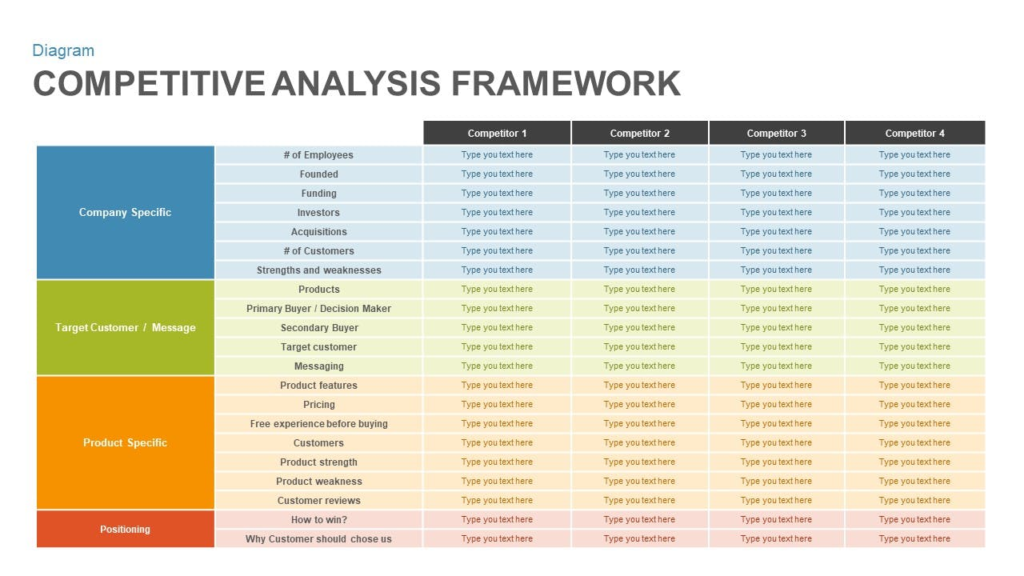
Link to source: https://www.antler.co/academy/startup-competitor-analysis
My rule of thumb is to stick to a maximum of 5 parameters.
If you’re doing a competitor analysis for a product-based business, my go-tos are User Experience, Design Sense/UI, Unique Selling Props, Content and Messaging, and Pricing.
If you’re doing one for a service-based business, go for Customer Reviews, Service Areas, Client Onboarding, Content and Messaging, and How They Work/Contract policies.
Once you’ve shortlisted your parameters, put everything in a sheet and rank it with your notes and scores. This is covered in more detail in the video.
Once you’ve done that ranking, turn it into a decision. Take every notable feature you found across competitors and sort it into three buckets: need to have, nice to have, and don’t need. That feature matrix is what converts a pile of research into an actual answer for what to build first, what to hold for later, and what to leave out.
SWOT Analysis
Moving on to SWOT (strengths, weaknesses, opportunities, threats). A term every ‘business’ person knows. What makes a good SWOT is the groundwork you’ve already put in. The out-of-the-box perspective you build from all that competitor research and parameter analysis is what makes your SWOT sharper than one written cold, whether it’s for a client or your own product.
The breakdown of SWOT is pretty standard, as you can see below:
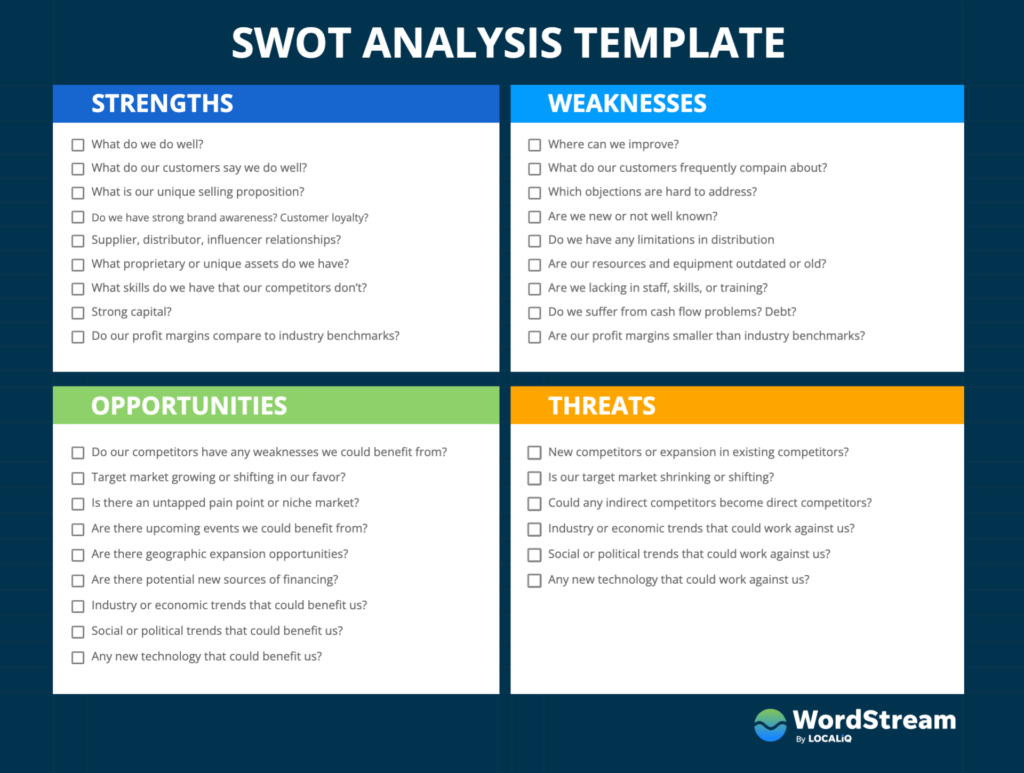
The work is in tailoring the answers to the specific business. My tip for an effective SWOT is to gather your research and then talk it through with the client, or a few real users, to pressure-test it. Think of it like a mini discovery.
Elevator Pitch
Done a lot of legwork so far, let’s get creative. Writing elevator pitches that actually resonate can be hard. But the pitch framework makes it easy for anyone to write one.
The Elevator Pitch framework helps you answer the following about the business:
FOR (target customer), WHO HAS (customer need), (business name) IS A (market category) THAT (one key benefit). UNLIKE (competition), Business (unique differentiator).
● For – who is the target customer for our business. We need to have a specific category to offer a good fit for our services and working style.
● Who – we need to identify a need that Company X promises to fill out
● The – what is the name of the business
● Is A – specific category of services we are offering or the product features we will be offering
● That – what is the benefit we are providing to other companies (not same as features)
● Unlike – Who are our competing businesses
● Our business – What sets us apart from competition
Example: Salesforce (CRM solution)
FOR small businesses without a CRM solution, WHO need to control their costs, Salesforce Is A CRM solution THAT is financially flexible with low initial cost.
Unlike Siebel or managing customer relationships manually, Salesforce is quick to set up and easy to use.
This example is a bit dated, but it does a good job of showing how a sharp elevator pitch stakes out a clear position in the market.
Market Trends and Learning
Finish everything off with a market-trends-and-learnings summary of all the work you’ve done so far. A one-pager focused on what should be high priority as you move into building.
Every product and business has different trends to watch. What matters most is tying those trends and learnings into a direction you can actually commit to.
One pattern worth building into that direction: the products that win start narrow. One user, or one industry, owned completely, before they ever claim to do everything. Vanta is a clean example, they went all in on SOC 2 compliance for early-stage startups, back when most startups didn’t even think they needed it, and grew from that beachhead into a category leader. Your research should point you at a beachhead like that, not a mandate to serve everyone at once. And when the market shifts, you differentiate on segment or positioning rather than rebuilding the product.
If you have the time, top all of this with a simple visual prototype of the end solution. Not technical architecture, just a workflow or mockup that makes the idea concrete. Nothing sells a research finding like showing what it could become.
Whether the research is for your own product or a client’s, the goal is the same: gather everything you need to understand the market, then turn it into a clear way forward.
Get the Competitor Analysis and Market Research
Getting off on the right foot matters for anything you build. Doing the market research first is how you get there, whether the product is yours or a client’s.
When a great team meets a lousy market, market wins.
When a lousy team meets a great market, market wins.
When a great team meets a great market, something special happens.
Understanding the market is the key behind success, no matter what you’re building.
This guide gives you a repeatable way to read the market before you commit to a client’s product or your own.
What’s included:
– A proven format used across 50+ projects and clients
– A filled sample showing how to apply it to a real project
– A 10+ minute video guide on getting the most out of it
If you have any issues with your unlock, kindly email admin@thewanderingpro.com
With or without my help – I wish you the best.
Come Build With Us
400+ members showing up, shipping work, and helping each other get better.
Or keep going: the Workshops and Templates & Tools →

See, at the heart of it – I love solving problems for people using tech, it doesn’t get simpler than that.
I am known for constant experimentation and relentless execution.
Right now – my focus is to help everyday folks of Pakistan understand tech, career, and business better with everything I do.