If you want to grow as a Freelancer or a Small Business, niching down is the best way to scale.
The thing is, to beat competition there are 2 universal truths:
- Offer the same value for a lower price
- Or offer more value for the same price
A lot of folks focus a bit too hard on the first one. There is only so much you can cut off your prices as a service provider before you burn out, or realize it is becoming impossible to scale.
So enter option 2, offering more value.
And as soon as you think about that, what comes to your head? Usually a whole lot of things that don’t make any sense.
If you are like any other hard working citizen out there, I am sure you are already providing the best quality of work there is. So how do you offer more value on top of that?
Well, you have to think outside the box. Think from the other perspective.
Who are you selling to?
Let’s take an analogy (hope it works well). If I have a gold ring I want to sell, who will give me a better price for it? A jeweller who deals in gold and understands what gold is worth, or a scrap buyer who buys anything based on weight?
The answer is obvious, but we often don’t apply this obvious logic when it comes to selling our skillset.
Let’s say you are a web developer. Do you think most clients care about what tech stack you know, what tools you use, or how many years of experience you have?
Not really. And if they do, they aren’t clients, they are looking to hire an employee.
A realistic client will only look at 2 things: are you the right fix for the problems they have, and do you have relevant past portfolio or samples to show for it.
For building a portfolio, I cover a technique in Casing Up Your Portfolio.
When it comes to fixing problems, you need to pick and choose what you offer. Niching down is the best way to offer more value.
If you do everything under the sun, you will seldom outshine the competition.
Do a quick Google search on how to niche down your services and you will find a LOT of frameworks to adopt. Some work, some don’t.
One of my favorites is the Elevator Pitch Framework that helps you figure out your business or product strategy. If we take the three core parts from it, you can focus on:
- THE: what kind of services you provide (web development, design, writing, etc)
- FOR: what kind of industry or niche you want to target (ecommerce companies, telehealth companies, auto insurance brands, etc)
- WHO: what kind of outcome the audience is seeking (increase sales, reduce churn, optimize performance, etc)
This sounds simple enough, but it is really hard to get to. If it works for you, great, no need to read further. But if you are still lost, let’s look at my approach.
My approach tends to work better for folks just starting to niche out. I am also assuming you already have some level of success as a Freelancer or a Small Business. This is the step by step plan I want you to execute.
1. Make Up Your Mind
Acceptance is always the first step. You need to accept that you want to niche down in the long term, until you find success with a specific problem solution pairing.
The problem needs to be well defined, tested and validated, and available in decent supply.
The solution you offer is well equipped to deal with the problem, is messaged in a way that is easy for your clients to understand, and it covers your core skillset.
2. Exploration
Now I am assuming you are already a relatively successful Freelancer or Small Business, so the next step is to explore your options. The goal is to find what is happening in terms of market trends and organic results.
Let’s say you are providing copywriting services. For exploration, I need you to take inspiration from the biggest and best copywriters out there and see how they define themselves.
For example, this copywriter specializes in B2B content marketing.
You can find folks in your industry with a simple Google search or by going through listicles of featured people.
This step is just to get a high level understanding of what the space looks like for successful industry leaders. If they are showing up organically (ignore ads or sponsored material), it means they are doing something that works.
3. Before You Imitate, Learn to Innovate
Now you know what the top looks like, but to get there we first have to look at how to package ourselves better.
I recently went through this exercise myself when I wanted to package my services for my PM site. What worked for me might work for you.
Which was going on Fiverr and doing a simple search for the premium sellers, identifying the niches they target.
Let’s stick with our example of copywriting. A quick Fiverr search hits you with a reality check, niching down the query:
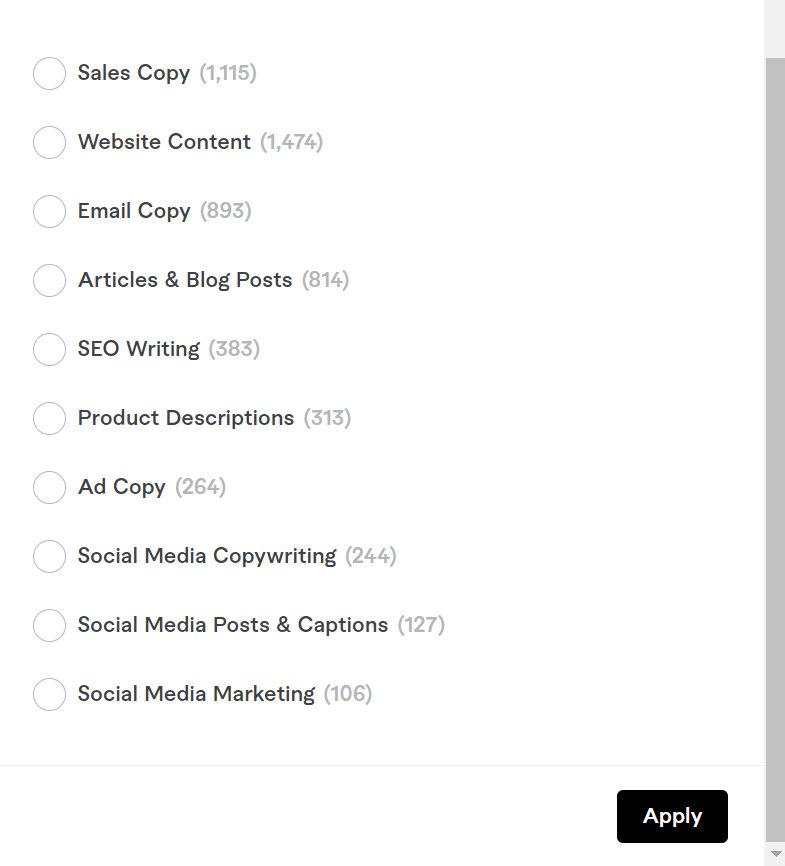
Even Fiverr wants you to be more specific, so let’s say I want to niche down into writing Sales Copy. Browse the top rated results and open the full profiles of some of the best sellers, and you will notice a trend.
Although all of these profiles are for ‘copywriters’, they have packaged their services into different niches.
And if you dig around enough, you will quickly notice that even though Fiverr might not be the best freelance platform, it is the best platform to sell packaged services.
4. Learning Through Execution
Now comes the hard part. Go create a Fiverr account. Create 4 gigs. Go through the process of forcing yourself to learn how to offer what you want to sell as packaged services.
The goal here is not to win projects on Fiverr, it is to go through the exercise and force yourself to think in terms of a product offering rather than a service offering.
Some prerequisites to keep in mind when creating these gigs:
- All gigs need to be tied to your core skillset, so if it is web dev, it needs to be related to web dev
- In your gig title, message the problem you are solving, not the tools or tech you will use to solve it
- Have at least one gig with multiple pricing options, this helps you figure out how to tier your offering
- Have at least one gig that is a low entry point or low budget, this adds variety
If you manage to create 3 to 4 gigs based around your core skillset, and these gigs get good impressions over time, it means you are ready for the next and last step.
5. Select, Test, Repeat
By now you should have a good understanding of how to package your services better. But you still need to test what works in the long term. This is where step 1 needs to be remembered.
You start with 3 to 4 services, you build your proposals and pitches around them for your future clients, and you see what works best.
Whatever outperforms eventually becomes your niche, and whatever doesn’t perform MUST get eliminated.
By the end of it all, you will have identified the niche that finally helps you offer more value to your clients and makes it easy to scale in a predictable direction.
As a Small Business or a Freelancer, it is becoming near impossible to stand out in the red ocean of competition. Niching down is your best bet.
The goal is to figure out one core problem, the different ways you can solve it, and then package yourself as a specialist rather than just another xyz skillset person.
And always remember, optimization is a journey, not a one step action. What matters is your long term goal being met, not the short term actions you experiment with. As long as the collective of all your actions results in you niching down, you will be successful.
With or without my help – I wish you the best.
Come Build With Us
400+ members showing up, shipping work, and helping each other get better.
Or keep going: the Workshops and Templates & Tools →

See, at the heart of it – I love solving problems for people using tech, it doesn’t get simpler than that.
I am known for constant experimentation and relentless execution.
Right now – my focus is to help everyday folks of Pakistan understand tech, career, and business better with everything I do.