There are 2 kinds of people at any workplace, and you can tell them apart by how they look at a clock.
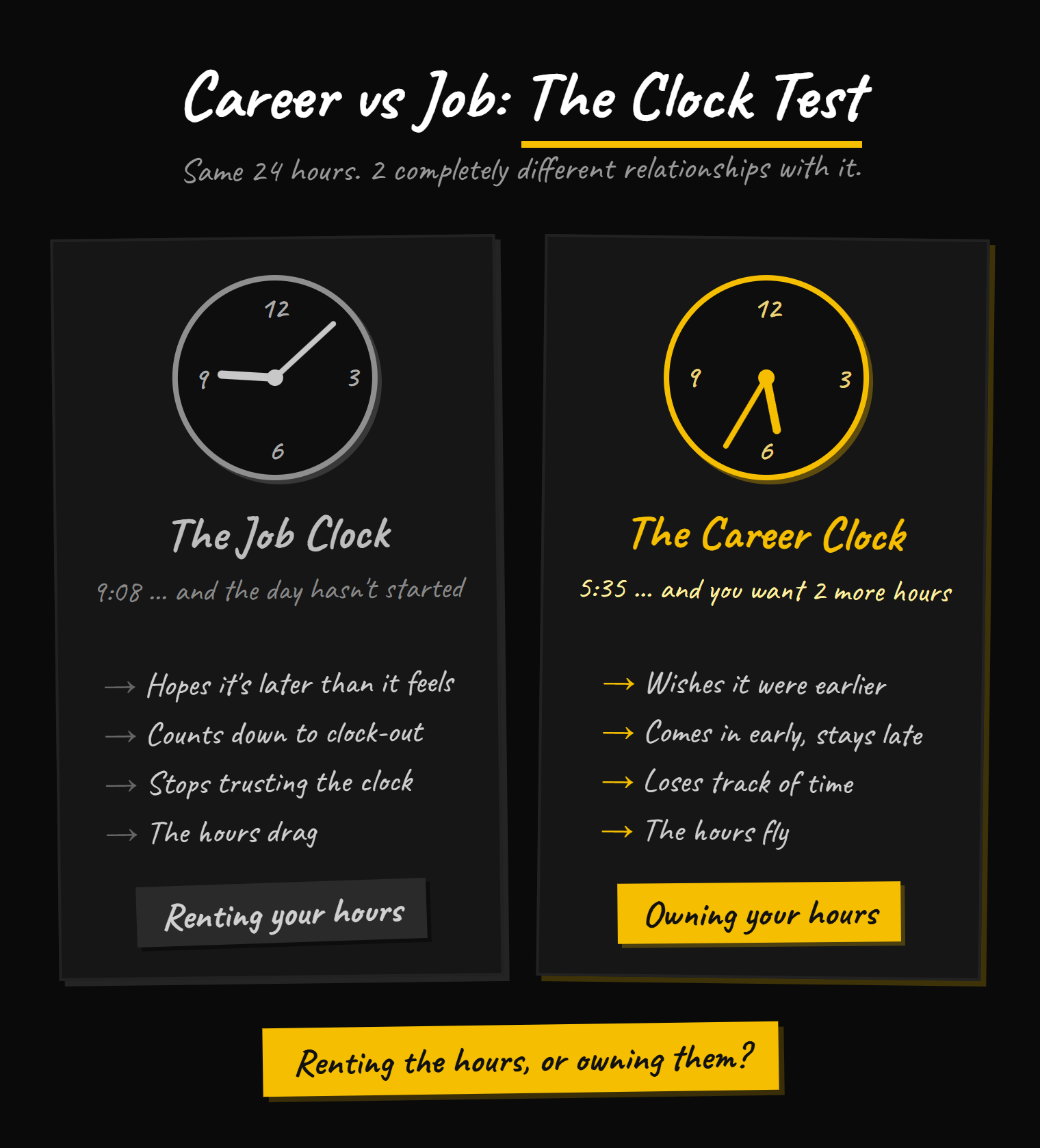
One checks the time and hopes it’s later than it feels.
The other checks it and wishes it were earlier.
I know the first one from the inside. My first real job was tech support, shift work with a headset on.
I watched the clock the whole time. I knew how many hours were left in the shift, when the next break was, how long until I could clock out and get my evening back.
The work wasn’t hard. It was time I was trading, and I counted every unit of it.
Chris Rock has a bit about exactly this. With a job, he says, there is too much time. You look at your watch, it’s 9:08, and the day stretches out in front of you like a sentence to serve.
You stop trusting your own watch. So you ask 5 coworkers what time it is, and whoever gives you the latest time is right, because all you want is for the shift to end.
It’s a stand up bit. It’s also the most accurate description of a job I’ve ever come across.
That drag has a cost you never name while you’re inside it.
You start wishing your own life away. Monday to Friday gone just to reach Saturday. Most of your waking hours spent trying to get to the small slice that’s actually yours.
You’re just trying to get to 5 o’clock.
A Job Can Be a Career. Most Here Won’t Be.
First, a fair word for the job.
A job can absolutely be a career.
Some jobs stretch you, pay you what you’re worth, and put you somewhere better every year.
A good one clears 3 bars. Your effort is paid fairly. Your bills are covered without constant stress. And there’s real room to grow.
If your job does all 3, you might be holding the rare kind that becomes a career.
Stay in it and build.
I run a business, and I try to make sure my own people get exactly that.
Growing, fulfilled, paid right. That is the point of a good job.
But be honest about the odds here. In a country like Pakistan, maybe 5% of jobs will actually scale you into something that fulfills you long term. The other 95% will pay you and plateau you.
So this isn’t me telling you to hate your job.
It’s me reading the environment we’re in.
The skill is knowing which one you’re holding.
A Nicer Prison Is Still a Prison
If your job is in the 95%, the obvious fix is to climb.
Get the senior title, the raise, a better spot on the org chart.
But plenty of well paid senior people watch the clock as hard as any teenager on a checkout counter.
The money is better. The misery is the same.
The title bought them a nicer prison instead of a career.
And a job rents you your success. You can be the reason a product ships, the reason a client renews, the reason the quarter looks good, and still own none of it.
You might be indispensable in practice and still show up on the org chart as a head count. The wins get filed under someone else’s name, and when you walk out the door they stay behind.
That is renting. A beautiful house you never built a cent of equity in.
So people try the other escape. Less of it. Fewer hours, an easier gig, the 4 day week, the plan to grind a few years and never work again.
But free time is only a prize if you have somewhere to put it.
Watch the people who finally get the empty calendar they wanted. A lot of them don’t come alive. They get restless, they start watching a different clock, and the drag they were running from follows them right into their free time.
The dream of endless free time is really a dream of time you don’t have to feel. You still have to feel it.
The Tell Is the Clock
So if a better title doesn’t fix it and more free time doesn’t fix it, stop arguing about the labels.
Salary versus passion. Stability versus freedom. Employee versus founder.
Watch the clock instead. It gives away which life someone is living long before their LinkedIn does.
Underneath the clock is the real split.
A job rents you your hours. A career is hours you own.
You can hold a senior title and still be renting. You can run your own company and still be renting, if you built something you now resent and spend the day counting down to closing the laptop.
Ownership on paper isn’t the same as ownership in how you feel about your own hours.
The line runs through your relationship with time, not your business card.
You can’t buy your way across it with a promotion, and you can’t quit your way across it either.
When the Hours Are Yours
The switch for me didn’t come with a better title. It came when I started building things that were mine.
The first time I lost track of time at work, it caught me off guard. I looked up and the evening was gone and I hadn’t noticed it leave. Because I wanted the outcome, and the outcome depended on me.
Psychologists call that flow. It shows up when the work is hard enough to absorb you and yours enough to pull you in. You can’t force it onto time you’re only serving.
That is the career clock. You come in early because you can’t wait to get back to the thing, and you’re annoyed when the day ends, the way a good book ending a chapter too soon annoys you.
Work that bends time like that has 3 things going for it. It’s hard enough to hold your attention. The outcome depends on you. And it’s yours in some real sense, a project, a craft, a business you’re building on purpose.
Take any of the 3 away and the clock comes back.
It’s why I keep pushing people to build something of their own, whether that’s products in Pakistan or a portfolio nobody asked them to make.
The work can look identical from the outside.
The only thing that changed is whose name the result compounds under.
Feeding the Future, Not Just the Now
Wanting out is the easy part. Doing it without blowing up your life is where most people trip.
Nobody’s life changes by quitting on Monday to freelance on Tuesday. That isn’t brave, it’s unprepared.
Think of your week as a calendar. Your job takes about 40 hours. That block feeds the now. It pays rent, keeps the lights on, and you need it stable before anything else.
Now look at the rest of the week. Can you carve out even 15 to 20 hours that feed the future? Not scrolling, not “thinking about starting something.” Real skill building, or side work that compounds.
Spend those hours on high leverage work only. Learn things that pay off more than once.
Build things you can reuse. Package a service you can sell again instead of trading every hour fresh.
And don’t romanticize the jump. The people who actually get out do it after months of quiet work in the margins, once the side thing has real demand and the job is still covering them.
You don’t have to quit anything today. You just feed the future long enough that the future starts feeding you back.
The Test You Can Run Today
One caveat first, because I’ve seen this go wrong.
Time flying isn’t always a good sign. There’s the version where the hours vanish because you’re absorbed, and the version where they vanish because you’re running, filling every minute so you never have to sit still.
I’ve done the second and called it dedication when it was closer to avoidance.
The difference is how you feel at the edges.
Absorbed work leaves you tired and full. Running work leaves you empty and still restless.
If your hours are flying but you dread the thing the moment you stop moving, the clock is telling you something, same as it was on the support line.
So, the test. Next time you catch yourself checking the time, notice which way you wanted it to go.
Did you want it to be later, so this could be over? Or earlier, so you’d have more of it?
You already know which answer you’re hoping for.
The real question is which one your own clock keeps giving you.
With or without my help – I wish you the best.
Come Build With Us
400+ members showing up, shipping work, and helping each other get better.
Or keep going: the Workshops and Templates & Tools →

See, at the heart of it – I love solving problems for people using tech, it doesn’t get simpler than that.
I am known for constant experimentation and relentless execution.
Right now – my focus is to help everyday folks of Pakistan understand tech, career, and business better with everything I do.