I made real money on Upwork for years. Top Rated Plus, the whole thing.
For a stretch I also saw the platform from the inside, on a consulting stint.
So when I say Upwork is dying, understand where it’s coming from.
I am not a bitter freelancer who never made it work.
I made it work for a long time, and I know how the machine runs.
I am saying it because the numbers have turned, and the numbers are public.
The headline is not the point, though. Freelancing is completely fine.
What’s dying is the easy way in.
Defending Upwork
A few months ago, someone in my community started ranting that Upwork just wants to rob freelancers and doesn’t care about them. I pushed back. I defended them.
I said what I still believe. Upwork isn’t some scam that got lucky. The reason it has no serious competition is not the website. Anyone can build a site where clients post jobs and freelancers apply, that part is easy.
The hard part is the payments network and the legal compliance sitting under it, moving money across a hundred countries without breaking a law in any of them. That is brutally expensive to build, and it is the real moat. Nobody is dethroning Upwork or Fiverr on that any time soon.
I also said they don’t have a talent shortage. They have the opposite. Hundreds of thousands of new freelancers pour in every month, and the overwhelming majority never earn a cent before they churn out. At that scale it is genuinely, structurally impossible to sort the serious from the freeloaders. Connects, the tokens you burn to apply, exist mostly as a filter. Pay a little to bid and you have at least shown you are serious. That is the logic.
And for what it is worth, the people inside genuinely want freelancers to succeed.
The hard part is that what is good for one freelancer is not always what is good for the marketplace.
All of that still holds. The moat is real.
The scale problem is real. I would defend every word of it again tomorrow.
I was just answering the wrong question though.
Upwork Is Dying…..Now
While I was busy defending the machine, I missed the obvious.
A moat protects you from your competitors.
It does nothing to protect you from yourself.
Upwork spent years turning the screws on the exact people who make the platform worth anything. Connects to bid. Fee tiers that quietly punished the loyal freelancers who had built long client relationships. Fees on both sides of the same job. And most recently, a service fee that is a variable rate set by an algorithm. There is no rate card. You only learn what cut they are taking when you go to submit, job by job. Read that again.
Every one of those moves made a quarter look better. Every one of them also told the people doing the actual work that they were the thing being squeezed, not the customer being served.
I used to call this a demand problem, not a supply problem. Too many freelancers, not enough clients, so of course freelancer complaints get ignored. I meant it as a defense. Look at it now.
Their own earnings tell the story: client growth has stalled, revenue is barely moving, the market cap is a fraction of what it was, and they are cutting staff in waves. The demand problem I described as a footnote turned out to be the whole story, and it is finally coming due.
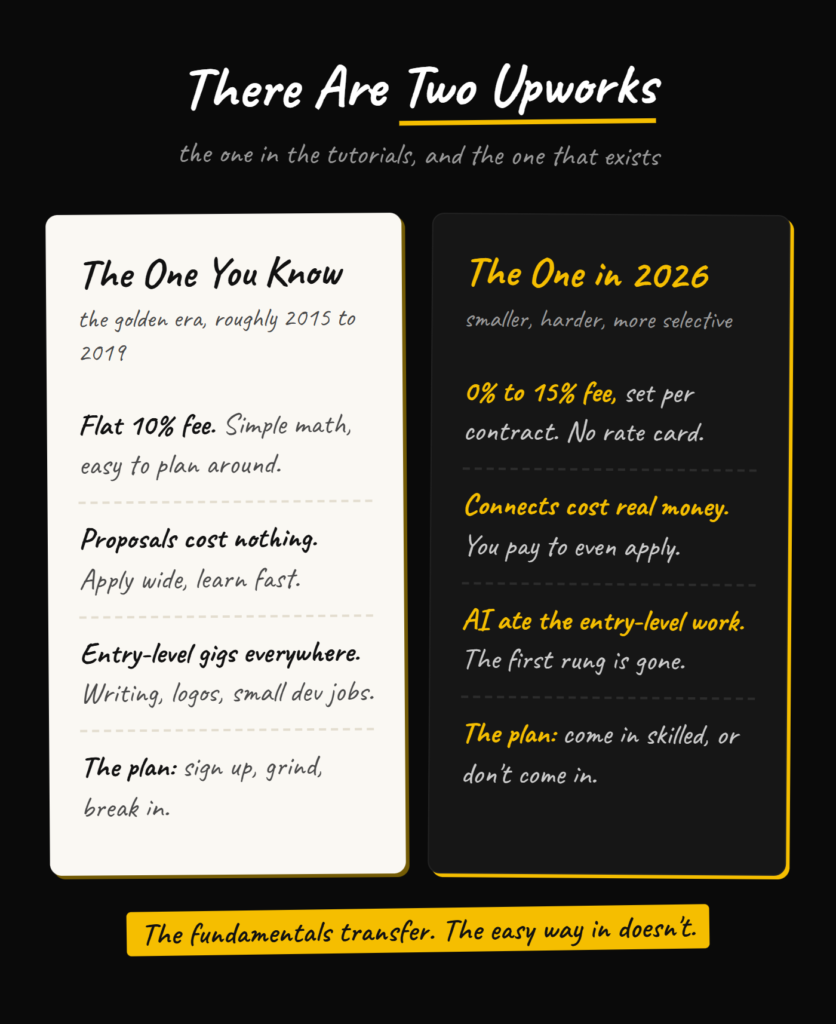
Not all of it was self-inflicted. AI and the end of the remote-work boom hit every platform.
But the fee squeeze was a choice, and they kept making it against their own base until the base stopped showing up.
Fiverr Didn’t Win Either
If Upwork is the villain, the obvious move is to run to Fiverr instead. Don’t.
Fiverr I only know from the outside, so this is the public record, not my own war stories.
The record is damning enough on its own.
Fiverr rode the pandemic to around eleven billion dollars and decided that was the new normal. It wasn’t. The world reopened, the growth stalled, and the stock fell something like ninety percent, roughly ten billion in value gone. And the tell: through the entire boom, with revenue at record highs, Fiverr never actually turned a profit. It was growth for its own sake, paid for with Super Bowl ads and an acquisition spree, with no floor under it.
Upwork’s sin was squeezing freelancers on fees. Fiverr’s was torching the trust of the people the whole platform depends on. It overhauled its algorithm and demoted its best sellers overnight with no straight answer why. It got sued over fees it slipped into checkout. And then, in the middle of everyone’s AI panic, it ran an ad bragging that it made the ad with AI, while its own CEO put out a memo saying AI is coming for your jobs. To an audience of human freelancers who are the entire product.
Same story, different flavor. Two giants, both shrinking, both treating the people doing the work as disposable. Picking Fiverr over Upwork right now is picking a different landlord in the same crumbling building.
No Better Platform Is Coming to Save You
The natural hope is that something better shows up.
A fairer platform, transparent fees, actually on your side.
I would not hold my breath, and it comes back to that moat. The thing that makes Upwork hard to kill is the same thing that makes a replacement hard to build. Payments and compliance at global scale is a multi-year, capital-heavy grind that no scrappy competitor stands up on a weekend. Smaller platforms keep appearing, and some are genuinely nicer to use, but none of them rival the big two on reach, and reach is the entire point of a platform.
So this is not a “wait for the next Upwork” situation. There is no cavalry coming.
If your plan is to sit tight until someone fixes freelancing for you, you will be sitting a very long time.
What Actually Collapsed Was the On-Ramp
Now the part I actually care about, because I don’t want you closing this thinking freelancing is over.
It isn’t. Not even close. Freelancing is fine.
What collapsed is the cheap, beginner-friendly way into it, and those are not the same thing.
For years the path was simple. Sign up on Upwork, take small commodity gigs, a bit of writing, some basic dev, a logo here and there, and use them to build a track record.
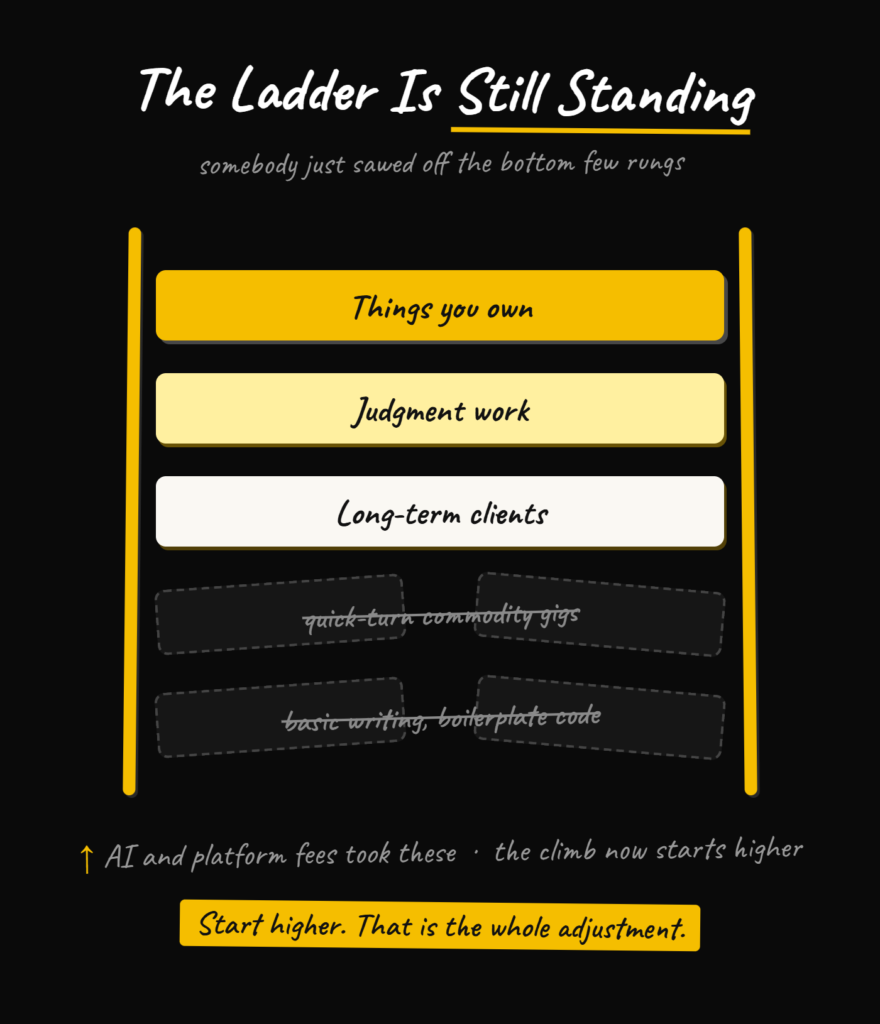
The platform was the free door. Entry-level work was the first rung on the ladder. Both got pulled out from under new people at the same moment.
The fees made the door expensive. And AI came for the first rung directly. The exact work a beginner used to cut their teeth on, the simple writing, the boilerplate code, the quick-turn tasks, is the work AI now does for free. I have said before that AI is your competition, and this is that landing on schedule. The bottom of the market is being deleted.
If you already have real skill and a real track record, none of this hurts you much. Clients still need people with judgment, and there are fewer cheap juniors crowding the field. You might even be doing better than last year.
It’s the person starting from zero who got hit. And in Pakistan, that is most people who walk into my server. Upwork and Fiverr weren’t one option, they were the whole plan. The ladder is still standing. Somebody just sawed off the bottom few rungs.
None of this means you cannot still start there. Plenty do. It means going in with open eyes, and I keep the Upwork Masterclass updated for exactly that, what it actually costs to break in now. The rest of our Upwork resources are getting the same pass over the coming months.
Stop Building on Rented Land
There is a lesson under all of this that goes way past Upwork.
You never actually owned anything there. Your profile, your reviews, your rank, your rate, all of it sat on land you rented from a company that could change the terms whenever it felt like it, and did. A platform that can reset your take-home with an invisible algorithm is your landlord, and it just raised the rent.
That is fine for getting started. It is dangerous as a place to live. The freelancers getting hurt most right now are the ones who built their entire livelihood on top of someone else’s platform and called it independence.
The move is to own your side of the relationship. Get the client into a direct relationship the moment it is allowed. Build a reputation and a network that belong to you, not to a marketplace.
I wrote a whole piece on why “I need clients” is the wrong question, and the channels that actually last, community, outreach, referrals, share one trait: nobody can rate-limit you on them.
So Where Does the Work Go
Up.
That is the honest answer. The work moves up the ladder, toward judgment, ownership, and building things, and away from anything a chatbot or a lowest-bidder can do cheaper.
One caveat before you run with that, because I won’t hand you a clean story. Moving up is not “quit everything and chase a startup”. Most products fail. Most of the builds I mentor stall out.
Moving up just means refusing to camp at the bottom, where the work is commodity, the price is a race to zero, and a platform sets your cut. Above that line is work that needs a human’s judgment and things you actually own.
That is the direction now.
Build Something You Own
The same AI gutting the bottom of the market is also the reason building your own thing finally got realistic. That is the flip in this whole story.
The floor dropped. It used to take a team, a runway, and years of specialized skill to ship a product. Now one person with taste and a real problem can build something that works, with no hundred grand in the bank and no VC waiting to catch them. I am doing it myself right now, a non-developer who spent a decade managing other people’s builds and never wrote one. The tools got good enough.
So when the on-ramp closes, don’t go hunting for a new platform to rent. Build and own something instead. And I mean that broadly. A product, sure. But also a real business, a publication, a service where you own the demand instead of renting it from a marketplace. Anything where you hold the keys.
The Room Is Emptying Out
The Upwork most people know is dying (for now). What remains is a smaller, harder, more selective marketplace, and if you are starting from zero the difference will not matter much. Either way, it gave a lot of us our start, mine included, and I am not dancing on its grave.
But it was always a middleman, and middlemen get cut out. The skill was yours, the clients were the point, and the platform was only ever the room you met them in. That room is emptying out.
So stop waiting for a better room. Build something that’s yours, somewhere nobody can change the rent on you. If you have been sitting on a product or a business idea, telling yourself you’re not technical enough or not ready, take this as the shove. That is what Wander Labs is for. One real build, in the open, with people who will help you actually ship it.
Upwork was a door, not a home.
Walk through it and go build.
I’m around if you want help finding your footing.
Is Upwork Dead? Quick Answers
Is Upwork dead?
It’s shrinking, and fast. Upwork cut about a quarter of its staff in May 2026 and client growth has stalled, so what’s left is a smaller, harder, more selective marketplace than the one most people remember. If you already have a track record there, it still works. If you’re starting from zero, don’t build your whole plan on it.
Is freelancing dead?
No. Freelancing is fine. What collapsed is the cheap, beginner friendly way into it, small commodity gigs on a platform used to build a track record. The work moved up, toward judgment, ownership and building things, and away from anything a chatbot or the lowest bidder can do cheaper.
Is Upwork still worth it for beginners in 2026?
As one channel, yes, if you treat it as practice in the fundamentals: picking jobs worth your Connects, writing proposals that show you read the brief, and delivering well. As your only channel, no. Pair it with direct clients and something you own. The Upwork Masterclass covers the fundamentals that carry over.
Should I wait for a better platform than Upwork?
I wouldn’t. The payments and compliance network that makes Upwork hard to kill also makes a replacement hard to build, so no cavalry is coming. Build something you own, a product, a service you sell directly, an audience, somewhere nobody can change the rent on you. If you want help shipping one, that’s what Wander Labs is for.
With or without my help – I wish you the best.
Come Build With Us
400+ members showing up, shipping work, and helping each other get better.
Or keep going: the Workshops and Templates & Tools →

See, at the heart of it – I love solving problems for people using tech, it doesn’t get simpler than that.
I am known for constant experimentation and relentless execution.
Right now – my focus is to help everyday folks of Pakistan understand tech, career, and business better with everything I do.