I’m writing this article about motivation while sick.
My nose is stuffed. My head is foggy. It’s Sunday. I have zero motivation to be doing this right now.
But I’m at my office. Because I’m here every day. And I had the outline for this article ready. The questions were prepared. The system was in place.
So here I am, writing this anyway.
That’s the whole point of this article. If I waited until I felt motivated, this wouldn’t get written. Not today. Probably not this week. Maybe not at all.
Motivation is unreliable. Systems aren’t.
Let’s talk about why.
This Is Part Three
This is the third article in a series I’m calling Productivity Traps.
In the first article, I talked about discipline. How it’s biased. How doing hard things only counts when they’re hard for you specifically. How discipline is a temporary bridge that gets you started until habits take over.
In the second article, I talked about rewards. How bad habits reward you instantly while good habits have long-tail rewards. How the dopamine junkie generation is wired for immediate gratification and fails when results take months to appear.
Now we get to motivation.
The thing everyone thinks they need. The thing everyone waits for. The thing that, if you understand it wrong, will keep you stuck forever.
What Motivation Actually Is
Motivation is the spark.
Think of it as fuel. The thing that gets you off zero. The initial burst of energy that makes you sign up for the gym, start the business, open the blank document, send the first proposal.
In my discipline article, I said discipline is about doing hard things that are specifically hard for you. Motivation is different. It doesn’t care if something is hard or easy. It just means you have the energy to start doing something. Anything.
You need motivation to start.
But here’s what people get wrong.
They think motivation is supposed to carry them the whole way. They think that initial spike of energy, that excitement, that “I’m finally going to do this” feeling is supposed to last.
It doesn’t.
There’s an image that captures this perfectly.
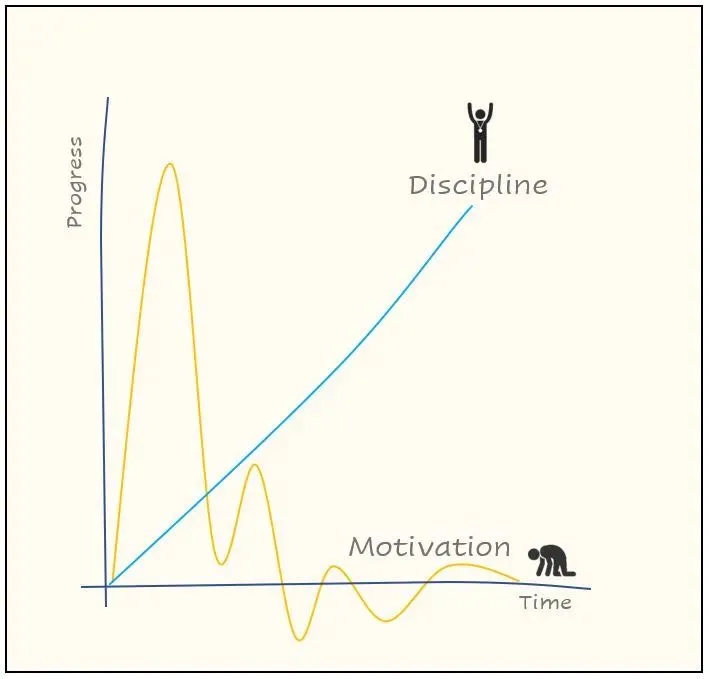
If you’re relying on motivation to keep you going, you will inevitably fail. Not because you’re weak. Because that’s how motivation works. It decays.
Why Motivation Decays
Motivation is emotional.
It’s tied to your mood, your state of mind, your emotional wellbeing. When you feel good, motivation is high. When you feel bad, motivation disappears.
And guess what? You won’t feel good every day.
Some days you’ll be sick, like I am right now. Some days you’ll be stressed. Some days you’ll be tired, overwhelmed, anxious, sad, or just not in the mood. Life happens. Emotions fluctuate.
If your productivity depends on your emotional state, your productivity will fluctuate just as wildly.
That’s the problem with motivation. It’s not stable. It’s not reliable. It’s a wave that goes up and down, and over time, those waves get smaller and smaller until there’s nothing left.
People who struggle with their emotions, who have mood swings, who don’t have good control over their mental state, these people struggle with motivation the most. Not because they’re lazy. Because they’re relying on something fundamentally unreliable.
The Core Trap
“I’ll start when I feel motivated.”
The thing is, you don’t need to wait for motivation to start. Your excuse should never be “I’m not motivated to do this thing.” If there is something hard for you, something you know needs to be done, do it anyway.
Figure out how to break it down into something easier. Figure out a routine. Talk to someone. That’s why communities like The Wandering Pro exist. Come talk to us and we can help you figure out: if you can’t do this, do this instead. If you can’t do that, try this smaller thing.
Break it down into chunks. Almost always, there’s a smaller subset of something you can start doing. And then one day, you’ll have motivation. You’ll be high on emotion. And you’ll tackle the harder stage.
But you don’t wait for that day. You start with what you can do now.
A lot of people get stuck waiting for motivation because the thing they’re trying to do is too hard for them. They might never have enough motivation for it. Or they might have it one day out of 365.
So instead of waiting, break it down. Start smaller. If you want to write articles, start writing paragraphs. Start writing one-liners. Do something small and don’t wait for motivation to save you.
The Handoff
In my discipline article, I explained that discipline is temporary.
You use discipline to do hard things until those things become habits. Once they’re habits, you don’t need as much discipline anymore. The behavior becomes automatic. Part of who you are.
Motivation works the same way, but earlier in the sequence.
You use motivation to get started. That initial spark kicks you into action. But immediately, you want to convert that motivation into discipline. You want to build systems that keep you going regardless of how you feel.
Then discipline carries you until the habit forms. And once the habit forms, you don’t need motivation or discipline for that thing anymore. It’s just what you do.
Here’s the sequence:
Motivation to start. Discipline to continue. Habit to sustain.
Once something becomes a habit, the motivation you used to start is freed up. You can use it to start something new. And the cycle repeats.
This is why things get easier over time. Not because you become more motivated. But because you need less motivation. The discipline you built converted into habits, and habits don’t require the same energy.
The Motivation Consumption Industry
People consuming motivation instead of doing the work.
YouTube videos. Podcasts. David Goggins clips. Motivational speeches. Self-help books. Inspirational Instagram posts.
They watch this content and feel good. They feel pumped up. They feel ready to conquer the world.
And then they do nothing.
Or they do something for a day, maybe two, riding that emotional high. Then the high fades, they go back to consuming more motivation content, and the cycle repeats.
Procrastination disguised as preparation basically…
There’s a distinction I want to make here. Amateurs look for inspiration. Professionals get the work done.
If you’re always relying on external motivation to get started, you’ll always be an amateur. You’ll always be waiting for the next video, the next podcast, the next speech to give you that hit of energy.
Professionals don’t work that way. They have systems. They show up regardless of how they feel. They understand that motivation is fuel, but fuel runs out fast.
The Spoon-Feeding Mentality
Someone joins the Discord server and expects everyone to answer all their queries. Most of what they ask can be answered by a quick Google search or a conversation with ChatGPT. Or we’ve already covered it in resources we give every new member. This article series is one example.
But they never do the homework.
The thing is, if you’re not the kind of person who’s going to do their work, I can’t motivate you to learn. You need to come with that energy, that willingness. I can guide you. I can say: go listen to this, go read this, then come back with your questions.
Maybe 1 out of 100 people actually do it. I’m not exaggerating.
Some people have actually complained: “I came here and you’re not helping me.”
And I have to explain: the reason we do these articles and workshops is because there are common problems everyone faces. It’s better to cover them once in an article or workshop so we don’t have to repeat ourselves constantly. I’d rather dedicate personal one-on-one time to specific issues you specifically face. Not generic problems that anyone without systems faces.
Nobody can give you motivation. It’s not something that transfers from person to person. You can be inspired by others. You can learn from their examples. But ultimately, motivation has to come from within.
And even then, as we’ve established, motivation is temporary. If you’re relying on others to motivate you, you’re doubly doomed.
Every toolkit, template, and guide we build is accessible to anyone. If they helped you land a client, pass an interview, or ship a project, consider paying it forward so we can keep building more.
The Goldilocks Connection
When someone loses motivation mid-project, it’s usually for one of two reasons.
Either the task drifted too easy and became boring. Or it became too hard and started feeling discouraging.
It’s usually pretty easy to tell which one it is. The hard part is knowing what to do about it.
If something is too boring, investigate why. How can you make it more challenging? There’s always a way to increase the difficulty.
Take writing articles. Someone might start using AI to write everything and think: this is so easy, there’s nothing to it. Okay, then figure out distribution. Figure out how to market it. Build a persona and write specifically for that audience. Do a series of articles. There’s always a next level to whatever you’re doing.
And opposite to that, when something is too hard, there are always levels below. Maybe you started on something too challenging. What’s the easier version? Use first principles thinking. Break it down. If you’re trying to write articles but can’t, write paragraphs. If you can’t write paragraphs, write one-liners. There’s almost always a smaller subset you can start with.
If you try to do too many things at once, you will almost always fail. I covered this in the rewards article. People who try to fix everything at once crash and burn. Layer things. One at a time.
Passion Is Just Another Form Of Waiting
Everyone is obsessed with passion.
“Find your passion.” “Follow your passion.” “Do what you love and you’ll never work a day in your life.”
This is dangerous advice in a country where most industries don’t pay enough for you to follow your passion. Where bills need to be paid. Where the job market isn’t diverse enough to accommodate everyone’s dreams.
Chris Rock said it best: “Follow your passion, if they’re hiring.”
More often than not, they’re not hiring.
Here’s my take. Keep your passion and your paycheck separate. Until your paycheck is big enough that you can afford to merge them, or until you find areas where they naturally overlap, don’t try to monetize your passion.
When you monetize your passion, you add expectations to it. Pressure. Deadlines. Client demands. Suddenly the thing you loved becomes a source of stress. It’s actually healthier sometimes to not monetize your passion, because then there’s no expectation and you can have mental peace around it.
I’ll use myself as an example.
I’m into tech. I love writing about tech, consuming tech content, running a Discord community, building things for people. None of this makes me money directly.
But I’m a product manager. I work in the software industry. My knowledge of tech, my understanding of community, my ability to communicate and manage, all of this helps me do my job well. There’s overlap. But my passion and my paycheck aren’t directly connected.
And that gives me sanity around it.
So when people say they’re waiting to find their passion before they start, they’re just waiting. Another form of the motivation trap. Another excuse to not begin.
My Personal System
Let me tell you how this plays out in my own life.
I’m blessed to have my own office. I wanted one for years, and two years ago I finally got it.
My rule is simple: unless there’s a serious emergency, I go to the office every day. Some days for 2 hours. Some days for 10. But I show up every single day.
And here’s what happens when I show up.
I turn on my computer. There’s always something to do. So I do something.
People ask me, “You work every day? Isn’t that exhausting?”
Not really. I’m actually pretty chill. Today is Sunday. I’ve played some games. I had an hour free, so I’m writing this article. Tomorrow I’ll probably do more. The day after, maybe less.
I think of my life like an hourglass full of sand. Some days I move a lot of sand to the other side. Some days I move one grain. But the point is, I move something every day.
Because I have this system, because I show up to the office every day, I end up working more than most people and getting better results. Not because I’m more motivated. Because I don’t need motivation. The system handles it.
The Gym
The same principle applies to health.
For 5-6 years, I couldn’t stick to a gym routine. I’d start motivated, go for a few weeks, then fall off. Classic motivation decay.
In the last 8 months, that changed. For the first time in over a decade, I’ve stuck to the gym consistently.
What changed?
Not my motivation. My environment.
I found a gym that’s open 24/7. That was my condition, because my schedule is unpredictable. It’s close to my house. I can drive there easily. It has machines I actually like using. And I found a decent trainer who expects me to show up.
Those external factors, that environment, removed the friction. Now I don’t need motivation to go to the gym. I have no excuse not to go. 24/7 gym. Close by. Good equipment. Trainer waiting.
Once those things clicked, discipline took over. And now going to the gym is just what I do.
I work in two time zones, Australia and US. I have a wife and two kids. My schedule is insane. But I still make it happen because I figured out the system.
When you figure out systems, you figure out how to get things done. Motivation becomes irrelevant.
The System So Far
Let’s connect the dots across this series.
Discipline is about doing hard things that are hard for you specifically. It’s temporary. A bridge to get you through the difficult beginning until habits form.
Rewards are the trap. Bad habits reward you instantly. Good habits have long-tail rewards. If you expect quick payoffs, you’ll quit before the real rewards arrive.
Motivation is the spark. It helps you start. But it decays over time, getting weaker and weaker until there’s nothing left. If you rely on it to carry you, you’ll end up crawling.
Here’s how they work together:
You need motivation to start something.
Immediately, you convert that motivation into discipline. You show up consistently, whether you feel like it or not.
Discipline carries you through the reward desert, that period where you’re working but not seeing results. 4-8 months at the gym before visible changes. 100 blog posts before an audience. 20 proposals before a client.
Eventually, the results arrive. The rewards kick in. And at that point, the behavior has become a habit. You don’t need motivation anymore. You don’t need as much discipline either. It’s just who you are now.
That’s the system. We’re still building it out. Environment is next. Then routine. Then we’ll tie it all together.
But the fundamentals are clear:
Motivation to start. Discipline to continue. Rewards to sustain. Habits to automate.
Stop waiting for motivation. Start building systems.
A Note On Scheduling
Before I close,
A lot of people hear “build systems” and immediately start building the perfect schedule. The perfect plan. The perfect routine.
And then they never do anything.
This is another trap. Working on the work instead of doing the work. Depleting all your resources on preparation and having nothing left for execution.
People waste too much time and energy on the early stages of behavior. They plan instead of act. There’s a whole debate here: action versus motion. Motion feels productive. You’re moving. You’re preparing. But you’re not actually doing the thing.
This might be another productivity trap article down the road. Scheduling and routine. How to build structure without getting trapped by it.
For now, just know: don’t use planning as another excuse to not start.
What Should You Reflect On?
If you’ve read this far, here’s what I want you to think about.
Whenever you want to start doing something, are you just looking at it from the aspect of motivation? Or are you thinking about the other pieces too?
Okay, I’m motivated to do this. But how will I keep doing this? Do I have any long-term targets?
Set loose long-term targets. Not too specific. Don’t spend too much time planning. But have some direction.
CGP Grey has a great video on this: why he prefers “Year of Themes” versus New Year’s resolutions. Themes are easier to work with. Most people fail at resolutions because they’re too specific.
Be a bit vague. But have some long-term vision.
And most importantly: don’t wait for motivation. It might come. It might not. Either way, you can start today.
What Trap Should I Cover Next?
That’s motivation.
The third trap in this series. The spark that everyone chases but nobody should rely on.
Next up is environment. Because as I mentioned with the gym example, environment often matters more than willpower. The right setup removes the need for motivation and discipline entirely.
What productivity trap do you want me to break down? Drop a comment and let me know.
With or without my help – I wish you the best.
Come Build With Us
400+ members showing up, shipping work, and helping each other get better.
If you’re working on something real, Wander Labs might be your next step.

See, at the heart of it – I love solving problems for people using tech, it doesn’t get simpler than that.
I am known for constant experimentation and relentless execution.
Right now – my focus is to help everyday folks of Pakistan understand tech, career, and business better with everything I do.