
The Habit Tracker That Knows
Who You Want To
Become
Systivia is an identity-based habit tracking app that flips the script. Instead of chasing streaks and checking boxes, you start with who you want to become — and let your habits follow.

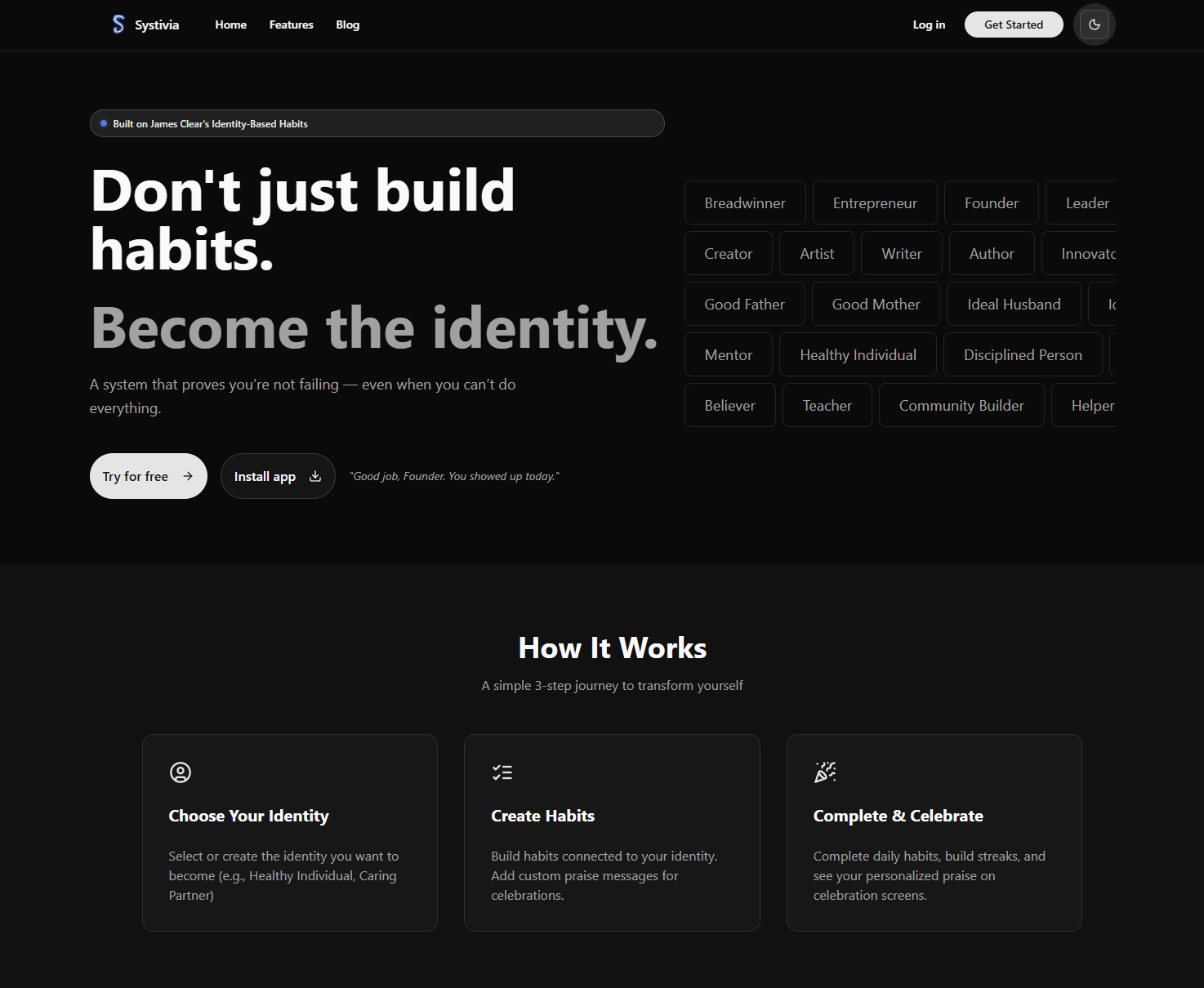
Systivia — habits organized by the identity you’re building, not just the task you’re completing.
Streaks Don’t Build Identity
Every January, millions of people download habit tracking apps. By February, most of those apps are forgotten.
The pattern is predictable. You set ambitious goals. You track religiously for a week. Then life happens — a sick day, a busy week, an unexpected trip. The streak breaks. The app sends a passive-aggressive notification about your missed habit. You feel guilty. You stop opening the app. Eventually, you delete it.
This isn’t a willpower problem. It’s a design problem.
Traditional habit trackers treat habits like tasks on a to-do list. Wake up, check “meditate.” Go to gym, check “workout.” The entire experience is built around streaks — maintaining an unbroken chain of checkmarks. Break the chain, and the app treats you like you’ve failed.
But habits aren’t tasks. They’re expressions of identity.
When you reduce a habit to a checkbox, you strip away the meaning. You’re not meditating to check a box — you’re meditating because you want to be someone with mental clarity. You’re not working out to maintain a streak — you’re working out because you want to be a healthy person.
The moment the streak breaks, motivation disappears. Because the motivation was never rooted in who you’re becoming. It was rooted in not breaking the chain.
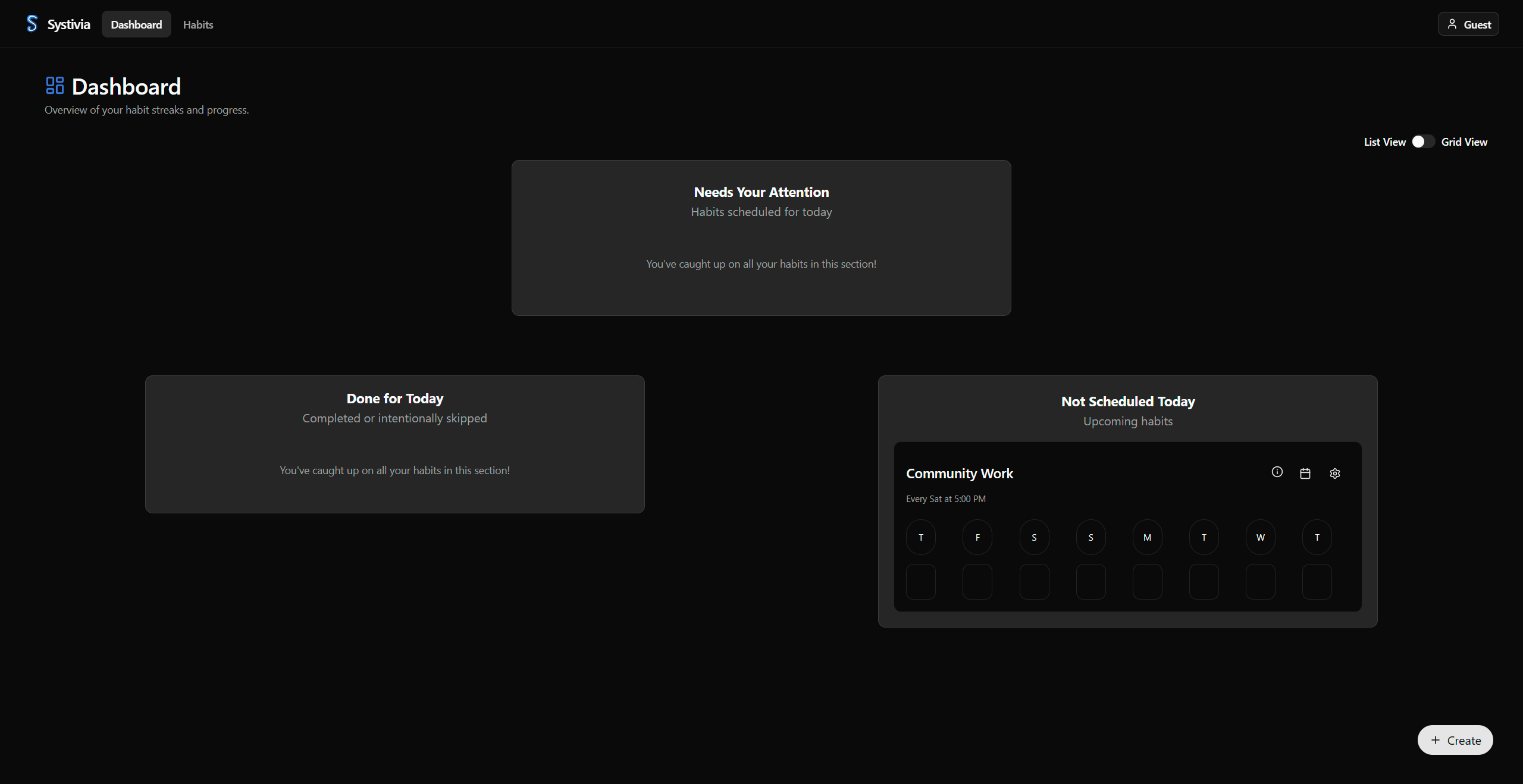
The Systivia dashboard — habits grouped by identity, progress measured by who you’re becoming.
Why Existing Habit Apps Miss the Point
The habit tracking market is crowded. None of the popular options solve the core problem.
The fundamental issue is that these apps optimize for the wrong metric. They measure streak length and daily active usage, not whether someone is actually becoming the person they want to be.
“Every habit app I tried made me feel worse about myself, not better. I wanted something that understood the difference between tracking tasks and building identity.”
Start With Who, Not What
Systivia asks a different question. Not “What do you want to do?” but “Who do you want to become?”
The app asks you to choose identities first — Healthy Individual, Disciplined Person, Good Parent, Creative, Lifelong Learner. These aren’t categories. They’re commitments to a version of yourself you’re building toward.
Every habit you create connects to an identity. When you complete a habit, you’re not just checking a box. You’re reinforcing who you’re becoming. When you miss a day, the identity doesn’t disappear. The direction remains.
This reframe changes everything. Missing a workout doesn’t mean you’ve failed. It means there’s a temporary gap between where you are and who you’re becoming. The identity persists. The guilt doesn’t.
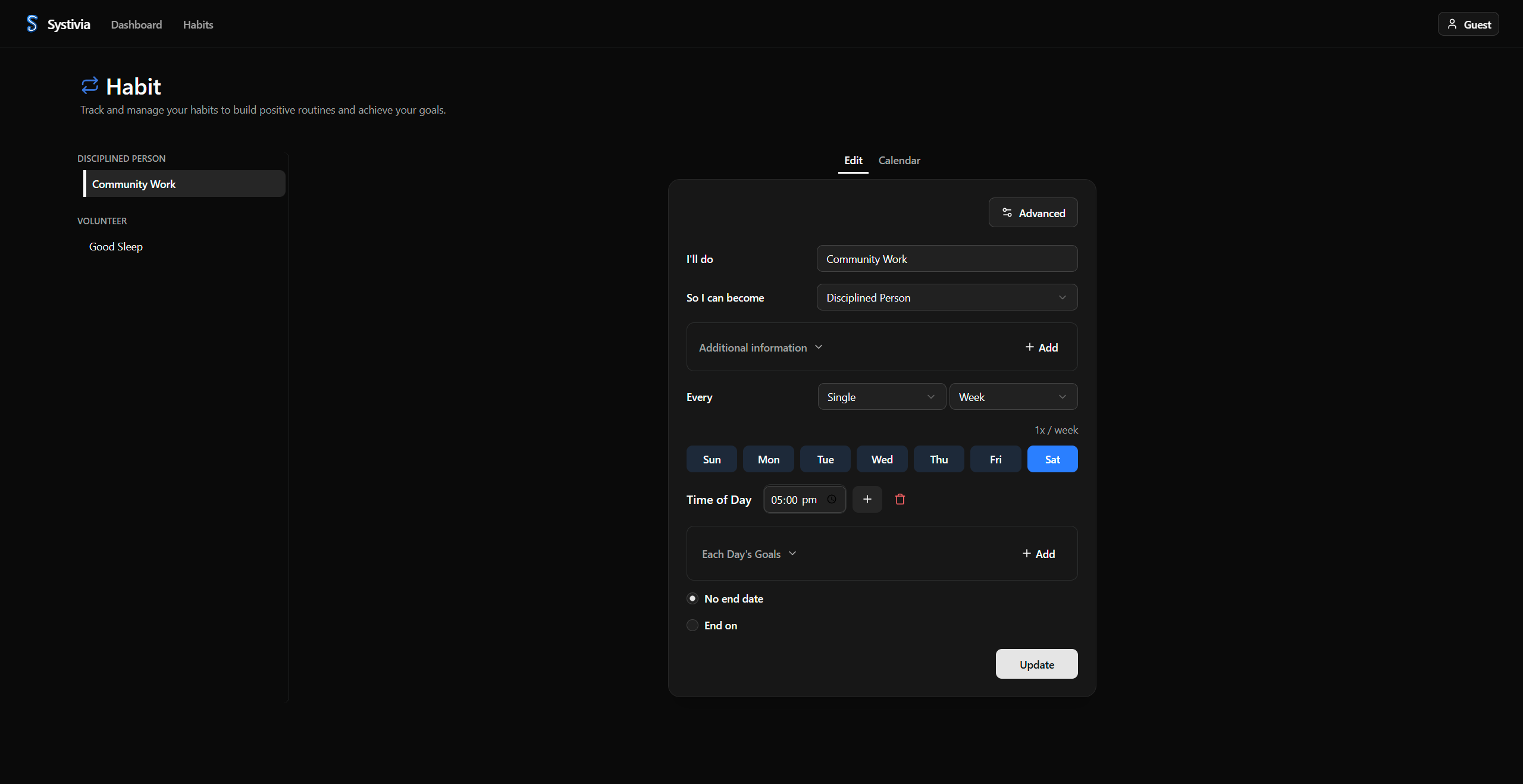
Every habit connects to an identity. The identity gives the habit meaning.
What Systivia Does
Identity-First Design
Choose who you want to become before deciding what to do. Habits attach to identities like Healthy Individual, Focused Creator, or Caring Parent — giving every action meaning beyond the checkbox.
Flexible Scheduling
Daily, weekly, monthly — whatever fits your life. Change schedules anytime without losing progress. Real life doesn’t follow rigid patterns, and the app doesn’t pretend it does.
Smart Completion Logic
Complete, skip with intention, or mark as missed. Skipping isn’t failing — it’s acknowledging reality. The app adapts to honesty instead of punishing it.
Personalized Celebration
Custom praise messages tied to your identity. Not generic “Great job!” notifications — messages that remind you of the person you’re building.
Progress is measured by identity alignment, not just habit completion. Instead of “you completed 4 of 6 habits today,” the framing is “you’re 80% aligned with your Healthy Individual identity this week.” There’s no public leaderboard. Habits are personal. Comparing your meditation streak to a stranger’s doesn’t help you become more mindful.
Progress measured by identity alignment — not just checkmarks on a list.
Building a Product That Didn’t Exist
Systivia started as personal frustration. Zaeem had tried every popular habit tracker and hit the same wall every time — the moment a streak broke, the motivation vanished. The apps were designed to make him feel guilty, not supported. So he started asking whether the problem was his discipline or the tool’s design.
The answer became the product.
He joined Wander Labs with an ambitious vision. The original concept was sprawling — a habit tracker with gamification, social features, Discord integration, minute-by-minute scheduling, and a dozen other features that sounded impressive on paper. The first lesson was scope.
Building a habit tracker sounds simple until you try it. Timezone handling alone took weeks to get right — making sure habits don’t break when someone travels. Scheduling logic for “every two weeks on Monday and Thursday” required building a custom recurrence engine. The technical complexity expanded at every turn.
Through Wander Labs accountability calls, the project found focus. Features got cut. The gamification layer disappeared. Social features were removed. The scope narrowed to the core idea: identity-based habit tracking. That focus is what turned an ambitious concept into a functioning product.
The codebase grew to over 25,000 lines of TypeScript. Not because of feature bloat, but because of the infrastructure required to make a simple experience feel effortless. GraphQL subscriptions for real-time updates. Apollo Client cache management for instant UI responses. A custom occurrence generation system that pre-computes future habit instances. The technical depth became invisible — which is exactly the point.
25,000+ lines of TypeScript — real-time GraphQL subscriptions, Apollo Client cache management, a custom recurrence engine, and BullMQ background job processing. The infrastructure to make simplicity feel effortless.
What the project taught goes beyond the tech stack. Frontend architecture decisions — when to use local state versus cache versus server state. Backend systems design with NestJS, Prisma, and BullMQ for background job processing. Date and time handling across timezones and recurrence patterns. And the hardest skill: learning to cut features, prioritize ruthlessly, and ship something usable instead of something perfect.
Why Systivia Matters
Systivia isn’t a commercial product aimed at market capture. It’s a portfolio project that demonstrates full-stack capability through a real, usable application.
That distinction matters. Anyone can say they know React and GraphQL on a resume. Systivia demonstrates it. The codebase covers frontend architecture with TanStack Router and Apollo Client, backend systems with NestJS and Prisma, real-time data with GraphQL subscriptions, background job processing with BullMQ, and the unglamorous but essential skill of handling timezones and recurrence logic across different user contexts.
But more than a technical exercise, Systivia represents a complete product thinking cycle. Zaeem didn’t just build features. He identified a gap in a crowded market, defined a differentiated positioning (identity over streaks), made hard scope decisions under real constraints, and shipped something that works. That’s the full loop — from problem identification to live product — and it’s the kind of evidence that separates portfolio filler from proof of capability.
For Wander Labs, Systivia validates the model. A participant came in with an idea, got structured accountability and mentorship, cut scope instead of adding it, and shipped a real product that people can use. That’s the outcome the program exists to produce.
Build Something Real.
Most communities optimize for engagement — more members, more messages, more activity. Wander Labs optimizes for output. We’d rather have five people ship real products than fifty people post daily updates that lead nowhere.
1-on-1 Mentorship
Weekly or biweekly calls with the founder and mentor team. Real conversations about your project, not recorded workshops.
Public Case Study
Your project gets a dedicated page on The Wandering Pro — with backlinks to your portfolio, LinkedIn, and product.
Builder Network
Access to mentors and serious peers who’ve built, shipped, and scaled. Not lectures. Not theory. Working professionals.
Fewer people. Deeper work. Real outcomes.
More from Wander Labs

Identity-based habit tracker that focuses on who you’re becoming, not just what you’re checking off.
Open-source form backend with BYOK integrations. Bring your own API keys, own your data, never hit a paywall.
Discord CRM that converts free community members into paying subscribers with AI-powered conversations.