
The Form Backend
That Belongs
To You
OSForms is an open-source form backend built on the BYOK model. Bring your own API keys, own your integrations, and never hit a paywall for basic features like email or spreadsheet sync.

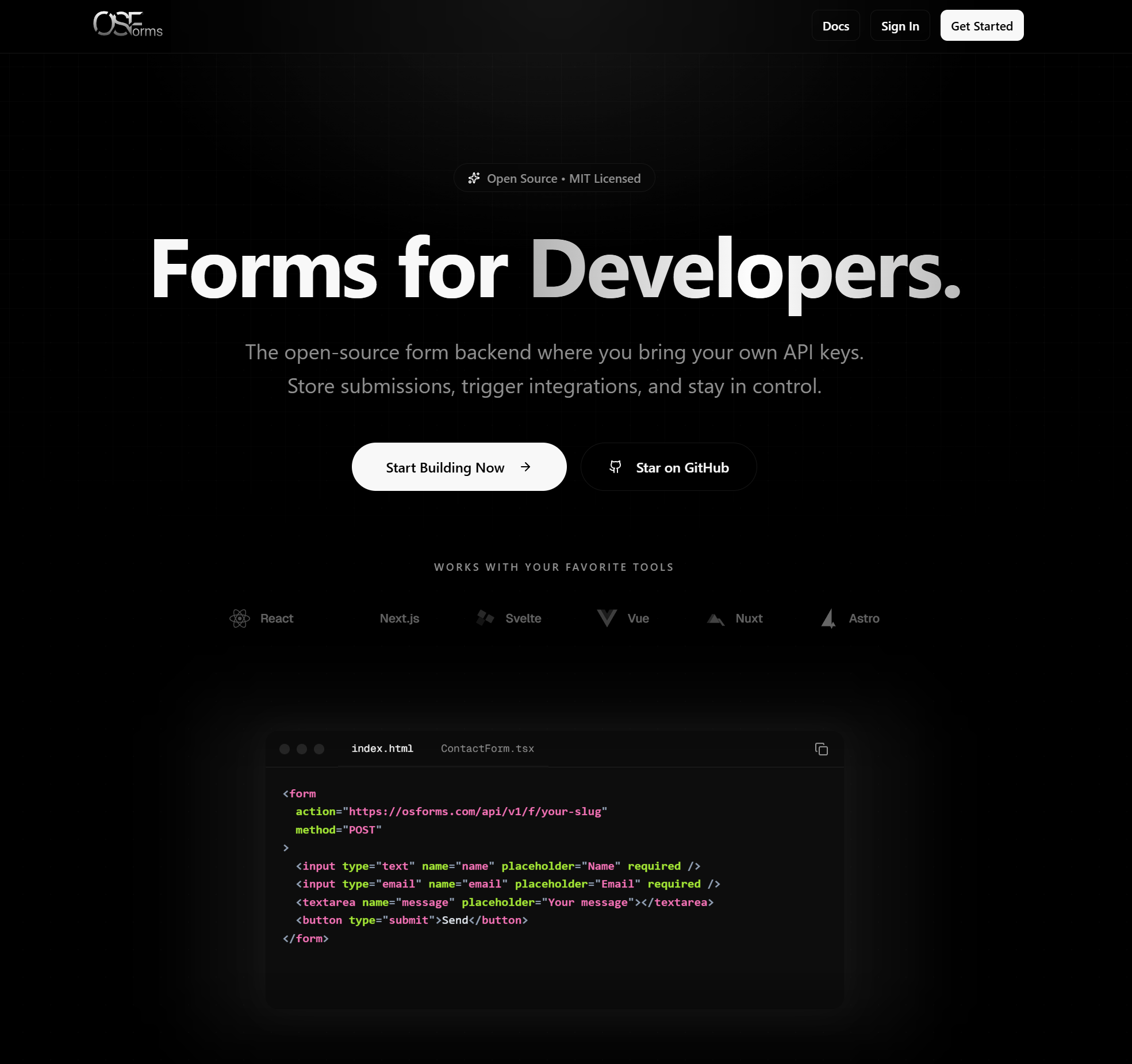
OSForms — open-source form backend with BYOK integrations
Form Backends Shouldn’t Have Paywalls
One of the most repeated parts of building a website is the form. Contact forms, lead captures, survey embeds, onboarding flows. Every project needs at least one, and somehow one of the most basic pieces of web infrastructure still comes with a paywall attached.
Tools like Formspree, Formsbold, and Basin offer hosted form backends. They handle submissions, route data, and connect to services like Google Sheets or email providers. On paper, the pitch is clean. In practice, the free tiers are razor thin.
Want to forward submissions to a Google Sheet? Paid plan. Need a custom email template when someone fills out your contact form? Paid plan. Hit more than a handful of submissions in a month? Paid plan. The integrations that should be table stakes are locked behind tiers that start reasonable and scale fast.
For freelancers and small agencies managing multiple client projects, this math breaks quickly. You’re either eating the cost across a dozen sites or duct-taping together custom backend logic from scratch for every single project. Neither option makes sense when you’re doing it for the fourth time in three months.
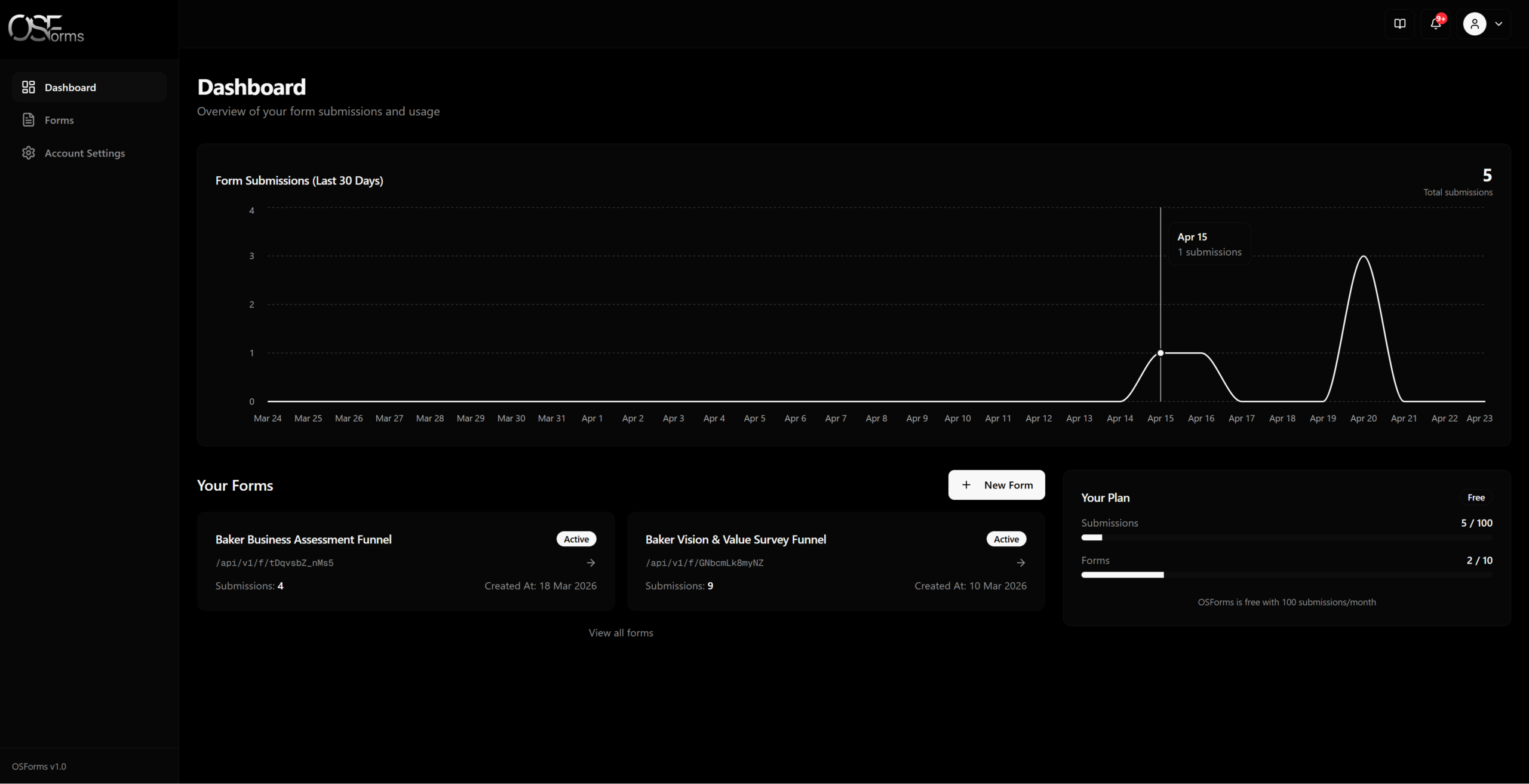
The OSForms dashboard — submissions, and usage in one place
Why Existing Form Tools Hit a Wall
The form backend space has plenty of options. None of them solve the ownership problem.
For a single project, these limitations are manageable. Across multiple projects for multiple clients, they compound into a real cost — in money, time, and fragility.
“OSForms didn’t begin as a public product. It started as an internal utility, rebuilt more than once across different projects before it made sense to generalize it.”
Bring Your Own Keys
OSForms flips the relationship between form tool and user. Instead of trusting a third-party platform to hold your integrations, manage your submission data, and dictate your limits, you bring the credentials. The platform orchestrates the connections.
You’re not limited by platform quotas. You’re not locked into a vendor’s email or storage. You’re routing your submissions through your own services, using your own API credentials. The platform handles the orchestration. You own everything else.
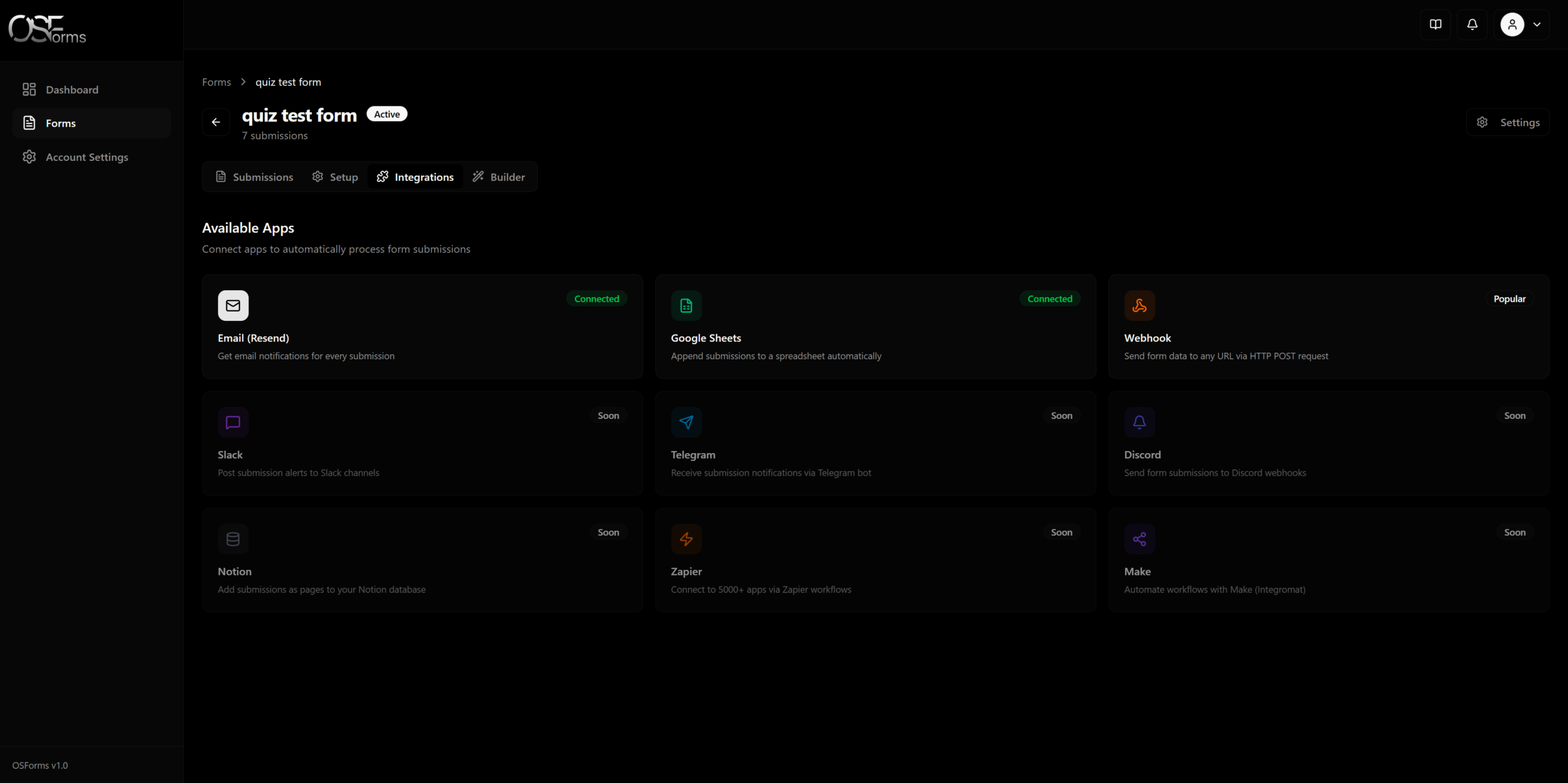
Connecting your own Resend key and Google Sheets takes under two minutes
What OSForms Does
Receives & Stores Submissions
Every form submission hits the OSForms backend, validates, and persists. No data lost in transit. Your submissions live in a database you can query and export.
Routes to Your Integrations
Connected to Resend for email and Google Sheets via OAuth. Submissions land where you need them, using credentials you control.
Logs Every Attempt
Every integration call is logged with pass/fail status. If a connection breaks, you know instantly. No black box routing or silent failures.
Conversational Form Renderer
A published React component on npm with classic and Typeform-style conversational modes. Drop in one component for a full form experience with keyboard navigation and progress tracking.
Beyond the core, OSForms handles CORS domain whitelisting, custom auto-reply templates powered by your own Resend key, and full self-hosting capability. The entire stack is open source.
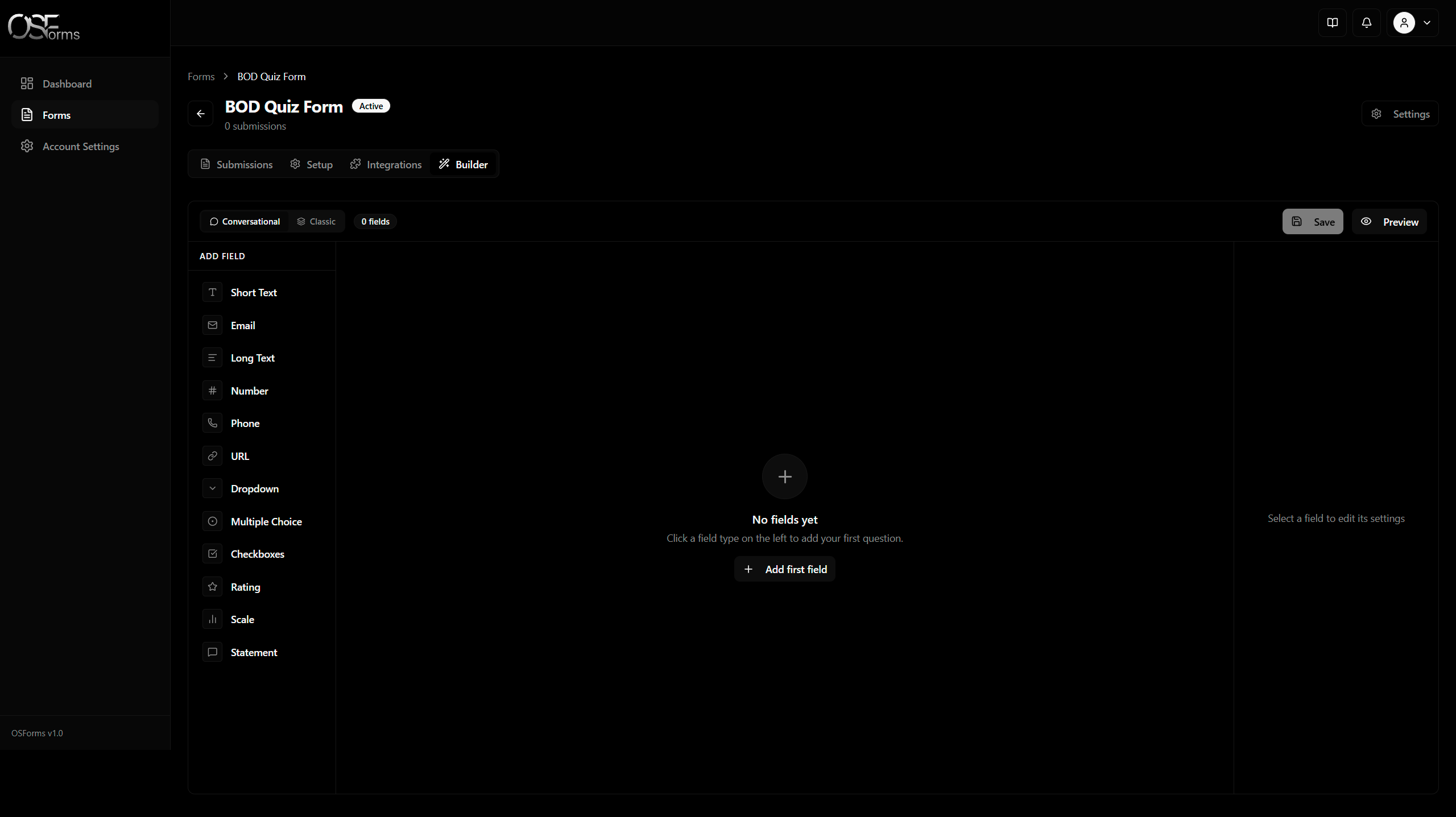
Classic mode for quick embeds. Conversational mode for guided experiences.
@osforms/react — plug-and-play form renderer for React projects. Classic and conversational modes included. Install, configure, ship.
From Internal Utility to Open Source Product
Every tool has an origin moment. For Bahroze, it wasn’t a startup idea or a market gap analysis. It was annoyance.
Working across multiple client projects, the same problem showed up again and again. Every new site needed a form backend. Every time, the options were identical: pay for a hosted tool that locked basic integrations behind a tier, or build the routing logic from scratch. Neither option made sense when you were doing it for the fourth time.
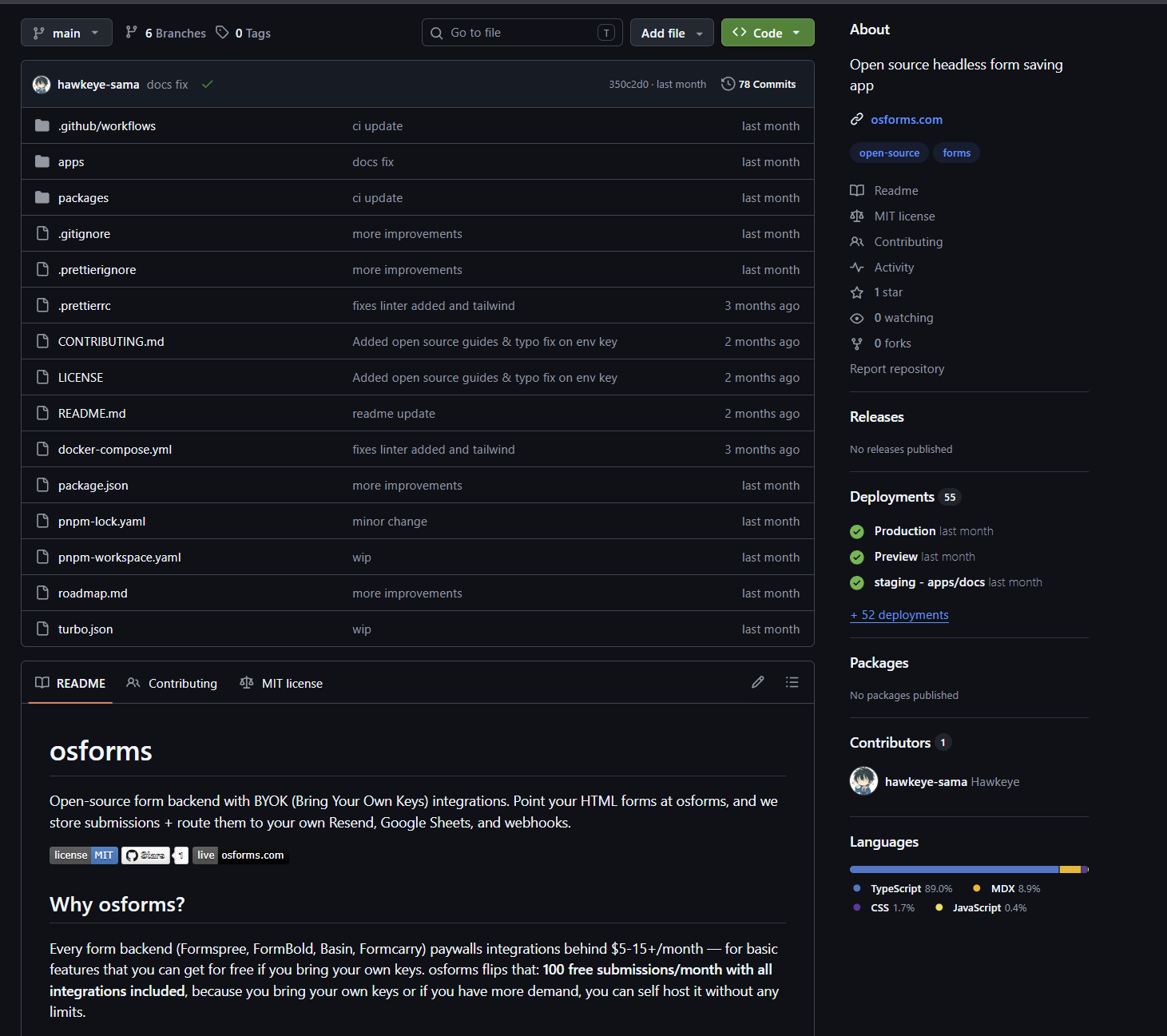
The repo has real commits, real features, and a published npm package
So the first version wasn’t OSForms at all. It was a quick internal utility — something to catch submissions, push them to a Google Sheet, and send a notification. No dashboard. No public interface. Just a functional backend that did the thing without asking for a credit card.
That version got rebuilt. Then rebuilt again. Each client project had slightly different needs — different email providers, different data destinations, different form structures. Each rebuild added a layer of flexibility that the previous version lacked. At some point, the question stopped being “do I build this again?” and became “why hasn’t someone generalized this properly?”
That was the moment OSForms became a product instead of a script.
The trap with developer tools is scope. When you’re building for other developers, the feature list can expand forever. Bahroze hit this early. A form builder interface. An AI integration layer. WordPress plugins. Customization dashboards. Every idea was reasonable on its own. Together, they were a recipe for shipping nothing.
Through Wander Labs, the discipline was in sequencing. Instead of building the full platform on day one, the focus stayed on the integration layer first: get Resend working with BYOK, get Google Sheets connected via OAuth, make the logging reliable. Everything else waited.
That focus is what separated OSForms from a side project that lives on GitHub with a single commit. The repo has real commits, real features, and a published npm package — because the scope stayed narrow long enough for the core to solidify.
What building OSForms taught applies to every builder, not just this project. Packaging decisions are product decisions — when you publish an npm package, you decide what the API surface looks like, what props the component accepts, what the default behavior is. These aren’t code questions. They’re product questions. Developer experience is user experience — building for developers who read documentation and evaluate trade-offs before installing anything forced thinking about onboarding, defaults, and the cost of configuration. Open source is a forcing function — the moment the repo went public, the code had to make sense to someone who wasn’t Bahroze. Variable names, folder structure, README quality — all of it suddenly mattered. And positioning matters even for free tools — a community member looked at the project description and said, “I don’t have time to read all this. Tell me what it is in short.” If a developer can’t understand what your tool does from the first line of your README, the code doesn’t matter yet.
Why OSForms Matters
Not every Wander Labs project is a commercial venture. Some are portfolio pieces. Some are tools built for an audience of one that turned out to be useful for more.
OSForms sits in a specific lane: a real tool, solving a real problem, with real users as the goal. It started as an internal fix and evolved into a publishable open-source product with a live hosted version, a React component library on npm, and an active development track.
From a technical standpoint, the project covers full-stack development with NextJS and NodeJS, database design with MongoDB, OAuth integration flows, npm package publishing and API surface design, and DevOps for a self-hostable open-source project. That’s a comprehensive stack demonstrated through a single, cohesive product.
From a product standpoint, OSForms represents clear positioning in a crowded space (BYOK as the differentiator), disciplined scope management (shipping core before expanding), and the judgment to know when an internal tool deserves to be generalized. These are the skills that matter whether someone is building their own products or working on someone else’s.
For Wander Labs, OSForms proves that structured accountability can turn a recurring frustration into a shipped product. Bahroze had rebuilt this logic across multiple client projects before Wander Labs. The program provided the deadline and the audience to finally generalize it, package it, and put it in front of people.
That combination — pressure without bureaucracy — is the design principle behind every Wander Labs project.
Build Something Real.
Most communities optimize for engagement — more members, more messages, more activity. Wander Labs optimizes for output. We’d rather have five people ship real products than fifty people post daily updates that lead nowhere.
1-on-1 Mentorship
Weekly or biweekly calls with the founder and mentor team. Real conversations about your project, not recorded workshops.
Public Case Study
Your project gets a dedicated page on The Wandering Pro — with backlinks to your portfolio, LinkedIn, and product.
Builder Network
Access to mentors and serious peers who’ve built, shipped, and scaled. Not lectures. Not theory. Working professionals.
Fewer people. Deeper work. Real outcomes.
More from Wander Labs
Open-source form backend with BYOK integrations. Bring your own API keys, own your data, never hit a paywall.
Discord CRM that converts free community members into paying subscribers with AI-powered conversations.
Identity-based habit tracker that focuses on who you’re becoming, not just what you’re checking off.