
So it’s finally time – the time everyone warned me about when I started writing coaching and mentoring content. The time to sell an Upwork course…
JK – but in all honesty, is it only me or are more people tired of Facebook Ads course spam?
Learn how to master Upwork. Make money in dollars. Stop being poor. Yaadi yaadi yaada.
Here’s the unfiltered truth: Freelancing on Upwork isn’t complex, but it certainly isn’t easy. It’s about consistency, strategy, and relentless improvement. Contrary to popular belief – and aggressive ads – there’s no secret formula, and no paid course can guarantee your success. Sure, some guidance can accelerate your progress, but let’s keep expectations real: there’s still a significant chance you might struggle initially.
So, why bother reading yet another guide? Because this isn’t a sales pitch – it’s a practical, honest perspective from someone who’s been in your shoes and successfully navigated the pitfalls and hurdles of Upwork, especially from the viewpoint of a freelancer based in regions like Pakistan, India, Nepal, or the Philippines.
In this guide, I’ll walk you through actionable steps, free resources, and critical insights you need to genuinely succeed – without breaking your bank on overpriced courses.
Let’s dive in.
Why Paid Courses Don’t Win You Upwork
In recent times, Upwork has officially become a ‘pay to win’ platform. Connects are too expensive, and you as a freelancer in Pakistan/India/Nepal/Philippines WILL have a harder time affording them compared to your western counterparts.
Coupled with the fact that most people interested in freelancing generally don’t consider that freelancing IS HARDER than a regular job – you need a lot of soft skills in addition to the skill you are selling to be successful.
Lastly, as a new account, your first job is easily 50 proposals out for most. At the average rate of 16 connects (yeah that’s what the good jobs cost, ignore the cheaper ones) – you are looking to spend 800 connects just to land your first gig. And if you are wondering, 800 connects are for 120$ or about 33,000 PKR at the current rate.
Silver lining, if there is one, this has actually resulted in a significant reduction in spam applications in my experience.
Yes, it is still easier for people with money and connects lying around to beat you. But as a new freelancer, you will generally have less competition on smaller jobs. Which should be the goal to get your foot in the door. More on that later.
Why Listen to Me?
As someone who went from 0 to top rated plus in just 18 months and with only 4 clients (quality matters, don’t be misled with quantity) – I know a thing or two about succeeding on the platform.
Over the past few years, I have been active in freelancing communities helping the next gen of freelancers. Having this opportunity led me to curate the most commonly asked questions and clear doubts. That is what this masterclass is for.
If this does well, I might actually create an end to end Upwork course ‘For Free’ – Upwork is already expensive as it is, you shouldn’t be paying more to learn what’s available already.
That being said, let’s get into it – first I will provide some basic study material for anyone fresh to Upwork – once you’ve been through it, consider the discussions posted on this article for specific queries most freelancers have these days.
P.S This article is from the perspective of a Pakistani Upworker – that is an important distinction to make. Some practices shared here won’t apply to you as someone not living in a low income region. And if you are living in Pakistan, Philippines, India, etc – good news! This will perhaps be the only well laid out article you find written for your perspective.
Best Resources to Get Started with Upwork
Below are free resources available for you to get started with Upwork and freelancing in general. No payment or course required.
Create a bookmark folder, bookmark everything here, visit every day to absorb some.
1 – Upwork Learning Hub
It’s funny how most paid courses are half filled with content from here:
https://support.upwork.com/hc/en-us/articles/35199491222803-Learning-Hub
Yeah, it’s available for free, for anyone. If you are just starting out, I would recommend picking the basics learning path and completing it.
Not only will you learn everything you need to know to get started in a clear manner.
2 – I hate reading, I wanna watch videos
Well, you won’t get far then, but here are my 2 top picks:
https://www.youtube.com/c/JoshBurnsTech
And
https://www.youtube.com/c/FreelanceMVP
I would HIGHLY suggest to only watch them once you have landed a gig. They are hyper successful freelancers and are based in the west, some of the things they share WILL NOT apply to you – simple as that. But besides that, their content and general advice is pretty solid.
But back to what I said above, get comfortable reading and writing if you wanna succeed as a freelancer – that’s like 40% of the job.
3 – Community and like-minded people
Freelancing is isolating enough without doing it alone. If you’re looking for a community of freelancers, builders, and early-career professionals who are in the same boat as you, come check out The Wandering Pro. Born and bred in Pakistan, built for people who are actually doing the work, not just talking about it.
4 – It’s me, it was me all along, I also want to help you
I wish I had unlimited time, but it is marching towards our inevitable death (wink wink).
When I can though, I really want to put in the effort to share mentoring content with fellow Pakistanis. If you would like me to answer anything specific feel free to leave a comment below.
Currently, I try my best to share any knowledge I have via blogs on the Arc Career Blog.
And am running career oriented workshops in our Blueprint series.
And then also creating helpful resources for professionals, freelancers, and small businesses.
With that taken care of, let’s get into the guide.
Learn How to Search for Jobs on Upwork
Your connects are valuable, and you must learn how to optimize your job hunt. Almost never apply to jobs that show up on the feed, the system almost seems to be designed to waste your connects on jobs that don’t matter mostly.
Learn to customize your search for your gig, see the image below on what that looks like:
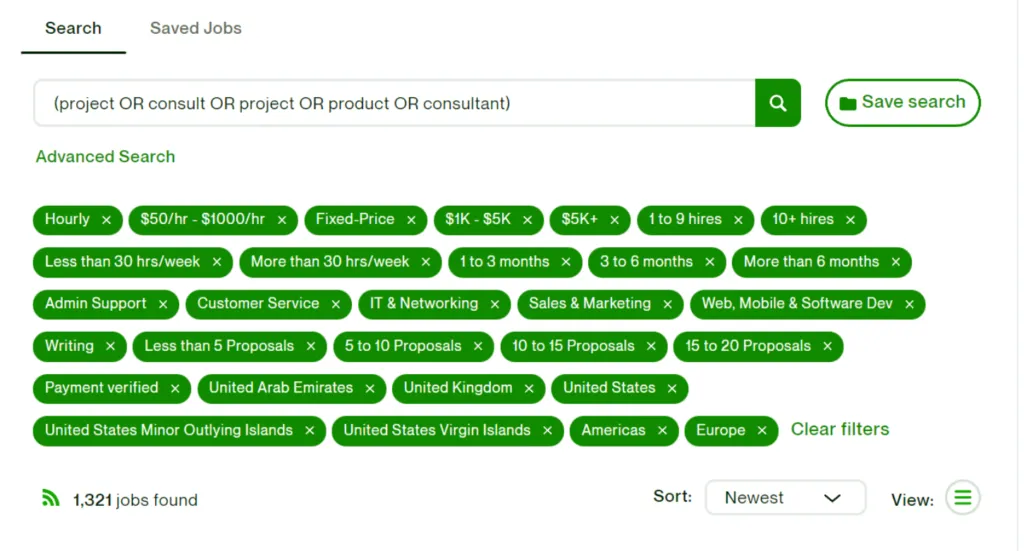
Here is what I want you to do to begin with:
1 – Search for the basic keyword for your gig, let’s say you do copywriting, we will use that.
https://www.upwork.com/nx/search/jobs/?q=copywriter
Without any filters you will be looking at around 5k+ jobs. Can’t pick between 2 Netflix shows, let alone 5,000 jobs to apply.
2 – Now you will need to do this from the filters sidebar:
- Select a category if it is well defined in Upwork, otherwise skip it.
- Pick Intermediate and Expert (Entry Level ONLY if you have 0 real world work experience)
- If you’re new check all the fixed pricing boxes from 100 to 1K, if you’re not new, pick to max, uncheck the ‘Less Than 100$’ box
- Do the same thing with your min and max hourly rate, I recommend a minimum of 10 USD/hr (more on that later) and a maximum of 50 USD/hr (because this is Pakistan, not the US, remember that)
- For the number of proposals, pick all the options except 15 to 50.
- Payment MUST be verified for the hiring party, check the box.
- Keep the no hires unchecked and the remaining checked in Client History.
The rest of the filters don’t matter much in my experience.
Once done you should have something like:
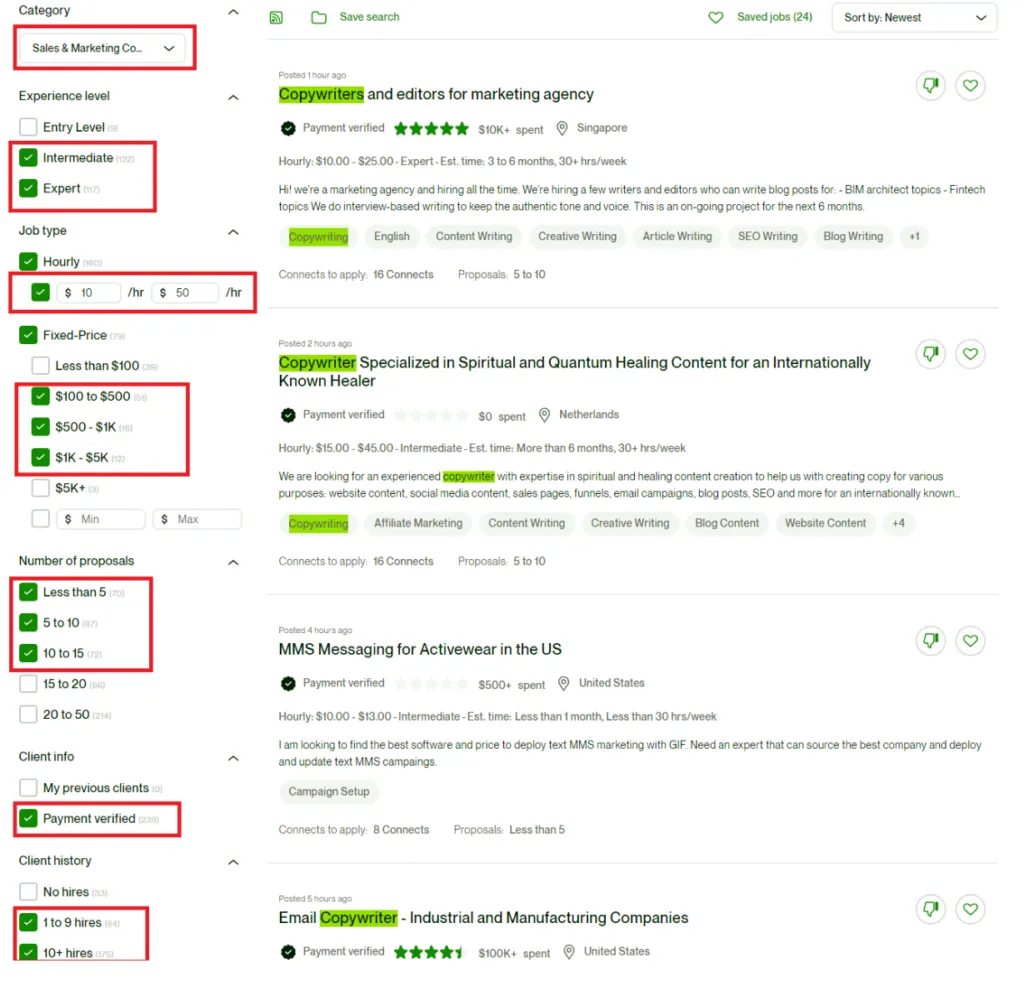
We went from 5,000 Jobs to 250 jobs – much more manageable.
But wait, this isn’t over yet.
From here on out is where your actual research starts, you need to apply only to jobs that meet the following criteria:
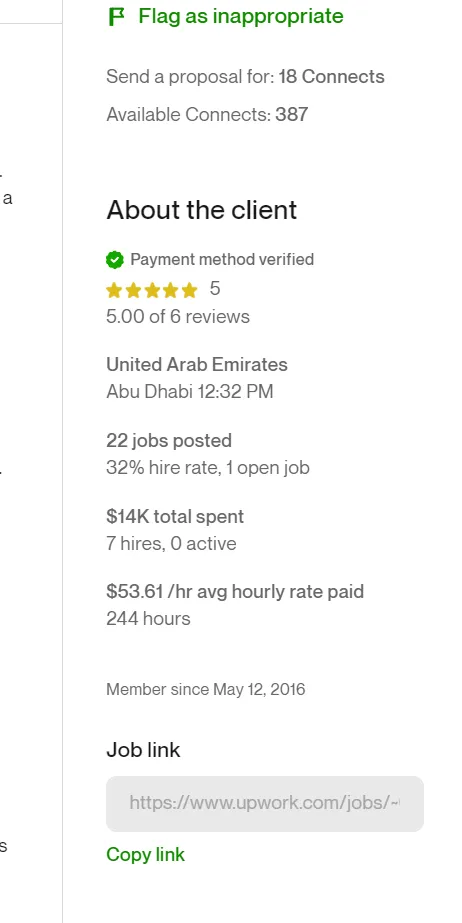
Client criteria to look for on Upwork
- The client has good reviews
- The client’s past hourly rate average matches your demands
- The client has successfully completed contracts in the past
- The job has a well laid out job description
- The client has good hiring ratio – if someone has 500 jobs open and only 5% hire rate, don’t waste your time
- The client has decent spending history
- Don’t waste effort on a job that asks too many questions, usually not worth the time
- Lastly, don’t fall for scam posts – Yes, they happen, keep an eye out for something too good to be true.
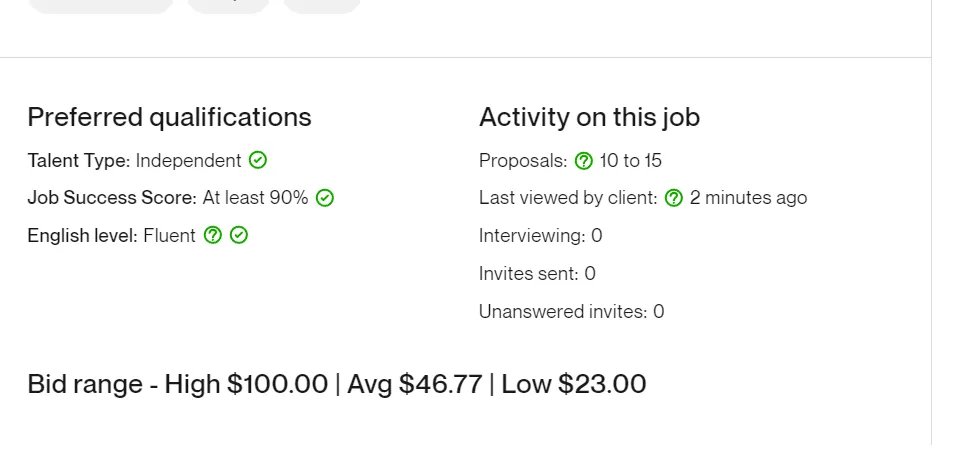
One way to make sure a job is active is to check for ‘Last Viewed By Client’ under the Activity on this job.
If you open any job you will see most of this here on the sidebar:
If you scroll to the bottom you can view this:
And with that, now you know everything about searching for jobs at a beginner level. There are some advanced intuitions you will build over time, but for now, this should be more than enough.
Understand Your Upwork Proposals
So you learned how to search for jobs, time to apply to some. Now I will spare the cover letter templates and the formula for writing the best proposal – because that you will have to learn over time. And you will learn, there is no one right formula – hence templates are pretty pointless since understanding the job post matters more.
However, you can refer to the resources shared above for a basic idea on how to compose a cover letter though. One tip I can give you is to first learn to write lengthy, then worry about filtering and cutting down things. Don’t stop at writing 150 word cover letters.
What I will share here are some crucial details you need to understand when applying to jobs.
The detail being this:
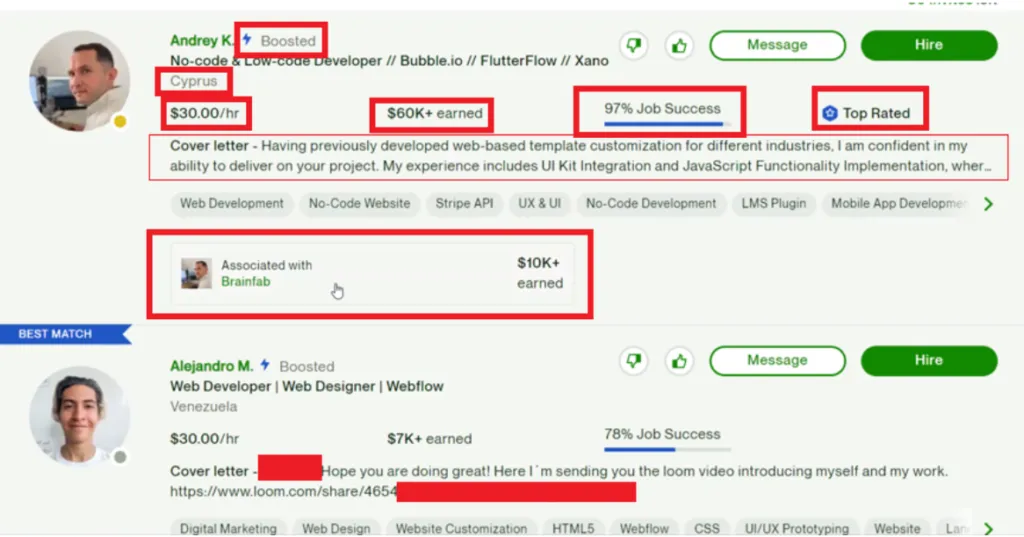
The screening section of the employer/client.
I have highlighted some key things you as a freelancer need to understand in the attached image, let’s dive in:
Location, Hourly rate, Earnings, JSS Score, and Badges:
These 5 things will have the highest impact on your proposal’s strength, especially when applying to people who understand Upwork and have hired a lot on Upwork. They can instantly gauge a candidate’s ability just by viewing these numbers and associating them with their skill level.
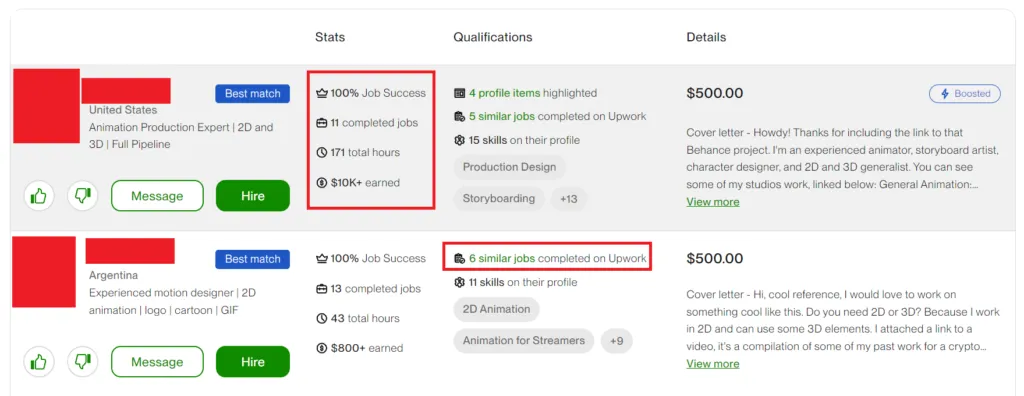
Update: As you can see in the new design, there seems to be more focus on ‘Similar Jobs’ now. A new stat you might want to keep in mind while applying.
Things for you to keep in mind for Upwork job applications
- Always maintain a 90+% JSS, anything below basically means you are no longer viable to scale on the platform as a freelancer. You can learn more about what affects your JSS here: https://support.upwork.com/hc/en-us/articles/211068358-Job-Success-Score
- Badges do matter, especially once you get Top Rated, you will see that your view rate has increased from when you didn’t have one. On average to get Top Rated, you need to be working for around a year, 4-5 jobs, around 2-5k USD earnings depending on industry and kind of work.
- The earned amount shows your seniority on the platform. A big number means either you have worked for very long on Upwork, or you have done really high value work – or a combination of both.
- If you are associated with an Agency, YOU WILL show up as an association. Be mindful of that when applying to jobs that say no to agencies, don’t waste your connects.
- Lastly, the most painful one for us, location and hourly rate – you WILL be judged on your rate and your location, that’s just the game – no way around it. People are looking to hire freelancers primarily to save costs, BUT at the same time they want quality work also. For newbies in most fields I recommend aiming a 10-15/20$ p.h rate – going for 30+ once you are top rated at least.
Again this is an average across fields, to learn more about your skillset’s going rate, just google the role + Upwork and you will land on a page like this: study this page, https://www.upwork.com/hire/front-end-developers/pk/ and get inspiration.
Lastly, as a new freelancer, you might not have the credentials above, so for you folks, this is the most important detail:
As you can see – the first 2 lines are what is first and foremost apparent to the employer – make good use of it, attach a video or use hooks to get the person to click on your proposal. Don’t waste paragraphs saying hi and hello, get to the point – state the problem and the solution leading to learn more about why you should get hired.
The 50/10/4 Rule: Understanding Your Proposal Funnel
This is one of the most common questions we get in our community: “How many proposals should I send before I start worrying?”
Here is the ratio you should be tracking, based on the current Upwork landscape with expensive connects and high competition:
For every 50 proposals you send in a 1-3 month period, you should aim for at least 10 views and around 3-4 interviews.
That’s the 50/10/4 rule.
If you’re hitting those numbers and still not closing, the problem isn’t your proposals. It’s what happens after the client messages you. Either you don’t know how to close, or you don’t know how to negotiate well. More on that in the next section.
If your views are low but your proposal count is high, the problem is likely your search. You’re applying to the wrong jobs. Go back to the search section above and tighten your filters.
If your views are decent but interviews are low, your proposal is the problem. The hook isn’t working, the first two lines aren’t compelling enough, or you’re not attaching relevant portfolio items.
Here is how a proposal can go once submitted. There are really only 4 outcomes:
- They go with you. Best case.
- They go with someone else. It happens. Move on.
- They ghost you. They ghost everyone. The job dies.
- They lost interest. Budget changed, priorities shifted, internal hire happened.
You cannot control outcomes 2 through 4. What you can control is making sure your search, your proposal, and your follow-up are as tight as possible.
One more thing. This ratio will vary by category. If you’re in a field with less competition, your numbers will be better. If you’re competing with thousands of developers, it will be worse. But 50/10/4 is the baseline to measure yourself against.
Track your numbers. If you’re not tracking, you’re guessing. And guessing doesn’t scale.
Every toolkit, template, and guide we build is accessible to anyone. If they helped you land a client, pass an interview, or ship a project, consider paying it forward so we can keep building more.
Your First Client Call: How to Not Blow It
So your proposal got viewed, the client messaged you, and now there’s a call scheduled. This is where most Pakistani freelancers lose the job.
Not because they lack the skill. Because they lack the preparation.
Here is the biggest issue I’ve seen across hundreds of freelancers in our community: people show up to client calls with no idea what to say or when to say it. They wing it. They ramble. They say “yes” to everything. And then they wonder why the contract never materializes.
Prepare before the call. Every single time.
This is non-negotiable. Take 30 minutes before the call and do the following:
- Re-read the job post. Highlight the key deliverables, pain points, and any specific language the client used.
- Write down 4-5 questions you want to ask the client. Not generic questions like “what’s your budget?” but specific ones that show you’ve done your homework.
- Open 2-3 reference items on your screen. Past work, portfolio pieces, case studies. Things you can screen share during the call if needed.
- Have your intro ready. Not a 5-minute autobiography. A 30-second elevator pitch: who you are, what you do, and why you’re relevant to this specific project.
On the call itself:
Let the client talk first. Most clients will spend the first few minutes explaining what they need, venting about past freelancers, or walking you through their vision. Let them. Listen actively. Take notes.
When it’s your turn, lead with what you understood from the job post and the conversation. “Based on what you’ve described, it sounds like the core challenge is X. Here’s how I’d approach it.” This alone puts you ahead of 80% of applicants who just list their skills.
Don’t say yes to everything. This is the fastest way to set yourself up for failure. If the scope is unclear, say so. If you need more information, ask. Clients respect freelancers who push back professionally. It shows confidence and expertise.
End with a clear next step. Don’t let the call end with a vague “I’ll send you something.” Be specific: “I’ll send over a brief scope outline by tomorrow with a proposed timeline and pricing structure.” That’s a CTA. That’s how you close.
One more thing on empathy: If a client is frustrated from a bad past experience with another freelancer, don’t badmouth the previous person. Just empathize. “I understand that must have been frustrating. Here’s how I’d make sure that doesn’t happen on this project.” That builds trust faster than any portfolio item.
Hourly VS Fixed Contracts on Upwork
First of all, I would urge everyone to watch this full session by the legendary Chris Do on pricing models. Just go to YouTube and type “Chris Do Pricing” and watch the whiteboard workshop. He explains it better than anyone.
Generally speaking, I am biased towards fixed contracts. They are riskier as more of your payments are tied up in milestones, and they are also slower to pay out sometimes, since you have to remind the client to process them. And they are harder to land as well on platforms like Upwork.
BUT
They ensure a higher quality of work and less burnout for you as a freelancer. And that is no small benefit.
Going with an hourly rate
See the thing is, on Upwork when you land an hourly contract, you get labeled as that rate. Let’s say you are a new freelancer who charged 5 USD/hr a gig, good luck, now forever your average will be hit by that number making it almost impossible to drastically grow out of it.
This issue in particular is more of a problem for us in low income regions where the ‘I will do it for cheap’ mentality runs rampant and causes hundreds to burn out and quit freelancing.
Here’s the deeper problem with hourly that most people don’t think about: imagine you’re a developer who used to take 20 days to make a website. With experience, you can now do it in 5 days. Under an hourly model, your reward for getting better at your job is literally getting paid less. You’re being taxed for being efficient. And then you have two options: take on more clients (which means 4x the operational overhead of calls, documentation, and project management) or raise your rate (which clients resist because they’re anchored to your history).
So my advice is, if you are doing hourly billing, stick to a minimum of 10 USD/hr, because growing from that to the average of 20 USD/hr (low income area average rate) is much easier than from 5 or 3.
For Pakistani freelancers the upper limit I have found after studying a 1000+ profiles is around 35 USD/hour on average. You can do the same by hunting through all the available profiles in the talent search.
Going with fixed price contracts
Hey Saqib, I totally understand your point on counting hours and getting burnt out. What do I do as a new freelancer to get fixed price contracts then?
For new freelancers what I recommend is to get your foot in the door.
Do a small engagement first with a client, for a fixed price. Clearly lay out what the deliverables will be of the engagement and that you will consider further working after it is over and reviews are completed.
Also be transparent that you will do the said engagement at a lower price because you want to get traction on Upwork and want to show the quality of work you can put in as a new freelancer.
And there you go, you get your foot in the door and then it all depends on your skills from there onwards. If you did your homework, applied to verified clients with a good history, chances are that if you do good work for them, you can negotiate a much better plan.
How to sell fixed price to a client who wants hourly:
You can explain it simply: “Hourly logging hurts my productivity. You’re penalizing me for being efficient. If you want the work done faster and at a higher quality, pay me for the outcome, not the hours.” Clients who understand this will respect it. Clients who don’t may not be the right fit long term.
If the client insists on hourly to start, that’s fine. Do 10-20 hours with them to build trust. Then once they’ve seen your work quality, propose converting to a fixed-price arrangement. This is exactly how most successful long-term freelancers operate.
All this said though, there are some roles that are stigmatized by hourly rate, such as dev work. Clients will usually not agree to fixed pricing on such roles. In that case, go with the hourly, but as mentioned earlier, stick to a base minimum of 10 USD/hr – anything below that is digging your eventual grave.
The Milestone Structure: How to Split Fixed Price Contracts
This is the section most freelancers skip and then regret later. If you’re going fixed price, you need to understand how to structure your milestones so you don’t end up doing all the work and waiting months for payment.
Here’s the framework I recommend:
Milestone 1 – Kickoff (10-20% of total): This is released when the project starts. It covers your initial setup, discovery, or onboarding time. It signals commitment from both sides.
Milestone 2 – Major Deliverable (40% of total): This is tied to a significant piece of work being completed. A first draft, a working prototype, a design system, whatever the core deliverable is.
Milestone 3 – Final Delivery (remaining 20-40%): Released on completion, revisions done, handoff complete.
The golden rule: Your total costs (including your time/labor) should be covered by the first two milestones. If the client disappears after milestone 2, you should be at zero loss. Milestone 3 is your profit.
Never, ever structure a contract where 100% of payment happens at the end. You will get burned. It’s not a question of if, it’s when.
Also, request reviews at the end of each milestone. On Upwork, you can request a review every 30 days. If the project is going well, the client will give you 5 stars at each checkpoint. If something goes sideways later, you already have positive reviews locked in from the earlier milestones.
Upselling Existing Clients: The Smartest Growth Hack
This is something I see freelancers ignore constantly, and it blows my mind.
If you already have 3-4 happy clients, your priority should always be to upsell those clients before going out and hunting for new ones. It’s 2-3x easier to get more work from someone who already trusts you than to convince a stranger to hire you.
Here’s a framework for doing it right.
Step 1: Identify the gaps. While doing your current work for a client, pay attention. What problems are they facing that nobody is solving? Maybe their website copy is weak. Maybe their onboarding emails don’t exist. Maybe they have no documentation for their processes. You’ll notice these things if you’re paying attention.
Step 2: Front-load the value. Don’t pitch a new service cold. Instead, go to your client and say: “I noticed you’re having an issue with X. I’d like to take a crack at it for the next 2 weeks at no extra charge. If you like what I deliver, we can discuss a proper arrangement. And this won’t affect my current work for you.”
This is the same approach as a free trial on a SaaS product. You’re removing all risk from the client’s decision. If they like it, you get more work at a better rate. If they don’t, no harm done.
Step 3: Position the upsell as value, not discount. There are two ways to provide more value than your competition. Either you do the same work for a lower price (the Pakistani default, and it’s a race to the bottom). Or you do more work for the same price. Extra services, extra attention, extra goodies. The second approach is always better long term because it builds your reputation as someone who over-delivers, not someone who undercharges.
For example, instead of building a website for $1850 and competing on price, you build the website for $1850 AND set up their social media profiles, connect their CRM, and include 3 months of free maintenance. Same price, 5x the value. Every smart client will choose that.
Niching Down: Why Generalists Lose on Upwork
This is a topic we’ve covered extensively in our workshops and it keeps coming up because people resist it.
If you are a web developer and your pitch is “I develop websites,” you will never stand out. A lot of other people develop websites. Your competition is enormous and your only differentiator becomes price. And competing on price as a Pakistani freelancer is a game with one ending: burnout.
Here’s what niching down actually looks like:
Level 1 (General): I am a web developer. Level 2 (Slightly Niched): I build e-commerce websites using WordPress and Shopify. Level 3 (Properly Niched): I build e-commerce websites for fashion brands, specializing in high-conversion product pages and integration with inventory management tools.
At Level 3, when a fashion brand posts a job for an e-commerce developer, your proposal doesn’t just look relevant. It looks like it was written specifically for them. Because it was.
Same thing for a writer. Don’t just say “I am a copywriter.” Say “I write landing page copy for early-stage SaaS companies, specializing in value propositions and conversion optimization.” Now when a SaaS founder sees your proposal, they immediately think “this person understands my world.”
The rule of thumb: the higher the competition for your skillset, the more you need to niche down. If you’re a product manager on Upwork, the competition is naturally low, so you can afford to be broader. But if you’re a graphic designer, writer, or developer, you need to go deep.
And niching down doesn’t mean you turn away all other work. It means your front page, your profile, your proposals, and your positioning all speak to one specific audience. Behind the door, once you’ve won the client, you can always upsell additional services (see previous section).
Have your intro ready. A good niche-based intro sounds like this: “Hi, I’m [name]. I’m a graphic designer that primarily works with clients on LinkedIn. My specialty includes content design for people who post about complex ideas. I love turning hard-to-digest information into clean, shareable infographics.” That’s specific. That’s memorable. That gets you hired.
Using AI for Proposals: The Right Way
Let’s address the elephant in the room. GPT happened. And now everyone is writing 25-paragraph proposals with it.
Here’s the problem: Upwork clients can tell. They’ve seen hundreds of AI-written proposals at this point. They all sound the same. They all start with “I am excited to apply for this opportunity.” They all end with “I look forward to collaborating with you.”
AI-generated proposals killed the old spam problem and created a new one: a wall of polished, soulless text that says nothing specific about the actual job.
Here is how to use AI the right way:
DO use AI to:
- Research the client’s company before writing your proposal
- Help you brainstorm hooks tailored to the job description
- Clean up grammar and readability on YOUR draft
- Generate different versions of your achievement blocks and portfolio summaries
DO NOT use AI to:
- Write the entire proposal from scratch
- Generate your hook (the first 2-3 lines need to be custom and human)
- Replace portfolio items or specific project references
- Write the same proposal for 50 different jobs
The proposals that win are the ones that feel tailored. The first two lines need to show you actually read the job post. The middle should demonstrate you understand the problem. The end should have a clear CTA. AI can help you polish, but it cannot replace genuine understanding of the client’s needs.
And here’s the irony: since everyone started using GPT for proposals, portfolio items matter MORE than ever before. Clients can’t easily fake those. A well-documented case study, a video walkthrough, or a before/after of real work you’ve done, that’s what separates you now. It wasn’t always this important. GPT made it important.
Optimizing Your Upwork Profile
Unlike on platforms like Fiverr (more on that later), your profile does not matter that much on Upwork. Profile views rarely translate to hires as a new freelancer so you shouldn’t really worry too much about it.
That been said though, if you have free time, I highly recommend working on the following items whenever possible:
1 – Having the necessary profiles
Note: Specialized profiles are going away soon, so maybe don’t pay too much attention to this section.
On Upwork you have a ‘general profile’ being your default when you sign up your account, BUT you can set up two additional profiles.
I highly suggest making use of this feature to cover more ground with keywords and your offering.
DO NOT copy and paste the same description on all three, cater to different audiences or different content depending on what you want to achieve.
You can do it in 2 ways:
Either – add variations of what you offer as profiles, for example:
- Copywriting can be your main profile
- Article writing can be your secondary
- SEO content writing can be your tertiary
Or you can have different verticals of work you can provide as your profile, for example:
- Web development using WordPress, Webflow, Shopify
- App development, using React, Swift, Kotlin
- UX design using Figma, Adobe XD, etc
Article on how to set up profiles: https://support.upwork.com/hc/en-us/articles/115013750068-Create-a-Specialized-Profile
2 – Working on ready to use blocks for cover letter
I NEVER recommend using a repeat template for your hook, your introduction, and the tailored content in your proposals. Keep experimenting and updating these three things.
But oftentimes, overtime, you will notice that a lot of job posts ask for similar details, like project history, or what tools you use, or any work history. For those parts, you can have go to templates.
Don’t SPAM these in every job, only when asked, and only when they are relevant to the job.
So an effective way to work on these is to have blocks ready to integrate into your tailored proposals as you are applying to jobs. Create a living doc and have ready to use blocks where needed as needed, some examples below:
What is in my Toolkit Block
[IMAGE: Toolkit Block]
Project Management Tools – Jira, Monday, Confluence, Basecamp 2/3, ClickUp, & Trello
Content Marketing and Strategy
SEO & Keyword Research (Search Console & Google Analytics)
Computer Repairs (Apple Certified Macintosh Technician)
Stocking, Pricing & Finances (FileMaker Pro)
Import & Export documentation (PK Specific)
Business Documentation (MS Office and Google Workspace)
Business Development (Corporate Tenders, Sales Prospecting, & Billing)
No-Code Web Dev & Content Management (WordPress & Wix)
CRM (Zendesk, Zoho, & SalesForce)
Corporate Communication (Slack, Gmail, & Zoom)
Live Streaming (OBS & Streamlabs)
Design (Animoto & Canva)
UI/UX (Miro & Figma)
Web Hosting Management (GoDaddy, BlueHost, & Hover)
Achievements Block
Some numbers to remember me by:
[IMAGE: Achievements Block]
Revamped the lead-to-launch process for 2 Development Agencies, resulting in a 30% increase in revenue.
Implemented a new quote estimation tool that reduced sales lag by 20% and improved lead conversion by 35%.
Streamlined the Help Centre to reduce the load on support calls and tickets by 30%.
Developed and implemented a marketing strategy that led to a 50% increase in organic leads.
Ensured 90%+ satisfaction among enterprise clients.
Consistently generated over $100K in revenue per quarter through upselling additional projects to existing clients.
Introduced a robust reporting mechanism that helped the company expand its organizational structure by 50%.
Improved the onboarding process to ensure rapid team growth and increased retention rate by 10% during probation periods.
Reduced ticket resolution time by 30% by automating manual processes on the IT help desk.
Boosted the company’s local presence by earning over 300 5-star reviews on Google Maps/My Business in 2 years.
Cut IT inventory costs by 20% by forecasting customer demand based on market trends and new product launches.
Client Reviews Block
Words to remember me by:
Custom Web Development Agency – 5 Star Review
I run a Web Design and Development Agency based out of the US. Saqib was crucial in helping my Agency grow and scale. We did over $300K in sales in 2022 and Saqib was a big part of it. He was a versatile team member who made significant contributions in being the product manager/strategist for enterprise clients, and helped build out repeatable and scalable processes at the same time…….
Matrix Marketing Dev Enterprise – 5 Star Review
Every winning team has a “Most Valuable Player”, and Saqib is that MVP. Leaving a job in his hands means forgetting to worry about its success – you will have the certainty that Saqib will do his best to deliver the best results. The problem and the solution are always viewed from a 360 degree perspective by him. His conviction will always be able to take you to the next level!
Mobile App Development Enterprise – 5 Star Review
Saqib is a very unique mix of talent and expertise. As a Business Owner I need people who can adapt to any task at hand – his versatile experience as a Product Manager sets him apart.
Projects Work History Block
Here is a summary of projects I have worked on that I will be more than happy to discuss in detail over a call.
Project: Custom CRM with EMR functionality Key Integrations/Tech: Django/Next.JS, GCP, SalesForce, Pathify, Jotform, HIPAA Compliance
Project: Healthcare Service Platform Key Integrations/Tech: Custom WordPress implementation, Dedicated Healthcare/Community/Admin panels, Complex Gravity Form integration
Project: Parcel Delivery Platform Key Integrations/Tech: Custom Quote Calculation based on Geofenced data, supported multiple delivery types (A to B, Wait and Drop, Multipoint Dropoffs) Mapbox API Integration, Gravity Form integration for quotations, Stripe auto invoicing integration
Project: Talent Show Platform Key Integrations/Tech: Custom Angular-based WebApp, Multi account setup for families of exhibitors, Show series setup for hosts, Intricate point system and payout calculation, Live attendance management
Project: Itinerary Marketplace Key Integrations/Tech: Custom React-based WebApp, Strapi open source backend integration for CMS, marketplace setup for buyers/sellers/admin, filtering and categorization algorithms
Project: eCommerce App Key Integrations/Tech: Native iOS App, Native Android App, Store Management Platform, Split and Multi Payment Options
Project: QSR Front End Revamp Project Key Integrations/Tech: OLO Online Ordering System, Punchh Reward Points System, WPEngine, AWS, Azure, React
Project: QSR Mobile App Key Integrations/Tech: Revel POS System, iOS Native App, Android Native App, WorldPay Payments
Project: Food Delivery Aggregator Platform Key Integrations/Tech: Native iOS App, Native Android App, React Native Restaurant App, Custom Rewards and Loyalty Program, e-Currency Implementation, Marketplace Payment Setup
Project: HIPAA Compliant Telehealth Certification Service Key Integrations/Tech: HIPAA Telehealth Function, Payments Marketplace, Encrypted Data Sharing, Scheduling Tool, Pre and Post Payments
3 – Recording videos, day in, day out
A picture is worth a thousand words but a video tells the whole story. The best way to show off your confidence and communication skills is via videos.
In your free time, record them. Just record anything. If you struggle with communication I would highly suggest to look into: https://www.youtube.com/@askvinh
Have a video intro on your Upwork profile, and for the jobs you REALLY want, have a structure ready to create one fast.
Typically speaking, you should open up 3-5 reference items on screen share, and record a video explaining them in context of the job post ending with a CTA (call to action).
4 – Working on your portfolio items
Upwork has a really nice system to show off portfolio items. But the NUMBER ONE mistake most freelancers make is that they just slap on some image and call it a day – DO NOT DO THAT.
People can Google images if they wanted to, explain your process, and dive deep into the work that went behind your work. Learn to build case studies for your portfolio. Show results, show process, show the thinking behind the work.
5 – Keep working on writing better hooks and CTAs
Hooks and CTAs are key to winning proposals.
The hook gets clients into your proposal, and the CTA leaves them acting on your request.
Learn to write better hooks and CTAs tailored to the job post. Have at least 10-20 hooks and CTAs ready to go at all times when applying for jobs:
https://www.upwork.com/resources/call-to-action-examples
When Upwork Stops Being Enough
This is the section nobody talks about in Upwork guides, because most guides are written to sell you on the platform. But the truth is that Upwork has a ceiling, and if you’re serious about building a freelancing career, you need to think about what comes after.
Upwork isn’t dead. It’s not a scam. It’s just not a gold rush anymore. It’s a functioning economy, and that means you need a strategy beyond “apply to more jobs.”
What makes Upwork harder now:
More freelancers are joining every month. Clients are savvier and more selective. The algorithm favors consistent performance and history. Connects are expensive. The “I’ll do it for cheap” crowd from low-income regions makes it a race to the bottom in many categories.
But here’s what most people miss: it also pays out more than ever. Clients are spending more on complex, long-term work. Niche specialists are winning high-ticket deals. Some freelancers are quietly building 6-figure funnels through Upwork alone.
So the issue isn’t the platform. It’s whether you’re using it as a crutch or as a launchpad.
Here’s what to build alongside Upwork:
Referral Network: The best source of work isn’t the Upwork job feed. It’s your last happy client. After every successful project, ask: “Do you know anyone else who might need help like this?” Turn completed work into short case studies you can share.
Personal Website: We’ve written extensively about this in our resources. You need a single-page site with your intro, portfolio, booking link, and contact info. It’s your home base. Upwork profiles get buried in search results. Your website is yours forever.
Direct Client Outreach: Once you have a portfolio and testimonials from Upwork, you can start approaching clients directly. Cold emails, LinkedIn outreach, networking in communities. The effort is 2x what it takes on a platform, but the margins are significantly better because there’s no platform cut.
Content and Thought Leadership: Write about what you do. Share what you’ve learned. This doesn’t have to be fancy. A blog post once a month about a project challenge, a process you built, or a lesson you learned. Over time, this becomes a magnet for inbound leads.
The freelancers who make it long-term are the ones who use Upwork to build their reputation, then gradually shift to channels where they control the relationship.
Every toolkit, template, and guide we build is accessible to anyone. If they helped you land a client, pass an interview, or ship a project, consider paying it forward so we can keep building more.
Fiverr Vs Upwork – What is Better?
Lastly, we get to the most asked question – Is Fiverr better or Upwork?
The simple answer is, they are different.
But mostly speaking Upwork is better in the long run.
The numbers don’t lie, one is clearly doing more and bigger than the other. But that doesn’t mean you can’t succeed on either. It just depends on the kind of work you want to do.
Here is what YOU NEED to know and what to ignore.
Type of work on Upwork Vs Fiverr
Fiverr is primarily a gig focused platform – gig meaning something that can be offered as a product or a package.
Upwork on the other hand is primarily a job listing style platform – meaning that jobs are posted and are open to applications of relevant applicants.
If you do more gig style work, Fiverr might be better for you.
Method of getting work on Upwork Vs Fiverr
On Fiverr, your profile and optimization is the bread and butter. People get hired because their profile shows up when they search for a query. Your profile needs to be optimized to get the best results.
On Upwork, you are applying to jobs, as a new freelancer – your application matters the most, nothing else. Also you are paying with connects for each job application – it is not a free for all.
If you have a good referral network, Fiverr is far easier to recommend working with you to Upwork; which requires a lot of steps by the client to proceed working with you.
Earning Potential on Upwork Vs Fiverr
Go look at 1,000 profiles on both platforms and you will quickly find that the ceiling of earning ‘in low income regions’ is higher on Upwork UNLESS you figure out a way to delegate your work on Fiverr.
See, Fiverr is more of a factory mentality, you package a good service, and you aim for the highest quantity of it possible to be sold.
Whereas on Upwork, although you can apply the same mentality to agencies, for solo freelancers, there are much more opportunities to make a higher earning due to the fact your engagements are usually longer and not gig based.
So this really depends on WHAT YOU DO – at the end of the day if your offering is something that can be packaged and delivered effectively, go with Fiverr. And if your offering is a bit more nuanced and has potential for higher value redemption, go with Upwork.
To start out with though, pick and stick to one as double dipping seldom succeeds.
And there you have it, a deep dive into the most important aspects of Upwork beyond the basics. If you enjoyed this, kindly do share with others in need as a lot of work and preparation went into this piece.
We’ve covered why paid courses alone won’t guarantee success, how to efficiently search for jobs, optimize your profile, craft effective proposals, and understand the critical differences between hourly and fixed-rate contracts. Most importantly, remember freelancing success isn’t just about technical skills – it’s equally about persistence, constant learning, and strategic decision-making.
This guide was crafted with your practical needs in mind, based on real experience from someone who’s been in your shoes.
Workshop Videos
We covered this article as a workshop as well for people who prefer watching stuff move on the screen.
Frequently Asked Questions (FAQs)
What is Freelancing? Is Freelancing on platforms like Upwork or Fiverr any different?
So if you look up ‘freelancing’ – you get ‘An individual who makes money on a per-job basis is a freelancer. They usually earn on a per-task basis and generally work for a short time.’
But the gist of it is that freelancing is a way of working, where you are directly contracted to provide services, usually on an hourly or fixed milestone basis. Unlike a job where you get a guaranteed salary + benefits. Freelancing allows more flexibility and scalability at the tradeoff of things like job security. But honestly you shouldn’t worry too much about that in Pakistan (and similar regions) because job security in our market is a different conversation entirely.
Why is Upwork the most important Freelancing Platform?
So Upwork is by far the biggest freelancing platform out there, especially when it comes to long term contract based work. There are a lot of other options such as Fiverr, People Per Hour, Freelancer.com, etc – but Upwork is leading in most categories and for good reason.
They have the most jobs available in terms of value to flexibility ratio. On top, since the nature of the platform is application based, it gives a fair chance to new freelancers who are good with their proposals rather than them having to rely on search optimization to land work.
Understanding the Upwork Fee System, how much does Upwork charge for jobs?
For up to date information please visit: https://support.upwork.com/hc/en-us/articles/211062538-Freelancer-Service-Fees
Generally speaking it is a percentage of your total billable amount that is paid to the platform as a service charge. Additionally there may be costs involved for special kinds of jobs, i.e where clients reach out to you directly.
Lastly, Upwork allows you to operate an Agency, which has different rules, so please do read the latest information on Upwork knowledge base.
How do I write an optimal bio page for Upwork?
So unlike other freelancing platforms, on Upwork, you rarely get profile visits in most cases. But that doesn’t mean you shouldn’t optimize it. Upwork allows you to have up to 3 specialized profiles, 1 being your general profile, and then 2 extra you can set up for specific categories of freelancing work.
Guide here: https://support.upwork.com/hc/en-us/articles/115013750068-Create-a-Specialized-Profile
Make use of all 3 profiles to cater to different categories of freelancing work you want to offer as a Pakistani freelancer.
As for the content, generally speaking you want to highlight your experiences, your results, and your skills.
Try to shy away from work you haven’t done, or generic lingo that doesn’t help anyone.
My biggest advice would be to search for the top freelancers in your category, and try to get inspiration from them as suggested in the article above.
What is Upwork connects price in Pakistan?
On Upwork, you need connects for literally everything. This is what makes the platform harder to spam by new entrants and while also making it kinda pay to win. That being the sad reality, you need to learn how to manage connects better.
The current cost of connects is $0.15 and you can learn how to buy them here: https://support.upwork.com/hc/en-us/articles/211062898-Understanding-and-using-Connects
Be wise with your connects, and only apply to jobs that are thoroughly searched. Read the section above about searching for better jobs.
What is Upwork JSS (Job Success Score)?
So basically speaking, the JSS is a combination of various metrics Upwork uses to track your efficacy as a freelancer. These metrics are constantly evolving and changing, so folks don’t abuse them. But generally speaking they are a combination of:
- Work with 2 clients
- Complete 2 eligible jobs in 24 months
- Client satisfaction
- Long-term relationships
- Higher earnings
- Contract length
- Ineligible jobs
You can visit the insights section to learn more about your JSS score: https://support.upwork.com/hc/en-us/articles/32389629156755-Job-Success-insights
I have an Upwork question I would like answered
Leave a comment below, or better yet, join our Discord community where you can get real-time feedback from other freelancers who have been through it.
Are there free Upwork courses?
The Upwork course world is kinda crazy, there are a lot of free and paid resources available. But I would generally ask you to stick to free stuff, as everything is out there and available, there is no magic bullet. It’s consistent effort and optimizations over time that lead you to be a better freelancer.
Upwork has its own academy, which is my go to resource for newbies looking to upskill, find it here: https://support.upwork.com/hc/en-us/articles/35199491222803-Learning-Hub
What should I include in my Upwork portfolio?
Portfolio is a word that is often thrown around without meaning or purpose. But in this case, have something that shows results, or at least shows your process of working on a specific task or project.
My go to recommendation is to look into case studies, and build some for the work you did either on Upwork or off of Upwork. A case study doesn’t need to be fancy. It needs to show: what the problem was, what you did, and what the result was. That’s it.
How do I set my rates on Upwork?
This answer varies from region to region. But for Pakistan and similar low income regions, my recommendation is to start around 10-15 USD/hr depending on your skillset and work experience, and then moving on to around 30-40 USD/hr after a year or two of active work.
Beyond that, frankly speaking, it isn’t possible to scale as a solo freelancer in most cases, and you will have to look into starting an Agency or working directly with clients based on personal branding and portfolio.
What are the common mistakes to avoid when applying for jobs?
The top 3 mistakes I often see people make are as following: 1 – They apply to too many random jobs without research and due diligence 2 – They apply with very short and wasteful proposals. No effort was put into understanding the job requirements 3 – People don’t share their portfolio/past work on their proposals
Bonus: Try to break the rules and get banned forever. Folks, please don’t try to move clients off of Upwork, it isn’t worth the risk.
How can I find high-paying clients on Upwork?
Well it depends on what field you are working in. But if you get good enough at searching high value work, it is easy to customize and save custom searches to filter out high value clients.
You can learn how to filter search above in this article, and further by visiting this link: https://support.upwork.com/hc/en-us/articles/211063078-Search-for-jobs
Look for enterprise clients, those with high spending history and multiple active contracts. These are the clients who value quality over price and are willing to pay for expertise.
What are the common challenges faced by Pakistani freelancers on Upwork?
The biggest challenge you will run into is fighting the common stereotypes that clients have for Pakistani freelancers. Unfortunately, there is nothing much you can do about it other than proving your worth with your high quality work.
We live in a culture, where there will always be abuse of systems, and the best we can do is to play our part and be ethical about our work in all means necessary.
Besides that you will run into geo limitations with certain roles, and also have a hard limit on how much you can charge a client depending on your skillset. Since most folks looking to hire on Upwork are usually looking for a bargain.
But, as a beginner, you should NEVER worry about all this, as there is a long way for you to go to hit those limits, and most folks I know are happy with what they have because we are at a decent advantage when it comes to earning in Dollars and spending in PKR.
What payment methods are available for Pakistani freelancers on Upwork?
For up to date information visit: https://support.upwork.com/hc/en-us/sections/360002707473-Payment-Options
But generally speaking, all major banks at the time of writing this support the Upwork direct withdrawal method.
You can also look into opening a foreign USD account on services like Payoneer, where you have more flexibility to manage your finances, especially once you have grown to a certain point.
Please avoid hacky payment methods, as the risk is not worth it.
How can I overcome client perceptions regarding rates for Pakistani freelancers?
Deliver on your work with high quality and according to promise. Perceptions are hard to fight, especially when starting out, but learn to stand out with a good portfolio and by putting constant effort into upskilling yourself as a freelancer and a professional.
One word of advice I have for Pakistani freelancers is to learn more about corporate adherence. A lot of freelancers jump into the gig without any prior corporate experience, and hence lack the basic fundamentals that a good employee should have and is expected of, especially by western clients. Learn etiquette of communication, meetings, documentation, etc and try to improve ownership of work as much as possible.
What strategies can I use to attract high-paying clients from international markets?
The best advice I can give on this matter is to learn how to niche down in any given category of freelance work. If you are primarily focusing on ‘I develop websites’, you will never get high quality work because a lot of other people are developing just ‘websites’.
You need to understand the importance of niching down in your service and why it is better. Read the section above on niching down for a detailed breakdown.
What are the most in-demand skills for freelancers in Pakistan on Upwork?
Anything you can package in terms of deliverables and scope of work is generally speaking an in demand skill for freelancing. Things that are more high level and strategic (like consulting) are usually harder to freelance with, especially for beginner profiles.
My recommendation would be to learn something that is deliverable focused like design work, or development work, or writing work, and then grow from there.
The only exception to this rule is Virtual Assistant work, which doesn’t require deliverability as much as having on-the-job sense and collaboration skills with your end client.
With or without my help – I wish you the best.
Come Build With Us
400+ members showing up, shipping work, and helping each other get better.
If you’re working on something real, Wander Labs might be your next step.

See, at the heart of it – I love solving problems for people using tech, it doesn’t get simpler than that.
I am known for constant experimentation and relentless execution.
Right now – my focus is to help everyday folks of Pakistan understand tech, career, and business better with everything I do.