Most people consume content their entire lives and never create anything.
They read articles. They watch videos. They scroll through feeds. They absorb information constantly. And then they wonder why they feel stuck, why they can’t seem to level up, why the knowledge never quite translates into anything tangible.
The problem isn’t consumption. The problem is stopping there.
The Learning Pyramid
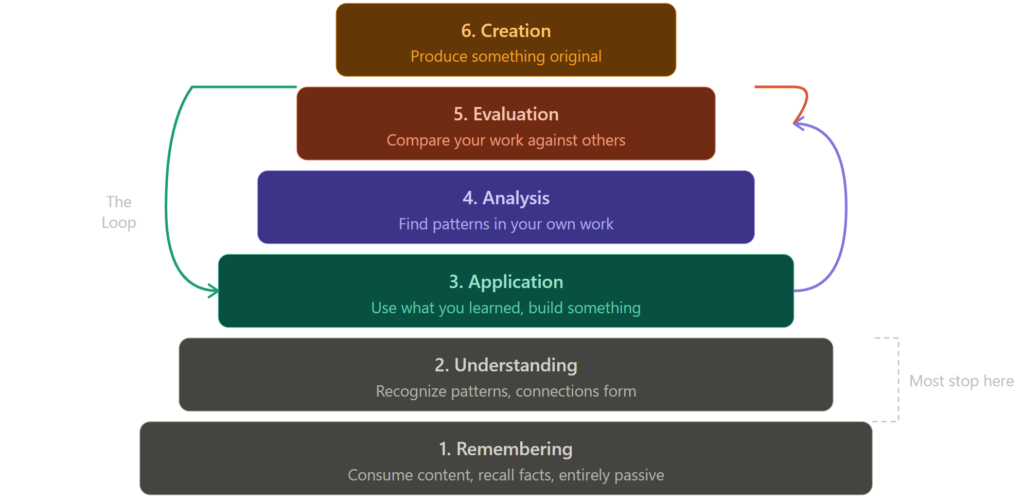
There’s a pyramid that explains how learning actually works. Most people only ever touch the first two levels.
Level one is remembering. You consume content. You recall facts. This is entirely passive. You read something, maybe you remember it, probably you forget it within a week.
Level two is understanding. You start recognizing patterns. The “aha moment” when things you’ve read in different places suddenly connect. This is where schema building happens. Your brain starts organizing information into structures.
Most people live their entire learning lives bouncing between these two levels. Consume, understand a little, consume more, understand a little more. An endless loop that feels productive but produces nothing.
Level three is application. You use what you learned. You build something. Write something. Make a project. Ship a portfolio piece. This is where most people fail because application requires output. Not just understanding, but proof.
Level four is analysis. You look at your own applied work and find patterns. What worked. What didn’t. Connections between different things you’ve created.
Level five is evaluation. You compare your work against others. You rank it. This is where imposter syndrome peaks. You see the gap between your output and the best output in your space. It’s uncomfortable. Most people quit here.
Level six is creation. You produce something that wasn’t there before. Your experiences, your learning path, your analysis, your evaluation combine into original work. You add to what existed instead of just consuming it.
The real loop is application to analysis to evaluation and back to application. You do this enough times, you learn to identify gaps. Once you can identify gaps, you can create something truly original.
But you can’t skip to creation. You have to go through the painful middle stages first.
Why Writing Specifically
Writing is the most accessible skill on the planet.
No tools required. No budget. No code. No equipment. Just words.
And writing forces you through the learning pyramid faster than consuming ever will. When you write about something, you have to understand it well enough to explain it. When you publish what you write, you get feedback. When you analyze that feedback, you improve. The loop accelerates.
There’s a reason the most successful founders and leaders are strong writers. Bezos and his memo culture. Nadella and his internal communications. Clear thinking produces clear writing. Clear writing forces clear thinking. It’s a feedback loop that compounds.
Writing about a skill is one of the best ways to learn that skill. Teaching is learning. Explaining is understanding. The act of putting thoughts into words exposes the gaps in your knowledge that passive consumption hides.
And writing compounds in a way nothing else does. 52 weekly entries is a year of documented thinking you can mine for insights. 100 articles is a body of work that proves you can show up. 200 articles is authority.
But you have to start. And starting means accepting something uncomfortable.
The First 100 Rule
The first 100 things you write will be bad.
I don’t mean mediocre. I mean bad. Embarrassing. Stuff you’ll look back on and cringe.
This is not a bug. This is the process.
The wrong metric is comparing your output to what already exists online. You read polished articles from writers with years of experience and think that’s the standard you need to hit on day one. It’s not. That comparison will paralyze you before you start.
The right metric is simple. Can you sit down with an idea and write 500 words about it? If yes, you’re improving. If no, keep practicing.
Judge progress against your own previous output. Not against established writers. Not against viral posts. Not against the best thing in your feed.
Your first article versus your tenth. Your tenth versus your fiftieth. That’s the comparison that matters.
The Japanese Mastery Model
There’s a framework called Shu-Ha-Ri that reinforces this.
Shu means obey. Learn the fundamentals. Replicate what works. Follow roadmaps and best practices. Don’t try to be original yet.
Ha means detach. Start remixing. Adapt what you learned. Find your own applications. Break from rigid imitation while still respecting the foundations.
Ri means transcend. Create your own path. Innovate. Have your own voice.
Most people want to skip to Ri. They want to be original and innovative before they’ve mastered the basics. It doesn’t work that way. You earn the right to break rules by first learning the rules.
Writing is the same. You don’t develop a unique voice until you’ve internalized structure, readability, and clarity. Style is what happens after the fundamentals are automatic.
Building the System
Before you can write consistently, you need a system for capturing ideas. Most people fail not because they can’t write but because they sit down to write with nothing to say.
The system has two conditions.
Condition one is immediate capture. When an idea hits, store it within seconds. Use the fastest tool available. WhatsApp self-chat. Notes app. Voice memo. Whatever requires the fewest taps. One liner is enough. Don’t elaborate in the moment. Just capture.
Condition two is weekly expansion. Once a week, sit down and expand those one-liners. Turn them into fuller notes, outlines, or drafts. Some will become articles. Some will get deleted. But you’re never facing a blank page.
This two-step system means you always have raw material. The capture happens in the flow of life. The expansion happens in dedicated time. They’re separate actions.
If it takes more than two taps to save an idea, you won’t do it consistently. The system has to be frictionless.
Active and Passive Research
There are two modes of building the knowledge that feeds your writing.
Active research is dedicated effort. Searching for specific information. Reading articles, watching tutorials, studying a topic intentionally. This is what you do when you sit down to write something and realize you need more material.
Passive research is lifestyle-integrated. Setting up your information diet so you absorb relevant knowledge without trying. Following the right accounts. Subscribing to the right newsletters. Curating your feeds so what shows up is actually useful.
The goal is that over six to twelve months, passive becomes higher volume than active. Your daily life should feed you material naturally. You shouldn’t have to go hunting every time you want to write.
Active research spikes temporarily when you’re working on something specific. But the foundation comes from passive accumulation over time.
Every toolkit, template, and guide we build is accessible to anyone. If they helped you land a client, pass an interview, or ship a project, consider paying it forward so we can keep building more.
The Information Diet
Your writing quality is directly tied to your consumption quality.
Most people consume mass content without curation. They let the algorithm decide what enters their brain. And then they wonder why they have nothing original to say.
Quality in, quality out.
Set up your social accounts to follow sources you can actually learn from. Curate aggressively. Fewer sources, better sources. Don’t just consume. When something resonates, capture it immediately.
The biggest mistake I see is people reading endlessly without saving anything. They consume ten articles and remember nothing. A week later, they couldn’t tell you what they read.
If you’re going to consume, capture. If it’s worth reading, it’s worth saving. Over time, that captured material becomes fuel for your own writing.
The Training Wheels
Two tools I recommend when you’re starting out.
Hemingway Editor is the primary one. It checks for passive voice, adverb overuse, sentence complexity, and readability grade. When you’re learning, target reading level grade six or seven. Use it as training wheels. Once you consistently score in that range, you can develop your own style and deviate intentionally.
Grammarly is secondary. Use it only for spell check and basic grammar. Nothing else. Do not use Grammarly’s style suggestions. They will flatten your voice into generic mush.
And don’t use AI writing tools for editing while you’re learning. They homogenize your style before you’ve developed one. You can’t break rules creatively until you know what the rules are.
The Long Game
Writing is a gym journey.
You have to show up. Consistency matters more than quality at the start. The first 100 will be bad. You’ll compare yourself to people who’ve been doing this for years and feel inadequate.
None of that matters.
What matters is whether you’re better than you were last month. Whether you can sit down and produce 500 words when you couldn’t before. Whether the feedback loop is running.
The people who win at writing aren’t the most talented. They’re the ones who kept showing up after everyone else quit.
Start before you’re ready. Write before you’re good. Ship before you’re confident.
The first 100 will be bad. That’s the whole point.
Once you’ve accepted that the first 100 will be bad and started building the habit, the next question hits fast: what do I actually write about?
I cover that in the second part of this series: The Next 100 Will Be Yours – Building a Personal Monopoly
With or without my help – I wish you the best.
Come Build With Us
400+ members showing up, shipping work, and helping each other get better.
If you’re working on something real, Wander Labs might be your next step.

See, at the heart of it – I love solving problems for people using tech, it doesn’t get simpler than that.
I am known for constant experimentation and relentless execution.
Right now – my focus is to help everyday folks of Pakistan understand tech, career, and business better with everything I do.