Development, Frontend, Backend and AI Hype
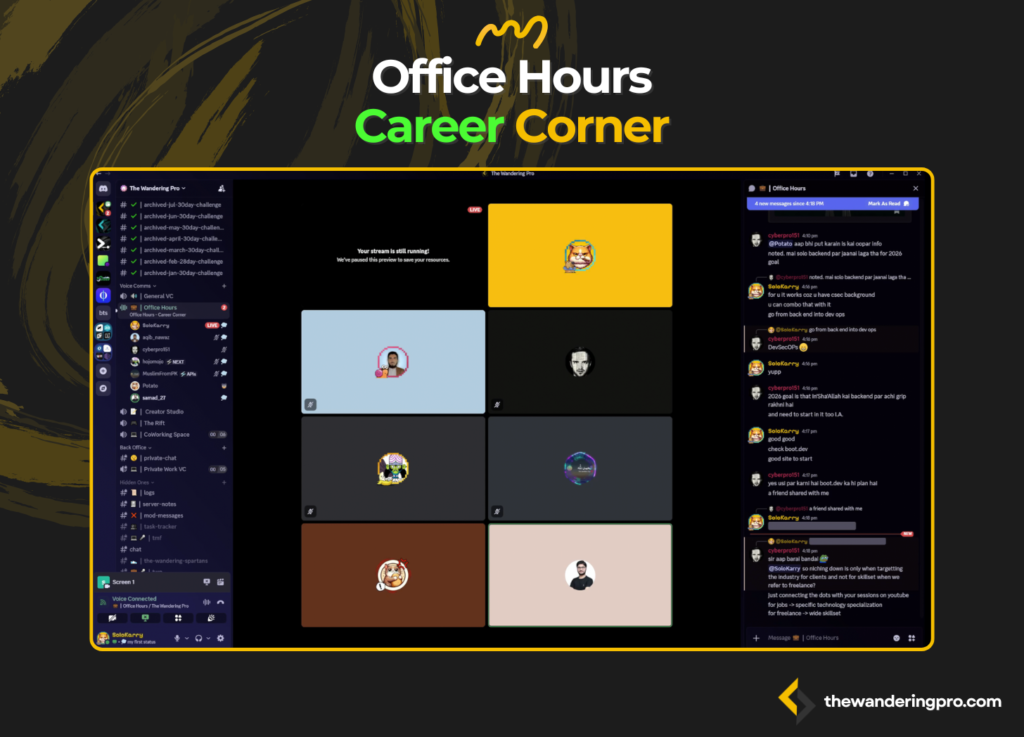
The Wandering Pro Career Corner Session Recap
Every week inside The Wandering Pro, the office hours surface questions that many developers are already thinking about but rarely articulate clearly. This particular session revolved around a recurring tension in modern tech careers: should developers aim to be specialists or generalists, especially in a world shaped by freelancing, startups, jobs, and now AI?
The hosts unpacked this question from multiple angles-freelancing vs employment, frontend vs backend depth, client expectations, job descriptions, AI hype, and long-term career stability. What emerged was not a single answer, but a framework for thinking clearly about where you are in your journey and what the market actually rewards.
Frontend Development Is Not “Easy,” It’s Just Misunderstood
A recurring misconception addressed during the session was the idea that frontend development is somehow less technical or more superficial. One host pushed back on this strongly.
Frontend development, when done properly, is a niche in itself. Building applications that scale to thousands of users, remain performant, and don’t degrade the browser experience requires real engineering. Understanding re-renders, component lifecycles, state management, and performance bottlenecks is not optional once a product grows.
The hosts shared practical examples, such as using React DevTools to trace unnecessary re-renders. These are not “design tasks” or “nice-to-haves.” They are core frontend engineering skills that directly impact user experience.
At the same time, the hosts acknowledged a boundary. A frontend developer should have a basic sense of UI and UX-spacing, colors, layout, and usability-but that doesn’t mean they need to replace designers. Awareness is different from responsibility. Expecting developers to master everything eventually leads to burnout and mediocre outcomes across the board.
MVPs Don’t Need Perfection, Products Eventually Do
Another important theme was timing. In the early stages of a product-especially MVPs-speed matters more than purity. Clean architecture, perfect optimization, and ideal abstractions are often less important than shipping something users can actually try.
The hosts emphasized that many early products succeed precisely because the team focused on features first. As users grow, so do problems. That’s when specialization naturally emerges. Teams expand, roles become defined, and optimization starts to matter.
Trying to prematurely optimize or over-specialize at the very beginning often slows progress instead of improving outcomes. This is especially true for freelancers working with early-stage founders or small businesses.
Job Descriptions Are Often Wrong (and Written by AI)
One of the most practical insights from the session was about job postings themselves.
According to the hosts, a large percentage of job descriptions today are inaccurate, inflated, or outright nonsensical. Many are generated using AI tools, leading to unrealistic requirements that combine multiple roles, frameworks, and years of experience into a single listing.
This doesn’t mean developers should blindly apply everywhere, but it does mean job descriptions shouldn’t be treated as absolute truth. The hosts advised learning how to judge jobs, not just match keywords. If a listing demands 40 or 50 unrelated skills, it’s often a red flag. On the other hand, if the core ecosystem aligns with your fundamentals, flexibility usually exists.
The JavaScript ecosystem was used as an example. Whether a job mentions React, Next.js, Node.js, Express, or GraphQL, the underlying concepts remain largely the same. With strong fundamentals, learning the missing pieces is often a matter of hours or days, not months.
Niche Down in Marketing, Not in Skills (At Least Early On)
A key clarification came around the concept of “niching down,” which is often misunderstood.
The hosts explained that when they talk about niching down for freelancers, they are referring to industry focus, not technical capability. From a marketing perspective, it makes sense to say, “I build platforms for X type of business.” That helps clients understand your value quickly.
Skill-wise, especially for new freelancers, a wider skill set dramatically increases the chances of landing work. Being able to deliver end-to-end solutions is often what wins early projects.
Specialization becomes more useful later, once you have experience, reputation, and leverage. Older or more established freelancers can afford to narrow their focus. Beginners usually cannot.
AI, Automation, and the Hype Cycle
The conversation also touched heavily on AI agents, workflow orchestration, and automation tools.
The hosts took a grounded stance. While automation and AI agents will continue to grow, their real value is limited to specific contexts. Large enterprises benefit because even small efficiency gains translate into massive cost savings. Highly technical startups may also benefit if automation aligns directly with their product.
For most small businesses and freelance clients, however, these systems often introduce more complexity than value. This is where hype outpaces reality.
Tools like n8n were mentioned as examples of practical automation platforms worth understanding. Learning such tools can open doors to specific projects, but abandoning core development skills to chase trends rarely pays off long term.
The Market Is Normalizing Again
One of the strongest predictions made by the hosts concerned the job market heading into 2026.
After a year of intense AI hype-where job posts demanded “Lovable apps,” “v0 apps,” and fully AI-generated platforms-the market is cooling. Companies are realizing that AI tools are excellent for prototyping and wireframing, but not for building production-ready systems end to end.
As a result, traditional roles and tech stacks are returning. React, Next.js, Node.js, and conventional web development skills are once again in demand. The hosts believe that developers who stayed consistent and didn’t panic-pivot during the hype cycle will be in a much stronger position going forward.
Those who repeatedly jumped from one trend to another without building depth may struggle to regain momentum.
How to Actually Learn New Skills Without Burning Out
When asked about the best way to learn new frameworks or skills, the hosts kept the advice simple and practical.
Learning happens fastest through building. A small amount of theory-just enough to understand the basics-followed by hands-on work consistently outperforms passive learning. Watching endless tutorials without applying them rarely leads to confidence or competence.
That said, the hosts acknowledged that some concepts are better introduced through videos or guided explanations. The key is balance. Learn just enough to start, then build something real.
This philosophy is also shaping new initiatives inside The Wandering Pro, where members will be encouraged to pitch project ideas, receive dedicated spaces, and get guidance over time. The goal is to turn learning into visible, practical output rather than abstract consumption.
Summary and Closing Notes
According to the hosts, the biggest damage they’ve seen to developer careers doesn’t come from choosing the “wrong” stack. It comes from abandoning paths too quickly. Many developers pivot before they’ve even given themselves a chance to succeed.
Especially for those early in their journey, consistency matters more than perfection. Trends will come and go. Tools will rise and fall. But fundamentals, patience, and steady growth compound over time.
The market is stabilizing again. The advice is clear: build real skills, stay grounded, and don’t let short-term noise dictate long-term decisions.
If you’re part of The Wandering Pro, these conversations are happening every week. And if you’re not, this is exactly the kind of thinking we aim to cultivate clear, grounded, and rooted in real-world experience rather than hype.
Key Takeaways
- Generalist vs specialist depends on context companies reward depth and specialization, while freelancers often need broad, end-to-end skills to deliver complete solutions.
- Freelancing and employment operate by different rules clients want outcomes, not roles, making pure specialization risky in solo freelance work.
- Frontend engineering is deeply technical performance, scalability, and state management are core engineering challenges, not superficial design concerns.
- Speed beats perfection in early products MVPs benefit from shipping quickly, with specialization and optimization becoming important only as products scale.
- Job descriptions are unreliable signals many are inflated or AI-generated, so developers should focus on fundamentals rather than chasing every listed requirement.
If you missed the session, join our next Office Hours on The Wandering Pro Discord. Bring your questions, your doubts, your drafts – that’s what we’re here for.
Ideas are only half the story, the rest happens when you put them to work.
Join The Wandering Pro, a community of makers, freelancers, and thinkers who believe in learning through doing.


See, at the heart of it – I love solving problems for people using tech, it doesn’t get simpler than that.
I am known for constant experimentation and relentless execution.
Right now – my focus is to help everyday folks of Pakistan understand tech, career, and business better with everything I do.